Get Full Government Meeting Transcripts, Videos, & Alerts Forever!
Get email alerts on the Public Safety Alcohol topic
No spam. Unsubscribe anytime.
Police present first annual report on alcohol retail inspections; 96 off‑sale establishments inspected, 20 corrections issued
Summary
Santa Barbara police presented a 2023–2024 annual report on the city’s off‑sale alcohol ordinance. Officers inspected 96 retail locations, issued 20 correction notices with 19 remedied and 1 outstanding, and described enforcement tools, container‑size limits, and staff coordination with Planning and ABC.
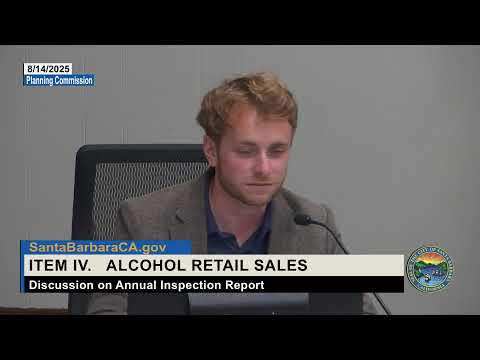
Commander Miller of the City of Santa Barbara Police Department and Public Service Coordinator Analisa Hoods presented the city’s first annual report on the Alcohol Retail Sales/Deemed Approved inspection program on Aug. 14. Miller said the Police Department implemented the inspection program in October 2023 to support the city ordinance adopted in 2021.
The ordinance regulates off‑sale alcohol retail establishments — liquor stores, grocery stores, gas stations and neighborhood markets — and establishes operating standards aimed at reducing secondary nuisances such as public intoxication, litter, assaults and DUI. The City’s ordinance applies to off‑sale licenses; the California Department of Alcoholic Beverage Control (ABC) retains state licensing authority.
Hoods told commissioners the Police Department invoiced all 96 off‑sale establishments for the deemed approved fee and inspected each site. The inspections yielded 20 violations that required corrective action; 19 of those corrections were completed and one remained outstanding at the time of the report. Hoods said many early violations involved small single‑serve bottles (“airline” bottles and shots) and display placement; she said the department required those items be placed behind the counter rather than in self‑service bins.
Key enforcement and program points presented: - The ordinance focuses on off‑sale outlets (not on‑site alcohol sales such as bars or restaurants). The city inspects establishments annually and follows up on complaint‑driven issues between inspections. - New or transferring businesses may be required to meet size‑limit standards (wine containers smaller than 750 milliliters, no single‑serve airline bottles for new outlets, and package quantity rules for some malt beverages) and other operating conditions; grandfathered establishments may remain subject to ABC’s existing conditions but must meet placement/display rules and other nuisance‑reduction standards. - Staff emphasized training requirements: at least one manager or owner should complete ABC’s lead training and many businesses encourage all clerks to complete the course. - The department invoiced 96 establishments; it received payments from 93 of them for the deemed approved fee (cost recovery fee to support inspections).
City Attorney Dominguez explained the ordinance’s approach to variations and hardship: development‑standard hardships (for example, unusual costs tied to building or site configuration) may be considered, but retail‑practice standards designed to reduce nuisance were adopted as non‑waivable community standards. Dominguez said that approach was intentional: the council and commission sought consistent standards to reduce nuisances across outlets rather than creating variable conditions that would be harder to enforce and produce inequitable outcomes.
Commissioners asked about the potential economic effect on small, independent retailers as ownership changes trigger CUPs and new‑owner conditions; staff noted the ordinance includes limited hardship consideration for development standards but that nuisance‑reduction operating standards were intentionally written as citywide expectations. Commissioners asked staff to return with crime‑stat summaries and additional context in future annual reports to help weigh public‑safety benefits against economic impacts for small retailers.
No enforcement hearings were reported at the Planning Commission; staff said cases that progress to repeated violations would be processed for notices, fines and, if necessary, hearings that could suspend or revoke a conditional use permit.
The department said it will return with an annual update next year and will continue coordinating with Planning and ABC on specific complaint referrals and license conditions.