Get Full Government Meeting Transcripts, Videos, & Alerts Forever!
Get email alerts on the Affordable Housing topic
No spam. Unsubscribe anytime.
St. Petersburg Housing Authority outlines redevelopment, 15,000-person waiting list in council update
Summary
An update to the City Council described the Housing Authority’s portfolio, redevelopment projects (including Ed White and Hartford sites) and programs that helped 22 families buy homes; the authority said it is serving 4,000 families and has a combined waiting list of about 15,000 people.
The St. Petersburg Housing Authority gave City Council an update Thursday on current properties, programs and redevelopment plans, saying the agency serves about 4,000 families and maintains a combined waiting list of roughly 15,000 people.
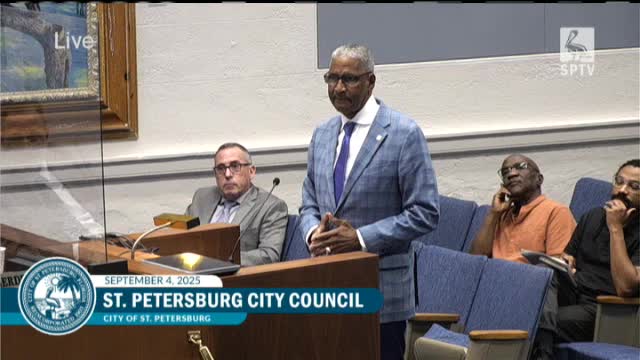
At the Sept. 4 council meeting, the housing authority’s presenter, Mister Lundy, a representative of the St. Petersburg Housing Authority, told council members the authority contracts with roughly 500 property owners to house about 3,600 families through the Section 8 Housing Choice Voucher program and spends “a little over $36,000,000 in housing assistance payments” annually to support those landlords.
The update outlined the authority’s owned-and-operated portfolio and planned redevelopment projects. Lundy said the authority directly owns about 458 affordable housing units across multiple properties and is pursuing several larger projects to expand supply.
Among assets described were Clearview (22 units, with room to add about four units on a rear acre), Domain (20 units), Gateway Place (20 units, planned interior renovations already approved by HUD with funding identified and expected to finish in 12–18 months), Palm Bayou (24 units), Saratoga (34 units, scheduled for major renovation), Sunset Oaks (about 38 senior apartments), Jordan Park (recently repositioned, 206 apartments) and the Legacy (60 senior units).
Lundy also described two larger redevelopment efforts: the former Ed White Hospital site on Ninth Avenue North — under construction as a mixed-use project that will include 71 affordable senior units, space for the housing authority to provide on‑site services and a leased health provider space — and a Hartford site on a 1.3-acre parcel on 30 Second Avenue North, where the authority is partnering with Blue Sky to build a proposed 75-unit family apartment complex and renovate an adjacent property identified in the presentation as the Sierra Towgo Apartments (34 units). Lundy said the Ed White renovation is scheduled to complete in 2026 and that, if funding is obtained, Hartford could yield units 18–24 months after award.
The authority highlighted its soft‑services and resident support programs. Lundy said a Family Self‑Sufficiency program is helping 147 families pursue economic independence through a five‑year, escrow‑based incentive, and that a homeownership program has assisted 22 families to buy homes over the past three years.
Lundy described a new procurement approach the authority’s board approved this summer to engage multiple qualified developer partners to speed production — a strategy he called a way to pursue several projects simultaneously.
Council members asked about construction phasing, resident moves during renovations and food‑security efforts. Lundy said Gateway Place renovations would be staged and handled mostly by attrition (he reported about five current vacancies at that site), and he described discussions about food lockers and partnerships with Feeding Tampa Bay and others to expand pantry options at sites including Jordan Park. Several council members and the mayor acknowledged the authority’s work and pledged continued support for funding and permitting assistance.
The presentation made clear several constraints and next steps: the pace of new construction will depend on securing capital (HUD, identified grants and other funding), permitting and the authority’s ability to staff or contract for design and construction management. Lundy said the board approved a strategic initiative to contract with multiple development partners and pursue funding to expand the authority’s pipeline.
Council members and the presenter emphasized the gap between current supply and demand: Lundy repeatedly noted the authority’s waiting list grew to about 15,000 applicants shortly after it reopened, a number he said the agency cannot manage while the list is open.
The housing authority update did not include a council vote; it was provided as an informational report and prompted follow‑up questions from several councilmembers. Council members said they would continue to coordinate with the authority on funding opportunities and neighborhood outreach as projects move into design and construction.
Ending: Lundy closed the presentation by thanking the council and mayor for support; council members praised the authority’s homeownership and services programs and asked staff to return with implementation details as projects advance.