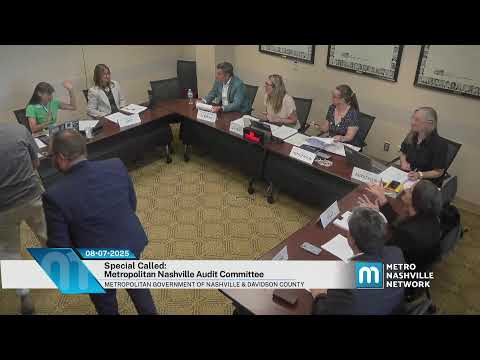
Audit committee adds review of assessor's office after council member's request; two audits removed from plan
Loading...
Summary
Council Member Benedict requested a comprehensive audit of the Metropolitan Assessor of Property’s office and the Metropolitan Board of Equalization, and the Metropolitan Audit Committee voted to amend the 2025 audit plan to add that review.
Council Member Benedict requested a comprehensive audit of the Metropolitan Assessor of Property's office and the Metropolitan Board of Equalization, and the Metropolitan Audit Committee voted to amend the 2025 audit plan to add that review.
Benedict told the committee the request is “about transparency and trust in government,” and asked for a full departmental audit of the assessor’s office, a structural review of the Metropolitan Board of Equalization (MBOE), an examination of board appointment and vetting processes, an accessibility review of the appeals process, and a review of how the state’s monitoring of the assessor’s work operates.
The committee’s auditor, Lauren Riley, briefed members on options for scoping the work and on existing oversight from the Tennessee Comptroller’s Division of Property Assessments. Ryan Duggan, assistant director with the Tennessee Comptroller’s Division of Property Assessments, described the state’s monitoring process: the assessor’s office must visually inspect parcels on a 3-year schedule tied to the county’s revaluation cycle; the state selects samples across zones and parcel types to verify characteristics and valuation practices; and the state follows established professional guidance in its monitoring.
Assessor Wilhoite said she will provide written responses to Benedict’s letter and emphasized that the MBOE is established by Metro government, citing Metro Code Title 5.48.02. Wilhoite said she has previously raised concerns about the board’s physical and budgetary placement inside the assessor’s office and expressed support for legislative action to realign the MBOE’s independence.
Committee members debated scope and redundancy. Several members said portions of the request could overlap with state monitoring or with prior audits, including a 2017 internal audit of administrative functions. Auditor Riley said the audit office could scope out elements already covered by the state and focus investigative resources on gaps or elevated risks. Riley also said the office may use outside appraisal expertise if the audit requires technical review of mass appraisal methodology.
After discussion, the committee voted to amend the 2025 audit plan to include the assessor’s office review, leaving scope broad so the auditor can narrow it to avoid redundancies with state oversight and prior work. The committee also voted to remove the Metro Action Commission Head Start program and the Historic Commission/Historic Zoning Commission from the 2025 audit plan to free staff hours for this work.
The committee did not publish a draft scope in open session, and Auditor Riley noted that draft audit workpapers are confidential until a final report is issued; follow-up briefings on administrative follow-up and links to existing state reports were discussed as ways to make the audit process more transparent to the public.
Votes and formal actions taken at the meeting were recorded by the committee. The audit addition was approved in a recorded committee vote; the committee also approved removing the two listed items from the 2025 audit plan. No numeric roll-call totals were provided in the public transcript of the meeting.
Background and next steps: Benedict told the committee she believed the assessor’s office has not had a full departmental audit since 2017. Ryan Duggan summarized how state monitoring samples parcels, reviews revaluation plans, demands quarterly progress reporting, and provides findings to the assessor’s office for remediation. Auditor Riley said the audit office will prepare the amendment to the audit plan and then begin planning work that may include consultant expertise for appraisal methodology, while explicitly scoping out areas covered by state monitoring or prior audits.
Who is affected: The audit targets processes used across Nashville and Davidson County that affect homeowners, businesses and taxpayers who receive property assessments and may file appeals. The committee indicated the audit could produce policy recommendations for the mayor and Metro Council, including possible legislative steps to change the MBOE’s structure if warranted.
The committee adjourned after completing the votes and making the changes to the 2025 audit plan.