Get Full Government Meeting Transcripts, Videos, & Alerts Forever!
Get email alerts on the Golf Course Capital Plan topic
No spam. Unsubscribe anytime.
Englewood staff outline 'Better Broken Tee' plan to address drainage, bunkers and clubhouse repairs
Summary
City golf staff presented a multi-year action plan for Broken Tee Golf Course focused on drainage and irrigation repairs, bunker renovation, expanded tees and clubhouse work. The golf operation is funded as an enterprise fund; major projects will be phased as money becomes available.
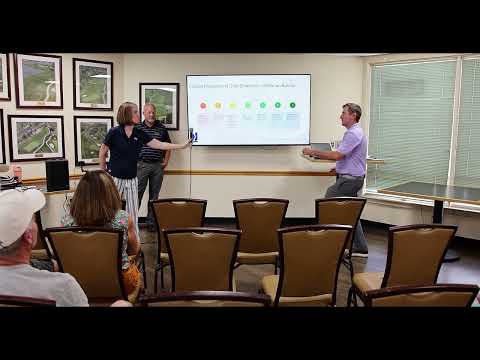
Englewood City golf staff on Monday presented the "Better Broken Tee" action plan for Broken Tee Golf Course, detailing a multi-year program of course and clubhouse repairs that staff estimate could total millions of dollars and will proceed only as enterprise-fund revenue and contractor availability allow.
Jeremiah Stumpf, golf course superintendent, said the plan is aimed at keeping the course "fun and friendly and playable for every skill level" while maintaining affordability. "Our goal our mission here at Broken Tee is promoting a quality golf experience at an affordable price," Stumpf said.
The plan groups work into course and clubhouse projects. Shannon Buccio, golf manager, listed exterior clubhouse work such as siding, windows, gutters and roof repairs and said restrooms will need updates for ADA compliance. Buccio said those clubhouse projects are tentatively expected to begin in late 2025 or early 2026, depending on funding.
Rick Phelps, the golf course architect on the plan, said the action plan is a roadmap that could run from an aggressive five-year program to a 10–15-year schedule depending on funds. "We've been working on this action plan for a little over a year now," Phelps said, describing the document as life‑cycle planning for irrigation, drainage, cart paths and bunkers.
Key cost figures and recent spending identified by staff include:
- Course improvements: estimated $7 million–$10 million. - Clubhouse work: estimated $1 million–$2 million. - Pump station replacement: pump work already ordered for November; staff cited a $300,000 project earlier in the presentation. - Staff spending to date on action-plan projects (2024 to present): $1,100,000, including irrigation work and a new golf cart fleet in 2024.
Stumpf and Phelps emphasized drainage and water-quality issues on the east side of the course (holes 1–6), where staff say turf sits on a former dump capped with clay and low-nutrient fill. Those holes drain poorly and are watered with well water that staff described as high in salts and bicarbonates; Stumpf said that combination holds salts near the surface and makes establishing turf difficult.
To address those problems, staff described a mix of near-term maintenance and incremental reconstruction: new sprinkler heads; 17 drains installed so far with 71 catch basins purchased for future installation; acid and wetting-agent injections to combat salts; aeration; sand, compost and topsoil topdressing; and a recent 10,000-pound application of organic fertilizer on holes 1–6. Stumpf said large-scale rebuilding of holes 1–6 — closing them and reconstructing with new soils — would cost an estimated $2.5 million–$3 million and is not feasible now.
Bunkers and other capital work are on the long-term list. Phelps recommended rebuilding bunkers in a consistent style across the course and said he would use a liner product to improve drainage and reduce storm damage to bunkers. He said that liner products may have a higher upfront cost but reduce long-term repair needs.
Other elements on the plan include driving-range improvements (regrading the hitting area to create four to five additional stations and adding a higher-quality artificial turf strip for shoulder seasons), expanding tees on holes 10–18 to better serve different skill levels, pond bank stabilization, and continued tee-box leveling and cart-path repairs.
Staff described funding constraints and phasing as central realities. Phelps and Stumpf repeatedly said the golf course operates as an enterprise fund — "whatever the golf course makes is what the golf course has to spend" — and that the city has no standing general-fund transfer available for routine course work. Buccio said short-term borrowing from the city was discussed earlier in the year but is not currently an option given the city’s fiscal projections for 2026. As a result, staff said projects will be prioritized and performed as funds and contractor windows allow.
On operations, Stumpf said the mid-season maintenance crew counts about 25 people, roughly half full-time and half part-time. Staff said they will hire contractors for larger construction projects where needed and plan work to minimize disruption during peak play by scheduling major tasks in spring or fall.
Speakers in the public Q&A asked about timelines, staffing, revenue forecasts and whether the city could access golf-operating revenues. Buccio said user fees have funded most recent work, the department does not plan fee increases for next year, and staff will publish updates on the course web page and send quarterly notices to stakeholders. Buccio also acknowledged that the city has taken money from the golf fund in the past and said staff are sharing the action plan and finances with department leadership.
What happened next: staff said they will continue incremental drainage, irrigation and turf‑health work on the east side, pursue bunker renovation when funds allow and work toward driving-range and tee expansions as construction-efficiency opportunities arise. The presentation materials include a QR code linking to a project web page where staff plan to post updates.
The presentation included several photo and drone comparisons staff said demonstrate measurable turf improvements on some fairways since last year, and staff urged patience because soil and water-quality fixes take multiple seasons to show durable results.