Get Full Government Meeting Transcripts, Videos, & Alerts Forever!
Get email alerts on the Wheel Tax topic
No spam. Unsubscribe anytime.
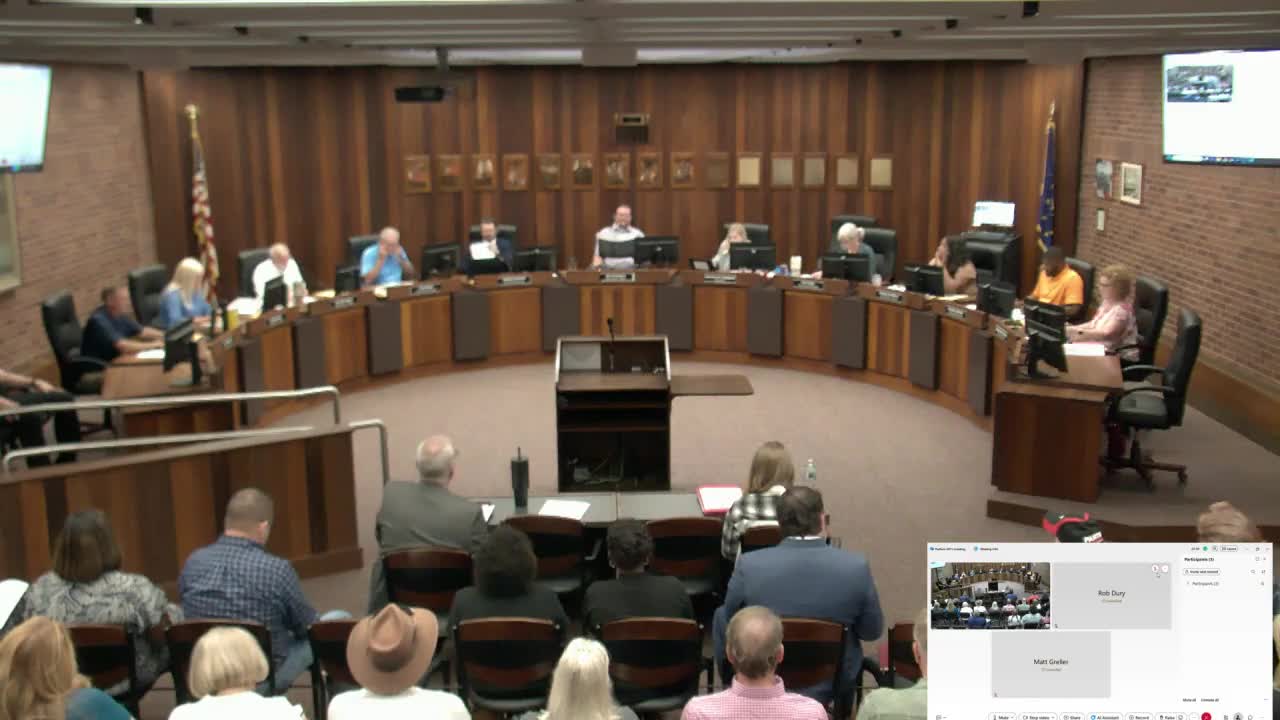
Evansville council adopts municipal wheel tax after hours of debate and public comment
Summary
The Evansville Common Council voted 8–1 on Aug. 25 to adopt an amended municipal wheel tax to raise road funding, triggering eligibility for a new state lane-mile distribution fund and changing local vehicle fees.
The Evansville Common Council on Aug. 25 voted 8–1 to adopt an amended ordinance imposing a municipal wheel tax and a motor vehicle license excise surtax, creating two dedicated city funds for road work.
Council members debated the tax at length and heard more than a dozen public comments before the measure passed. Council President Michael Trotman presided over the meeting as the council accepted an amendment lowering several rates from the originally proposed maximums and then approved the ordinance by roll call.
The council and city staff framed the tax as a response to changes in state grant programs, notably House Bill 1461 and related state actions that reduced the size of the Community Crossings Matching Grant (CCMG) program and created a new lane-mile distribution fund tied to municipal wheel taxes. Robert Hunter of the Controller’s office told the council the city expects roughly $500,000 less in state road program revenue in 2026 if it does not act; the CCMG maximum award for an applicant was described as having been reduced from $1.5 million to $1.0 million.
City Engineer Mike Levitsky said the city’s pavement program requires significantly more money than currently available. Levitsky described local classifications of streets (arterials, collectors, local roads), said it costs about $300,000 to pave one mile of road, and estimated the city would need about $3.6 million per year to maintain arterials and collectors at current standards and another roughly $10.4 million per year to address the larger network of local roads.
Speakers including Matt Greller of AIM (Association of Indiana Municipalities) told the council other Indiana cities face the same decisions and said a municipal wheel tax can produce an automatic distribution from the lane-mile fund that the city does not currently receive. Multiple residents urged caution or suggested lower rates; others, including retired road workers and contractors, urged passage to preserve recent progress on pavement projects.
After discussion the council adopted amended rates: $20 for most passenger vehicles (municipal surtax), $30 for larger commercial vehicles, and $10 for trailers and motorcycles. The amendment was offered by Councilwoman Mary Allen and carried on a voice/roll call vote before final passage.
Roll call on the final ordinance recorded these votes: Councilwoman Mosby — Aye; Councilman Hieronymus — Aye; Councilwoman Carruthers — Aye; Councilwoman Kayler Lindsey — Nay; Councilwoman Brinkmeyer — Aye; Councilwoman Allen — Aye; Councilman Green — Aye; Councilman Johnson — Aye; Councilman Trotman — Aye. The clerk declared the ordinance adopted 8–1.
Council members and staff emphasized that state statutes limit how wheel tax revenue can be used: money collected under the municipal wheel tax and motor vehicle license excise surtax must be used on public roads and related projects only. Hunter and Levitsky said the city also receives a portion of a county wheel tax and that adopting a city tax would add a separate city distribution while the county distribution would continue.
Several residents and speakers urged the council to consider lower initial rates or to hold off for another year. Others pressed for stronger contractor accountability and for better coordination between paving schedules and utility projects so newly paved streets are not later torn up. Council members said the tax can be amended or repealed later if conditions change.
The council’s action also followed questions about alternative funding sources. Staff noted that riverboat (casino) funds have historically been used for capital projects — drainage, curb ramps, Barrett Law ADA work, and to match grants — but are limited and not a substitute for ongoing pavement funding. The council tabled discussion on a separate finance ordinance (F 2025-10) to a later meeting while moving forward on the wheel tax.
The ordinance takes effect according to the schedule in statute and the city will submit the adopted rates to the Bureau of Motor Vehicles so collections could begin Jan. 1 if other administrative steps are completed.
The council indicated it will revisit rates and program details in future meetings and directed staff to continue public outreach about how collected revenue will be prioritized among arterial, collector and local road needs.
Ending: The council’s adoption of the wheel tax positions Evansville to seek new state lane-mile distribution funds but leaves open how quickly additional paving and local-road work will proceed; staff said proceeds will be applied only to roads and that coordination with utilities and contractor accountability will be emphasized.