Lifetime Citizen Portal Access — AI Briefings, Alerts & Unlimited Follows
State public‑health working group revises MOLST website, plans feedback and commissioner review after Labor Day
Loading...
Summary
Members of a Department of Public Health working group edited language for the state’s MOLST webpage, agreed to solicit public and provider feedback on four draft documents (consumer, provider, EMS FAQs and a resources list) and set a timeline to finalize materials for commissioner review after Labor Day.
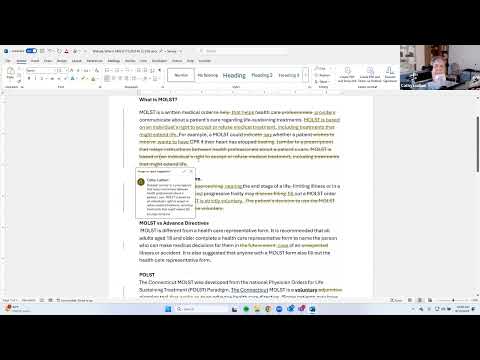
Members of a Department of Public Health working group spent a meeting reviewing draft text for the state’s Medical Orders for Life‑Sustaining Treatment (MOLST) webpage and agreed on next steps to solicit feedback and present the materials to the commissioner after Labor Day.
The group pared and reworded explanatory text to emphasize that MOLST is a medical order arising from a conversation about a patient’s wishes and goals of care, and that MOLST sits within the broader concept of advanced care planning. Participants agreed to move historical material about POLST to a history section, simplify language for general audiences, and retain a statement that MOLST is based on respect for patient autonomy.
Discussion and decisions
Participants reviewed headings, examples and draft paragraphs and debated where to place background content and how to phrase technical terms so the public would understand them. They discussed distinguishing “patient,” “individual” and “person” in different contexts and decided that some wording may be tailored by context (for example, “patient” in clinical settings and “individual” elsewhere). The working group also discussed whether to include detailed information about the health care representative form on the MOLST page and concluded that much of that detail was out of scope for the public‑facing MOLST page and better suited to provider guidance or outreach materials.
Members noted related resources and evidence: a journal article attributed to Leah Ward, identified in the meeting as the working group’s newest MOLST member, was cited as a source of background on an earlier Connecticut MOLST pilot; the group said staff would verify dates and archival records at the Department of Public Health.
Actions and timeline
The group agreed to circulate four draft documents for feedback: consumer FAQs, provider FAQs, EMS FAQs and a consolidated resources list. Staff said they would add additional EMS questions (beyond the three provided earlier by a colleague identified as Joel) and then distribute the package for comment. The members discussed feedback windows and settled on a schedule to request comments in late August and to finalize materials so they could be presented to the commissioner after Labor Day. The working group planned a follow‑up review after collecting feedback and to meet again as needed before the scheduled commissioner review.
Outreach, training and scope
Participants emphasized that MOLST should be framed as the product of an interdisciplinary conversation that may involve clinicians, social workers and spiritual care providers, while also noting that questions about specific medical interventions should be directed to eligible health care providers. They agreed that outreach and training for facilities and clinicians should underscore the limits of nonclinical advisers when questions require medical detail.
Next steps
Staff will send the four draft documents to the review list, add the expanded EMS FAQs, set a clear deadline for comments, and prepare a final packet for the commissioner’s review meeting after Labor Day. The group asked staff to verify documentary dates from archived paper files and to circulate a clean copy of the website text for external readability checks before wider distribution.