Get Full Government Meeting Transcripts, Videos, & Alerts Forever!
Get email alerts on the Utility Billing Policy topic
No spam. Unsubscribe anytime.
Denton staff outlines utility-billing policy changes for deposits, payment plans and leak adjustments
Summary
Customer Service Manager Krista Foster presented an independent review and recommended ordinance and administrative changes to deposit retention, commercial deposit refund timing, payment-arrangement processes and leak-adjustment rules to improve responsiveness and reduce manual workarounds.
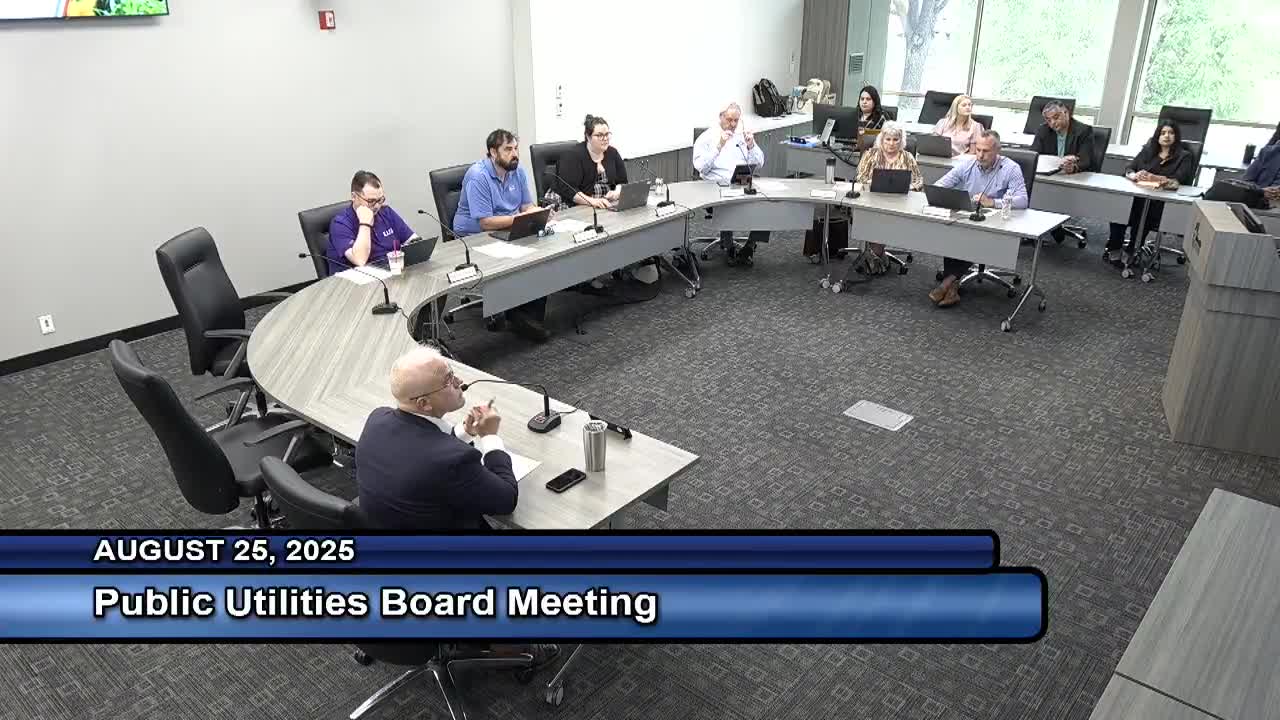
Krista Foster, Denton’s customer service manager, presented a utility-billing review during the Aug. 25 Public Utilities Board work session and recommended changes to commercial deposit rules, payment-arrangement procedures and leak-adjustment provisions.
Foster said an independent consultant reviewed staff interviews, call evaluations, performance trends and policy language and found that Denton’s collections generally outperform benchmark utilities but that certain ordinance provisions create unnecessary manual work and restrict staff flexibility. "Our calculation is consistent. Our application of supplying deposit interest is consistent, that our retention period is not aligned with the majority of the cities, and that our current ordinance is written in such a way that it requires us to manually screen every account before we can do a refund of a deposit," Foster said.
Key recommendations presented to the board included:
- Residential deposits: retain for 12 months (no change from current practice).
- Commercial deposits: refund eligibility after 24 months of good payment history (presentation noted that 72% of new commercial businesses in Denton close within two years, which staff said informed the change). Eligibility qualifications would include an internal "A" credit rating with the utility (an internal metric based on late payments, disconnections and other payment anomalies), no disconnections, no meter tampering and a current account.
- Payment arrangements: move the due date to the customer’s current bill date (to avoid manual date calculations); remove hard limits on the number of arrangements so long as customers fulfill them; and apply a 12-month restriction on setting new arrangements after failing two agreements in a 12-month period. Foster also recommended authorizing program-level changes to the city manager with discretion to the customer-service department head for exceptions, while retaining council notification via routine reporting.
- Leak adjustments: revise ordinance language that hard-codes the process. Foster recommended increasing the submission deadline to 60 days, updating language to include renters (who previously were excluded because they could not pull permits), and aligning provisions for AMI metering. She proposed no residential cap on loss for leak adjustments, a commercial cap at 100,000 gallons, and a separate sprinkler/pool provision capped at 5,000 gallons with a reduced rate compared with a standard leak adjustment.
Board members asked clarifying questions about the internal credit-rating metric and the lines of program authority; Foster said the credit rating is an internal, automatically calculated 12-month rolling score and confirmed staff can explain the components to customers. Board members responded that delegating program authority to staff rather than requiring Council action for routine changes appeared reasonable given market and community shifts; Foster said the recommendation includes transparency to Council through reporting.
The presentation was informational; no formal action was requested or taken at the meeting.