Lifetime Citizen Portal Access — AI Briefings, Alerts & Unlimited Follows
Legislative oversight panel reviews Californias 2026-27 CSBG state plan as funding threats loom
Loading...
Summary
State and local officials, community action agencies and tribal providers told a joint Senate-Assembly Human Services oversight hearing that the Community Services Block Grant (CSBG) is a flexible lifeline for low-income Californians, but federal budget proposals and administrative changes threaten services statewide.
SACRAMENTO
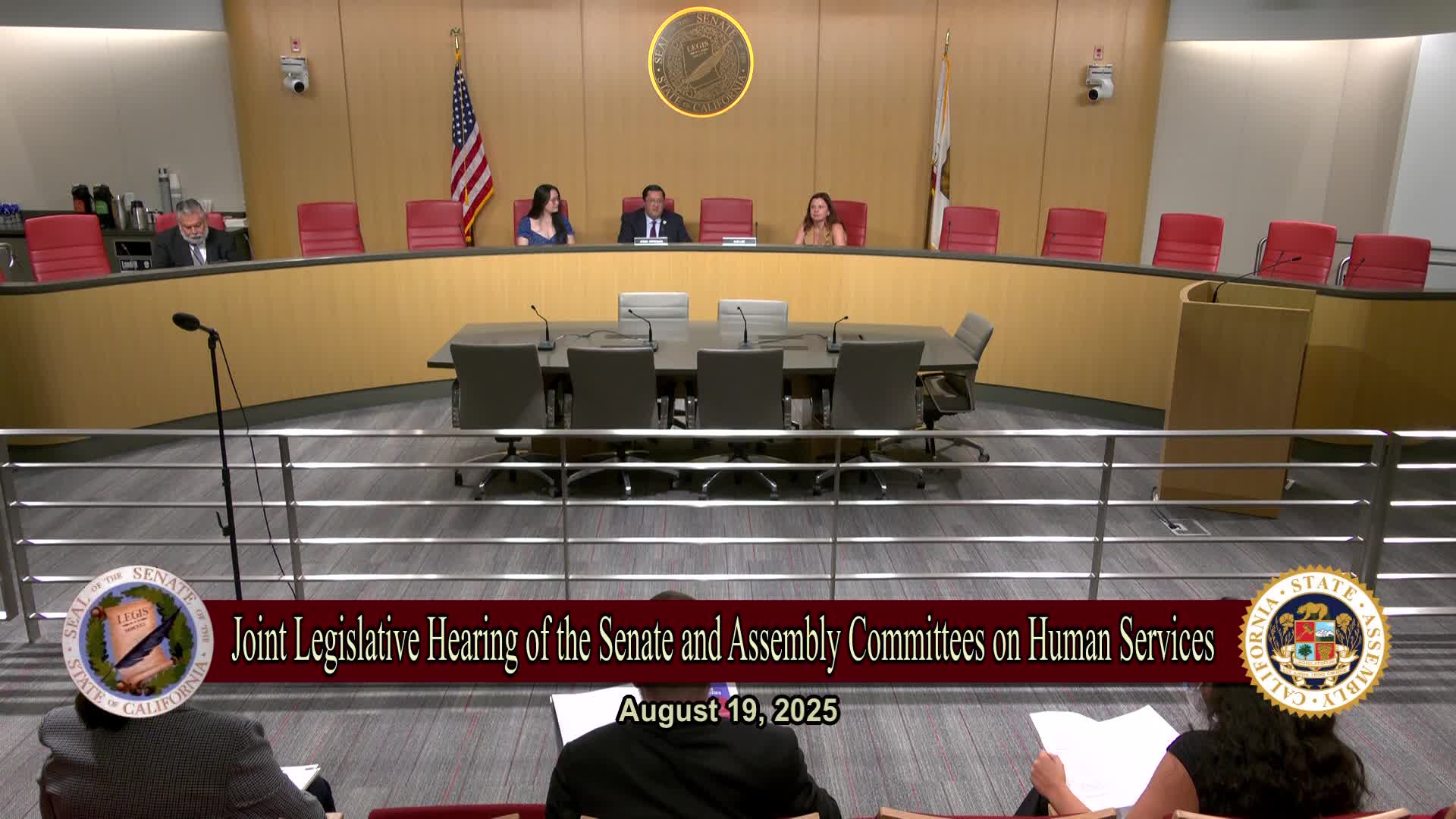
State and local officials and representatives of Californias community action agencies testified at a joint Senate and Assembly Human Services Committee oversight hearing on the 2026-27 Community Services Block Grant (CSBG) state plan, emphasizing that CSBG funds support housing, food, employment and emergency services statewide while warning that federal budget proposals could sharply reduce or eliminate the grant.
The hearing opened with Jason Wimbley, director of the California Department of Community Services and Development (CSD), who described CSBG as a flexible federal anti-poverty funding stream administered by CSD and delivered through a network of 60 local agencies across 58 counties. "CSBG is unique in that it's not a typical program, narrowly focused on addressing a specific need," Wimbley said, adding that the program "is often leveraged to support and enhance other services and activities that target low income community members." He told the committee California received $68,400,000 in CSBG funds in federal fiscal year 2025 and that the states network reported serving about 1,500,000 low-income Californians in 2023.
Why it matters: Witnesses said CSBGs flexibility allows local agencies to tailor services — from homelessness prevention and permanent supportive housing conversions to workforce training and food distribution — and to blend CSBG with other resources. Several speakers warned that proposals in Washington, including the Trump administrations 2026 budget and other legislative changes, could cut or eliminate CSBG funding and increase pressure on already strained local safety-net providers.
Local examples and program mix
Multiple panelists gave concrete examples of how CSBG dollars are used locally. Wimbley highlighted Sunrise Apartments in Hanford, which was converted from a motel through Californias Project Homekey; he said King's Community Action Agency and CSBG contributions helped make the project operational and provide case management for tenants.
Mary Alice Esgarciga Fechner, executive director of Community Services and Employment Training (CSET) and president of the California Community Action Partnership Association (CalCAPA), described CSBG as "the lifeline connecting those struggling in poverty to essential resources" in Tulare County and the Central Valley. She said CSBG funding ("literally a million dollars out of a $39,000,000 budget" for her agencys region) helps sustain grant-writing capacity, rural offices and senior centers that serve thousands of seniors.
Proteus Incorporated CEO Michelle Inglesilva described an agency budget of $34,600,000 with approximately $2,500,000 in CSBG funding, which she said leverages about $20,000,000 in additional federal and state resources. Proteus reported last year it helped 285 youth and 853 adults obtain employment, prevented 422 evictions, provided utility assistance to 315 people, and repaired or improved energy efficiency for more than 5,000 homes through its energy division.
Darren Seaton of Sacred Heart Community Service, the CSBG agency for Santa Clara County, said CSBG supports a range of services including a market-style food pantry, gardening programs, county homelessness-prevention coordination and utility-assistance programs that helped roughly 11,000 households keep utilities last year.
Equity and specialized providers
Madison Flynn, chief executive officer of the Northern California Indian Development Council (NCIDC), described Californias long-standing American Indian set-aside within the state CSBG allocation. Flynn said NCIDC receives about $2,000,000 to serve Native communities statewide, delivering services through a subcontractor network that reaches 57 counties and more than 100 reservations and rancherias. "Last year, we had over 20,000 native people assisted directly by CSBG programs and services within the state," Flynn said.
CalCAPA priorities and data systems
David Knight, executive director of CalCAPA, urged continued emphasis on local flexibility, capacity-building and data. He described the statewide use of ROMA (Results Oriented Management and Accountability) as the core performance management framework and said ROMA helps agencies set measurable outcomes, collect consistent data and communicate impact to funders and policymakers.
Disaster response and interagency coordination
Panelists also described CSBG-funded contributions to emergency responses. Wimbley said CSD redirected CSBG-funded supply distribution (through a partnership with supplybank.org) to provide diapers and other supplies to Los Angeles after wildfires and that local CSBG agencies in L.A. mobilized to distribute food, water, masks and other essentials while helping residents access FEMA applications.
Implementation challenges and federal threats
Several witnesses described steps they are taking to prepare for possible funding reductions. Proteus and other agencies said they "braid" CSBG with WIOA, state programs and private philanthropy; Proteus said CSBG is used to support infrastructure and to sustain programs that otherwise would not be viable. Agencies described contingency planning that includes tightening budgets, preparing staffing contingencies, and ensuring lease and contract clauses allow adjustments if funds are cut.
Contra Costa County Employment and Human Services Director Dr. Marla Stewart said CSBG is "the safety net for the safety net," describing a county CSBG allocation of just under $1,000,000 that supports 11 community-based providers and reported last year helped 3,600 households avoid utility shutoffs and sheltered 141 people experiencing homelessness. Stewart warned that county services are overwhelmingly state and federally funded and that counties generally lack local revenue to backfill federal or state cuts.
CalAIM alignment and billing capacity
When asked about CalAIM implementation, Knight said CalCAPA helped agencies learn from early adopters and now supports 20 agencies operating CalAIM supports, focusing on partnership matching, performance alignment and capacity to handle billing differences between grants and managed-care reimbursement.
Public comment and compliance concern
During public comment, Lynn Bussey of Chico urged the committee to ensure community action agencies follow California law and requested committee attention to transparency and records access where she said local agencies withheld financial documents during a past partnership. The committee accepted her written materials for the record.
What the committee heard and next steps
Committee members and witnesses repeatedly framed CSBG as a flexible, locally directed funding source that enables rapid responses to local needs and leverages other funding. But they also stressed that future federal budgets and administrative changes pose a material risk to service continuity. No formal votes were taken during the oversight hearing. Staff and panelists indicated ongoing monitoring, technical assistance and advocacy will continue as federal appropriations and policy proposals develop.
Ending: The committee recessed to take public comment after the panels and adjourned after hearing testimony and public statements; witnesses asked the legislature to champion continued CSBG funding and to support capacity investments that enable local agencies to sustain services if federal support is reduced.