Get Full Government Meeting Transcripts, Videos, & Alerts Forever!
Get email alerts on the Policy Updates topic
No spam. Unsubscribe anytime.
Board reviews sweeping policy updates, consolidations and rescissions in public workshop
Summary
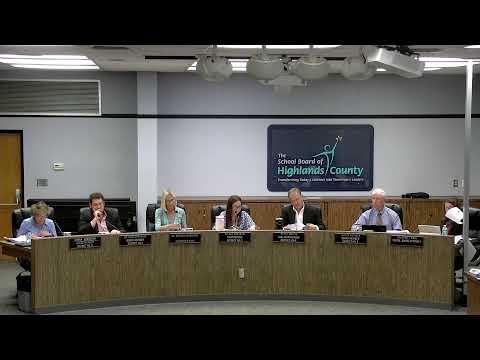
Mrs. Nash, the board attorney, led a policy-development workshop in which she presented proposed revisions, consolidations and rescissions affecting many Highlands board policies.
Mrs. Nash, the board attorney, led a policy-development workshop in which she presented proposed revisions, consolidations and rescissions affecting many Highlands board policies. The packet covered technical corrections, definitional changes and more substantive edits tied to changes in Florida law or administrative rule.
The workshop matters because the proposed changes affect board governance (meeting rules), personnel rules (drug-free workplace, educator misconduct reporting), student services (exceptional student education, physical education, field trips), and operational policies (capital naming, food-service rules). Several policies were recommended for deletion and consolidation into broader policies to reduce duplication.
Nash told the board the first set of changes were largely editorial and definitional, including a new definition for "eligible student" and replacement of an older term. She recommended deleting multiple meeting-related policies (0165.20, 0165.203, 0166 and 015.2 in the packet) and consolidating that material into a single policy 165 titled "School Board Meetings." Nash said the consolidation moves existing language into one location rather than removing substantive content.
Several personnel policies were updated in response to statutory changes. The proposed drug-free workplace language was revised for administrators, instructional staff and support staff across separate policies. Educator-misconduct reporting language was changed to require self-reporting within a statutory window for certain offenses; Nash noted the administration-specific policy requires administrators to self-report within 48 hours and that a separate paragraph reminds all employees of a duty to report known misconduct by administrators.
The workshop also included student-facing policy changes. Policy 2124 (school improvement) was updated to add voluntary pre-K students with a substantial deficiency in early literacy skills, per new law. Policy 2280 (physical education) was amended to require the superintendent to annually review wellness and physical education policy and present it to the board for public input. Policy 2460 (exceptional student education) adds language on transfer of parental rights at the age of majority and staff explained the district—s practice of sharing that information at age 12 and at transition meetings.
On capital and facilities, Nash proposed trimming the previously required 18-month waiting period for renaming facilities and adding criteria and a faster process for submitting name-change recommendations to the board. She said the change is intended to let the board consider renaming sooner when circumstances warrant.
Food-service and nutrition policies were consolidated. Nash proposed rescinding two specific policies on vending machines and competitive food sales and moving their content into a single updated policy 8500 (Food Service Program). She said the change is organizational: the content is not being removed but centralized.
Board members and staff asked clarifying questions on timing and implementation. Members asked whether some changes would be timed to align with the school year (for example, wellness and PE review) and whether local practice matched new policy language (for example, parental notification procedures for students who reach majority). Staff and Nash clarified where language mirrored state statutes, the Florida Building Code or Department of Education rules, and where local wording was purely internal.
Nash marked several policies as "recommended for deletion" or "recommended for rescission" in the packet; the workshop did not record formal votes on those recommendations. The session closed with staff offering to supply corrected drafts (typo fixes and punctuation) and a timeline for board review; no final policy adoptions were made at the workshop.
A follow-up public meeting or board agenda item will be required to adopt or rescind any policy formally; until then the proposed changes remain recommendations discussed in this workshop.