Get Full Government Meeting Transcripts, Videos, & Alerts Forever!
Get email alerts on the School Finance topic
No spam. Unsubscribe anytime.
Highlands board hears explanation of FEFP, required local effort and millage limits
Summary
Bond counsel and the district—s financial advisor told the Highlands County School Board workshop that state FEFP rules and statutory millage caps limit local discretion, and that levying discretionary millage is effectively required to secure a $4.3 million compression supplement and other state funding.
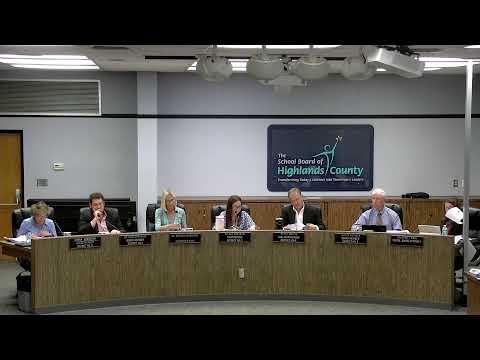
Ritesh Patel, bond counsel with Neighbors, Giblin & Nickerson, and John Ford, financial advisor with Ford and Associates, briefed the Highlands County School Board on K-12 funding formulas and the limits the Legislature places on local millage decisions.
Patel and Ford told the board the primary operating funding source for Florida school districts is the Florida Educational Finance Program (FEFP), and that participation in FEFP requires districts to levy the statutorily computed required local effort (RLE). Patel said, "In order to participate in state FEFP funding . . . the district must levy the required local effort at the rate set by the Legislature." The presenters outlined how the state computes gross FEFP dollars and how required local effort and adjustments yield a district—s net FEFP allocation.
The discussion matters because Highlands relies heavily on state dollars and faces trade-offs between operating and capital millages. Board members were given projected dollar amounts for fiscal year 2025-26, and staff explained how those amounts affect the district—s budget choices.
Patel and Ford summarized the key numbers the board is using for budget planning. For Highlands, the required local effort is 3.104 mills and is projected to generate about $29.2 million for FY 2025-26. Net state FEFP funding for the district is projected at just over $68.2 million. The state—s nonvoted discretionary operating millage is capped at 0.748 mills; for Highlands that levy is expected to produce about $7.0 million, and because Highlands generates less per-student revenue from that millage than the statewide average, the state provides a compression (supplement) payment. Ford and Patel estimated the compression supplement for Highlands at about $4.3 million for the year. Patel noted the district would forfeit that supplement if it did not levy the full 0.748 mills.
The consultants also reviewed capital revenue and debt. The legal maximum local capital outlay millage is 1.5 mills; Highlands— capital millage is estimated to generate about $14.1 million this year. Patel said the district—s debt service this year is roughly $5.38 million and transfers from capital millage to the general fund are about $8.5 million, leaving limited discretionary capital resources. Highlands also benefits from a half-cent local sales tax that staff estimate brings in about $9 million annually. Patel warned board members that if the district adopted a budget without appropriating required debt-service amounts under certificate of participation (COP) documents, trustees could take possession of COP-financed facilities; he said about 15% of Highlands students were using COP-financed facilities in 2024.
Board members asked whether cutting capital millage or applying capital dollars to prepay select COP maturities would be possible. Staff said some higher-interest maturities (about $6 million total maturing in 2026 and 2027) could be prepaid now, and that refinancing plans considered in 2024 were not broadly economical. Multiple board members and staff commented the late state budget adoption compressed the district—s timeline for preparing its budget this year.
Patel and Ford emphasized the limited local discretion the FEFP structure creates: levying less than the RLE or the full 0.748 discretionary millage can reduce or eliminate state supplements and thus materially reduce the district—s total operating revenue. Several board members thanked the presenters for clarifying the trade-offs and the practical limits on local choices.
Board direction and next steps were limited to staff follow-up. The presenters and staff encouraged board members to direct additional questions to district finance staff and the presenters; no formal motions or votes were recorded during the workshop.
The workshop closed after member questions and staff confirmations about next steps for budget planning and follow-up contact information.