Get Full Government Meeting Transcripts, Videos, & Alerts Forever!
Get email alerts on the Milwaukee Zoo Front Entrance topic
No spam. Unsubscribe anytime.
Milwaukee County zoo officials press Capital Improvements Committee to fund redesigned front entrance to reduce traffic losses during Blue Mound construction
Summary
Milwaukee County Zoo officials on Aug. 12 urged the Capital Improvements Committee to advance a front‑entrance redesign intended to speed vehicle and pedestrian flows and preserve ticket and parking revenue during a March–November 2028 Blue Mound Road construction project.
Milwaukee County Zoo officials on Aug. 12 asked the County’s Capital Improvements Committee to advance a front‑entrance redesign intended to speed vehicle and pedestrian flows and capture ticket and parking revenue during a March–November 2028 Wisconsin Department of Transportation project on Blue Mound Road that will limit the roadway to one lane in each direction.
The zoo’s executive director, Amos Morris, told the committee the project is a timing issue and urged action now “either we’re going to pay now or we’re going to end up paying later.” Morris said the design team’s goal is to move vehicles off Blue Mound into the zoo parking area with minimal stopping and to reconfigure ticketing so more guests buy online or at kiosks before entering the grounds. John Teppler, project manager with the Concord Group, described planned changes including new traffic signals, a median to eliminate a hazardous crossover and a consolidated pedestrian entry/gathering space where tickets are validated as guests arrive.
Deputy Zoo Director Vera Westfall told the committee the zoo’s 2025 revenue budget is about $22,600,000 and that roughly 80% of that is generated from April through October, the season most likely to be affected by Blue Mound construction. “If we didn’t have an efficient way to get cars in … you won’t wait hours and hours to get into the zoo,” Westfall said, pointing to observed instances of paying customers leaving long lines. Zoo staff also said parking currently generates about $2,000,000 annually and that separating parking fees from admission provides flexibility for free admission days without losing all revenue.
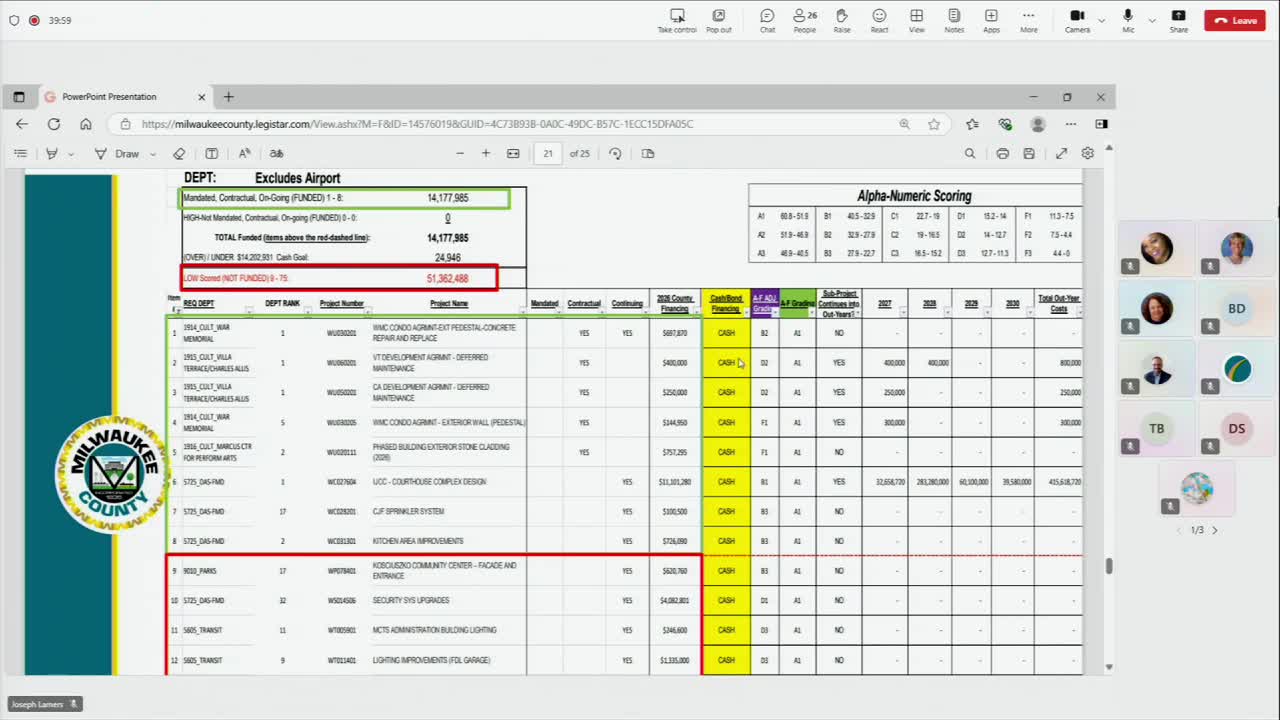
Zoo presenters said the project is currently ranked just below the committee’s recommended funding line (number 32 on the packet list) and that the work is timed to allow design to begin in early 2026 so major construction elements would be in place before the DOT’s Blue Mound work begins in 2028. The design includes a phased approach that would allow some ticketing and gate changes to occur while the zoo remains in operation; presenters said they had looked at doing only a new ticket building but warned that demo of existing booths without traffic work could create dangerous backups and risk parking revenue.
Supervisors on the committee pressed for more detail. Supervisor Sumner asked for a firm estimate of the cost to build the ticketing component alone; Concord Group staff said that specific figure was not available at the meeting and promised to follow up. Supervisor Rawland and others asked how much revenue the zoo might lose during the 2028 construction window; Westfall said the zoo generates about $17.6 million from April to October and that it was plausible some percentage of that could be lost but she could not quantify it precisely. Supervisor Alexander asked whether an exit ramp from the freeway had been studied; presenters said that option had not been modeled and that it would likely be more complicated than reworking the local intersection and parking layout.
Committee Chair and staff told the zoo team to provide more refined cost breakdowns (including the cost to build ticketing only), confirmation about whether the project can be staged across budget years, and other supporting materials. Committee members asked that those numbers be available for the next committee meeting (Aug. 19) and for departments to make the case for any items they want moved above the red line. No funding decision or vote on the zoo project was taken at the Aug. 12 meeting.
The discussion highlighted tradeoffs the committee faces in allocating limited county capital: several departments describing projects ‘‘ready to go’’ and county staff noting the county’s bonding cap was nearly filled by higher‑scored projects. Committee members said they want precise construction/staging costs before displacing other projects that are already ranked for funding.
The committee did take one procedural vote earlier in the meeting to approve the July 23, 2025 CIC minutes. That motion, moved by Supervisor Johnson Jr., passed on a recorded roll call 6–0.
Looking ahead, zoo officials said they would return with the requested cost breakdowns and staging scenarios; the committee said it will consider the materials at its next scheduled meeting as it finalizes recommendations for the 2026–2030 capital improvements plan.