Get Full Government Meeting Transcripts, Videos, & Alerts Forever!
Get email alerts on the Ai Adoption Workforce topic
No spam. Unsubscribe anytime.
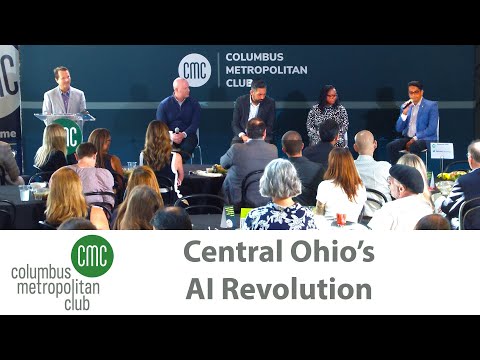
Panelists: Columbus can grow as an AI hub by applying tools to industry, but needs data center capacity and power
Summary
Speakers at a Columbus Metro Club forum said Columbus can capitalize on AI by focusing on applied solutions across healthcare, finance and startups, while ensuring data center capacity and power supply keep pace.
Panelists at a Columbus Metro Club forum said Columbus can compete in AI by applying tools to everyday business problems rather than trying to replicate Silicon Valley's model of building foundational model research.
Guru Vasudeva, senior vice president and chief technology officer for property and casualty at Nationwide, said Columbus ‘‘doesn’t have to compete in the same space’’ as Silicon Valley and can lead by applying AI in health care, financial services and local startups. Vasudeva cited research and medical work at Ohio State and Nationwide Children’s Hospital and said financial firms such as Nationwide and Chase are ‘‘investing heavily’’ in generative AI for decision support.
Vasudeva warned that large‑scale AI deployment requires data center capacity and significant power. ‘‘To make those data centers run, what do you need? You need power,’’ he said, pointing to utilities such as AEP and vendors like Vertiv and suggesting that local infrastructure will be critical to growth.
Nicole Jackson, principal AI consultant and AI practice lead for Optimum Technology, and other panelists described a range of enterprise uses, from knowledge graphs that connect disparate datasets to agentic tools that automate cross‑system workflows. Jackson said these hybrid approaches — knowledge graphs coupled with generative and agentic tools — can ‘‘transform entire business operations’’ in organizations that contend with siloed data.
On workforce change, panelists said roles will evolve more than disappear. Jackson argued that task‑oriented or repetitive administrative roles are most likely to transform, and new roles will require ‘‘algorithmic thinking and systems thinking’’ alongside domain expertise. Mike Cohn, vice president of network operations at CoverMyMeds, and others recommended business leaders use AI as a decision‑support copilot and to adopt practices such as A/B testing to preserve organizational voice and judgment.
Panelists also noted early signs of automation in software development. Guru Vasudeva and others said coding productivity tools such as GitHub Copilot are speeding programming work and enabling small teams to build complex products faster.
The discussion combined practical adoption advice with infrastructure warnings: Columbus has assets — universities, hospitals, startups and corporate R&D — but scaling AI will require attention to data center construction, grid capacity and local supply chains for critical equipment.