Get Full Government Meeting Transcripts, Videos, & Alerts Forever!
Get email alerts on the Ai Basics topic
No spam. Unsubscribe anytime.
AI primer: panelists define generative models, agents and why the technology feels different now
Summary
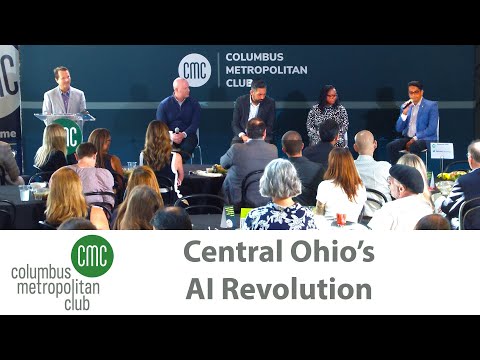
At a Columbus Metro Club forum, Nathan Craig of Ohio State explained generative AI and agents, and panelists described how scale, data and compute have shifted AI from narrow tools to a general‑purpose technology with broad applications.
Nathan Craig, associate professor of operations and business analytics at The Ohio State University’s Fisher College of Business, told a Columbus Metro Club audience that ‘‘artificial intelligence is the field that takes software and machines and teaches them to do tasks that would typically require human intelligence.’’ Craig said the recent shift that makes AI feel new stems from scale: vastly larger datasets, bigger models and much greater compute power.
Craig distinguished ‘‘generative AI’’ — systems that output the same type of data they were trained on, such as text from text — from other AI that makes classifications or predictions. He defined ‘‘agents’’ as systems ‘‘that can autonomously achieve a goal,’’ describing tools that can combine vision, language and action to accomplish tasks such as making a restaurant reservation.
That scale, Craig told the forum, is extraordinary: models like ChatGPT are trained on datasets ‘‘of over a trillion tokens’’ and, he said, ‘‘if you were to try to read that start to finish, it would take you 12,000 years.’’ He said modern AI is moving from narrow, task‑specific systems to ‘‘general purpose technology’’ — tools leaders should explore to improve existing work and enable new capabilities.
Craig cautioned that the pace of change will accelerate but framed the shift as an extension of earlier general‑purpose technologies such as electricity and the Internet. ‘‘Economists find that 60% of the jobs Americans held in 2020 did not exist in 1940,’’ he said, arguing that society has previously adapted to major technological change even as new disruptions arrive.
Moderator John Hersovksi, managing director of Cynexis Consulting, prompted the overview and asked panelists to give practical examples of how they use AI today. Panelists described using so‑called ‘‘deep research’’ prompts, agentic tools and copilots to gather competitive intelligence, prepare meeting briefs or speed software development.
Panelists emphasized that the features distinguishing current systems are scale, model generality and new ways to integrate AI into workflows, not a single new algorithm. Craig urged organizations to ‘‘explore how can this let us do what we're currently doing better? How can this enable us to do brand new things that we never imagined?’’
The session combined a technical primer with discussion of business and civic implications as the region’s institutions and companies consider how to adopt and govern emerging AI systems.