Get Full Government Meeting Transcripts, Videos, & Alerts Forever!
Get email alerts on the County Budget topic
No spam. Unsubscribe anytime.
Collin County commissioner warns budget leaves little room without tax increase or cuts
Summary
Commissioner Webb told the Commissioners Court the county’s general fund is essentially balanced at current tax rates and that meeting elected officials’ supplemental requests would require voter approval or departmental reallocations.
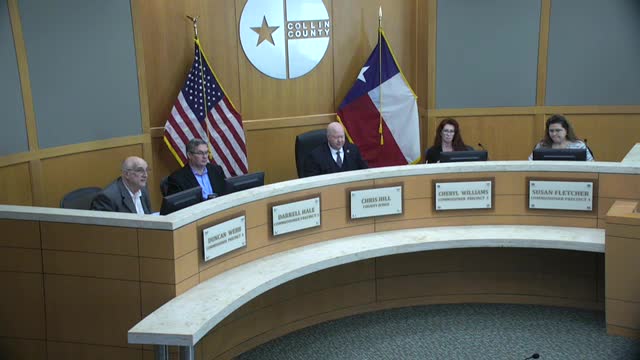
Commissioner Webb said Collin County’s general-fund revenue leaves almost no room for the supplemental requests county elected officials and department heads have submitted for the 2026 budget.
Webb told the Commissioners Court on July 24 that the county’s no-new-revenue baseline is about $314.0 million and that keeping the current tax rate adds roughly $9 million more; increasing to the voter-approval (rollback) rate would add about another $10 million. Even after those options, Webb said the requests from elected officials, market movement and mandatory base increases would put expenses above available revenue unless the court either asks voters for more or departments find internal cuts.
The commissioner said netting the adopted 2025 budget and the 2026 base requests produces a tight picture: “If we stay at the no-new-tax rate, we only have available for anything $424,000 unless we start cutting budgets,” Webb said. He added that adding 2026 market movement and other mandatory increases pushes expenses past revenue at the existing rate. “We are already past the amount of revenue that we can generate at the current tax rate, period,” Webb said.
Why it matters: Webb emphasized Collin County’s rapid growth — he repeated the frequently cited figure of roughly 200 new residents per day — and warned that growth drives service needs across courts, jail, public works and clerk offices. He noted aging infrastructure (escalators, roofs) and continuing health- and jail-related requests from the sheriff and district attorney that, taken together, exceed what the county can absorb without higher revenue or significant cuts.
Court discussion and next steps: Webb said he prefers not to raise the tax rate but that the court will have to consider reallocating within department budgets, denying supplemental requests, or seeking voter approval. Several members of the court and department heads agreed that statutory mandates and state-imposed changes have increased county workload without commensurate state funding. Commissioners asked staff to reconcile the revenue-and-base presentations and to return alternate budget scenarios showing deeper cuts versus tax-rate increases.
Webb also flagged that some supplemental requests (notably large sheriff requests for jail mental-health staffing and overtime) would effectively require either voter support or reallocations; he said he will be “very unwilling to approve anything that’s not in those first two categories,” meaning the budget-recommended items, unless departments identify internal savings.
Ending: Webb urged department heads to prioritize and find savings where possible, and the court directed staff to provide clearer reconciled budget figures at the next session so members can evaluate trade-offs between cuts and potential tax-rate options.