Get Full Government Meeting Transcripts, Videos, & Alerts Forever!
Get email alerts on the Emergency Care Immunity topic
No spam. Unsubscribe anytime.
Guam Legislature expands Good Samaritan protections to cover emergency transport and bystanders; adds "without compensation" amendments
Summary
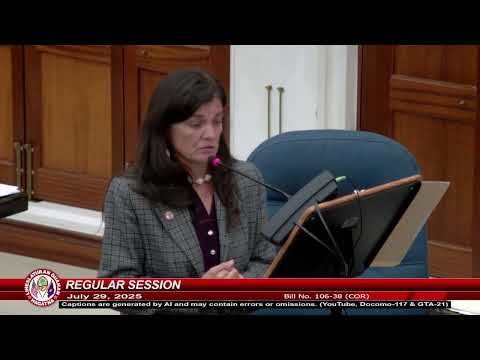
Lawmakers advanced Bill 76-38 to third reading after debate and floor amendments to clarify that civil immunity applies to emergency care rendered in good faith, including during transport and by bystanders, provided the care is given without compensation and absent gross negligence.
Speaker Frank Blasch moved Bill 76-38 COR, which would add a new subsection to Guam law to extend civil immunity for emergency care given in good faith, into third reading after floor debate and two on-the-floor amendments. The measure’s written aim is to protect people who render emergency medical assistance — including bystanders and first responders — from civil liability so long as they act in good faith and are not grossly negligent.
The bill’s author said the measure “provides immunity, protection from liability, for primarily those individuals that provide and render emergency medical assistance in good faith,” and singled out paramedics and medics in the Guam Fire Department. The author told colleagues he had consulted with the Criminal Law Revision Commission and the Attorney General’s office on the definition of “good faith.”
Supporters argued the change would encourage prompt life‑saving interventions. “This bill seeks to encourage prompt, life saving interventions by removing the fear of legal liability for well intentioned bystanders and health care personnel who act reasonably in emergency situations,” Senator Cowell said in floor remarks endorsing the measure. Several senators cited examples and comparable state laws — for instance, California and Texas — during debate.
Several members pressed for tighter definitions and limits. Senator Barnett and others pointed to an existing statute, 20 GCA §2104, which already exempts persons rendering emergency care from civil liability except for gross negligence, and asked how the new text differs. The author said the bill expands existing coverage to explicitly include care during transport (for example, treatment provided while transporting a patient to a clinic or hospital), which the author said the older statute did not clearly cover.
The floor debate repeatedly returned to two concerns: (1) whether the bill’s language would inadvertently extend immunity to private companies and clinicians acting as part of their paid duties (for example, private ambulance services or clinic obstetricians), and (2) whether the broad phrase “any person” in a subsection on emergency obstetrical care might protect untrained laypeople who attempt specialized interventions.
To address the first concern, the author offered and the chamber adopted two clarifying amendments on the floor that insert the words “without compensation” in targeted places of the bill (page 1, line 10, and page 2, line 6 in the bill text as discussed on the floor). The author explained those amendments were intended to make clear the immunity applies to unpaid acts — i.e., typical Good Samaritan assistance — and not to compensated private transporters or clinicians performing their paid duties. The amendment was adopted with no recorded objections.
On the definition of “good faith,” the author said the bill treats good faith as the absence of gross negligence and that the drafters consulted existing Guam law and the Criminal Law Revision Commission and AG’s office for consistency. The author also said the Department of Public Health and Social Services and the Guam Fire Department participated in the review and that the bill’s language is intended not to reduce the standard of care for trained EMS personnel.
Opponents and questioners — including Senators Trelahi, Law and Chilayi — urged caution, saying departmental testimony (from DPHSS and Guam Fire Department) had indicated current protections may already cover many responders and private transporters are required by other statutes to carry insurance. Some legislators worried the draft could unintentionally immunize providers who violate public‑health regulations. The author responded that the bill expressly excludes conduct amounting to gross negligence or willful misconduct and that certain regulatory and peer‑review structures for EMS remain operative.
The bill author also referenced operational context: the Fire Department’s line personnel had urged the change, and the author noted the island’s ambulance fleet and response capacity during floor remarks, saying there were six ambulances in service versus an NFPA standard of eight and relating a recent child fatality while waiting for an ambulance to underline the bill’s policy purpose.
After debate and the floor amendments, the chamber moved Bill 76‑38 COR, as amended, to third reading. The author added multiple cosponsors during the floor session. The measure will next appear on the third‑reading calendar for a final vote and any additional floor amendments.