Get Full Government Meeting Transcripts, Videos, & Alerts Forever!
Get email alerts on the Budget topic
No spam. Unsubscribe anytime.
Griggs County Commission approves preliminary 2026 budget, levies for building reserve
Summary
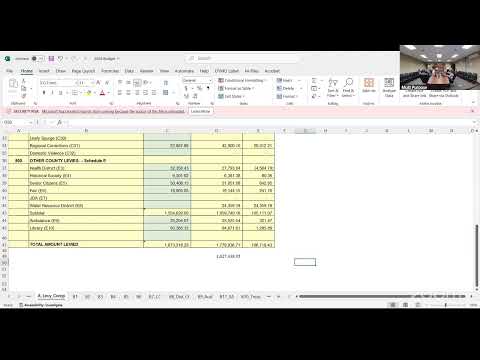
At a July 28 special meeting the Griggs County Commission approved a preliminary 2026 budget that includes scheduled employee pay adjustments, an expanded vehicle fund and a newly earmarked building-depreciation reserve funded by the county's 30-mill levy.
The Griggs County Commission approved the county's preliminary 2026 budget at a special meeting July 28, 2025, voting to levy at the county's maximum and to set aside an amount in the county's general fund as a building-depreciation reserve for future courthouse and facility repairs.
The action finalizes a draft that incorporates raises and longevity adjustments discussed at prior meetings, adds $30,000 to the county vehicle fund and repurposes a budget line to create a designated building reserve of about $32,000. Commissioners and staff also discussed changes to an extension office administrative position's weekly hours, limits that trigger benefits, and how weed-board funds can be used to contract spraying.
Commissioners placed the levy at the maximum allowed for the county budget calculation, and directed staff to earmark the additional levy proceeds into a named account for building repairs and depreciation so those dollars are not spent for other general-fund purposes. Staff said the earmarked amount would be roughly $32,000; commissioners asked that the line be labeled clearly in the budget as a building-depreciation or building-projects account.
On personnel matters, the draft budget includes the wage increases the commission reviewed at prior meetings. The budget adds a scheduled $1.00-per-hour increase after six months for a recently hired road employee (hired at $20 per hour), which will move that position to $21 per hour in January, and commissioners agreed to increase a separate long-serving road employee's boost to $1.50 per hour to create a clearer differential across years of service. Commissioners discussed that the pay adjustments include longevity and that a matrix for next year will be developed to make step differences clearer.
County staff and commissioners discussed the county extension office admin post, which currently worked about 15 hours per week. To avoid triggering the benefits threshold (staff said state retirement/insurance provisions apply at 20 hours and above), the commission agreed to add four hours to that position so it will be 19 hours per week; that increase was described as intended to help handle heavy seasonal work such as 4-H programming and fair week without creating an immediate insurance/retirement obligation.
On weed-control spending, staff told commissioners the county can use its tag money to contract for spraying: the program can cover 75 percent, up to $7,500; the commission also has about $6,000 budgeted for chemicals now that could be reallocated to pay a contractor if necessary. Staff reported that one local applicator, Dane Mueller, was not interested and that another local applicator, Justin Hanson, was a possibility for contract work.
The commission placed $30,000 into the county vehicle fund; staff said the county currently has about $65,000 in that fund, which would total roughly $95,000 if no vehicles are purchased before year end. Commissioners discussed whether to continue buying three-quarter-ton pickups or alternate with smaller vehicles to allow a unit to be passed down to other departments.
Commissioners also reviewed road-department material issues and gravel availability in the region, noting that gravel pits have become scarcer and hauling distances have increased. Road staff described efforts to identify additional pits and noted constraints where some pits contain rock or wet material that requires extra processing.
After discussion and minor line-item adjustments (including the repurposing of a former human-services line to hold the building-depreciation reserve), a motion to approve the preliminary 2026 budget passed on a voice vote. The meeting record shows three votes in favor and one opposed.
The commission scheduled its next regular meeting for Aug. 11; the preliminary budget approval moves the process forward toward final adoption later in the budget calendar.