Get Full Government Meeting Transcripts, Videos, & Alerts Forever!
Get email alerts on the Housing Policy topic
No spam. Unsubscribe anytime.
Council approves first reading to implement state’s co‑living mandate (House Bill 1998); debate centers on parking and zoning options
Summary
The council voted to adopt first reading of code changes implementing Washington’s House Bill 1998 (coliving). The Planning Commission recommended approval; councilors debated parking limits, local zoning responses and asked staff for options on rezonings before second reading.
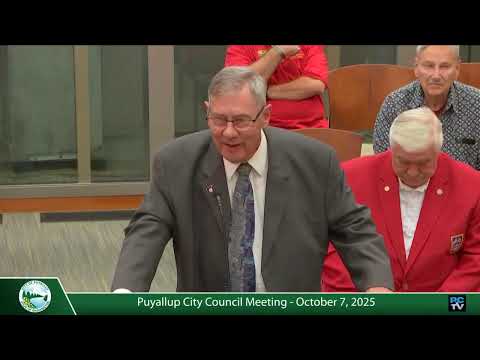
The Puyallup City Council on Oct. 7 adopted first reading of an ordinance to implement House Bill 1998, which requires Washington cities to permit ‘‘co‑living’’ housing where at least six multifamily units are allowed. The ordinance implements the state law’s minimum standards into city code and adds related definitions, SEPA documentation and parking rules aligned with the statute.
Planning staff and the Planning Commission recommended the code amendments after a public hearing. Planner Katie Baker summarized the changes: co‑living would be permitted in zones that already allow multifamily, require shared kitchens and define ‘‘sleeping units’’ and ‘‘kitchenettes’’; the city’s sewer connection charge for co‑living would be set at 50% of a typical dwelling-unit connection fee as allowed by statute. Parking rules follow the state limit: no parking requirement within a half‑mile walk shed of the Sounder Station, and outside that area the city may require up to one-quarter space per sleeping unit (i.e., one space per four sleeping units).
The ordinance produced extensive council debate. Several council members objected to the state-mandated parking limits and asked whether the city could rezone areas to avoid the requirement; staff said rezonings are a possible, but substantive, separate process and would take analysis. Council members expressed concern the statutory parking standard could strain on-street parking and downtown merchants. Other councilors emphasized the Planning Commission’s review and the city’s limited discretion to deviate from the state floor.
Timing and compliance: staff told council the state statute requires implementation by Dec. 31, 2025, and that, absent an ordinance, state law’s requirements would be effective and would apply to qualifying lots beginning Jan. 1, 2026. Council members asked staff to provide options on zoning changes (e.g., reducing density in affected zones so lots could not accommodate six or more multifamily units) and to highlight elements in the draft that derive directly from the state statute before second reading.
Outcome: After procedural votes (an initial motion to delay first reading failed), the council passed first reading of the ordinance implementing House Bill 1998. Council members directed staff to return with zoning-option analysis and the requested clarifications for second reading later this fall.
Why this matters: HB 1998 changes how cities must treat co‑living housing; Puyallup’s implementation affects parking, sewer fees, and where that housing may be developed in the city. Council debate highlighted tensions between state mandates and local parking/street impacts.
Next steps: staff will (a) provide a packet for second reading showing which code provisions are state‑required versus locally discretionary, (b) analyze rezoning or other options to alter where co‑living would apply, and (c) return for second reading and final action before the end-of-year statutory deadline.