Get Full Government Meeting Transcripts, Videos, & Alerts Forever!
Get email alerts on the Traffic Safety topic
No spam. Unsubscribe anytime.
Residents press Puyallup council for traffic calming after teen struck; council pledges engineering review
Summary
Neighbors urged the City Council to add stop signs, streetlights and traffic calming near Second and Seventh avenues after a teenager was struck; city officials said a traffic engineer examined the site and explained the neighborhood petition/traffic-calming process.
A group of Puyallup residents told the City Council on Oct. 7 that speeding and poor pedestrian infrastructure near Second and Seventh avenues are putting people at risk following a crash the previous day in which a teenager was struck.
Neighbors called for immediate fixes — stop signs, speed bumps and better lighting — and asked the council to change the city’s petition threshold for traffic-calming requests.
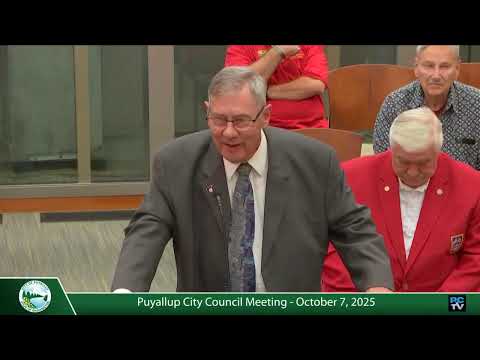
The speakers said the collision on the corner of Second and Seventh left them shaken. ‘‘This is the second teenager that’s been hit in front of my house in the past, I’d say, four months,’’ said Greg Magoo, who lives at 614 Second Avenue, describing frequent cut-through traffic and limited controls on a stretch from Valley Avenue north to the Maine Street signal. He asked the council to lower the petition threshold the city requires before engineers will evaluate a street.
Mayor Jim Castema and staff responded that the teen was in serious-but-stable condition and that the city had already sent a traffic engineer to the site the day of the crash. The mayor corrected an earlier assertion by a resident about the petition threshold: the city requires signatures from 50% of properties on a block, not 94%.
Other residents described similar concerns: Kelly Jackson, who lives two blocks away at 611 Fourth Avenue Northeast, said there are stretches without sidewalks that force pedestrians, including children, into the roadway. Jim Couch, who has lived on Third Avenue Northeast since 1984, urged both quick enforcement actions — periodic police presence — and longer-term engineering changes such as a 4-way stop and adjusted signal timing near the railroad crossing.
Council members and staff described the city’s traffic-calming process: residents may submit a request (the city clerk’s office reads guidelines during each meeting), obtain the signatures required under the city’s petition process (50% of residents on the affected block), and then the city’s traffic engineers will perform counts and a formal assessment. Mayor Castema and other council members said the city would follow up and speak further with the residents about specific options, including the location of an existing streetlight one resident said might need relocation.
Why this matters: Council members noted the pattern of neighborhood crashes and the particular vulnerability of students and pedestrians. Several councilors emphasized both engineering fixes and temporary enforcement as complementary steps; the city’s short-term actions can include targeted police enforcement, signage changes and evaluation for traffic-calming devices while engineers study longer-term capital improvements.
The meeting record shows the council and staff committed to follow-up and local engineering review; residents urged the city to revisit the petition threshold and provide more visible, near-term traffic enforcement in the corridor.