Get Full Government Meeting Transcripts, Videos, & Alerts Forever!
Get email alerts on the County Budget topic
No spam. Unsubscribe anytime.
Marathon County committee accepts administrator's proposed 2026 budget; capital projects largely deferred
Summary
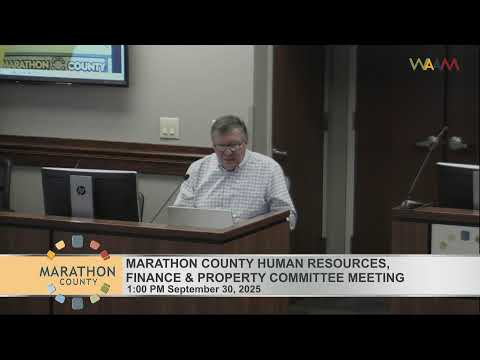
Marathon County's Finance and Property Committee voted to accept the administrator's proposed 2026 annual budget and capital improvement plan on a voice vote Oct. 1, advancing the document as the county board's budget for committee review and public hearing.
Marathon County's Finance and Property Committee voted to accept the administrator's proposed 2026 annual budget and capital improvement plan on a voice vote Oct. 1, advancing the document as the county board's budget for committee review and public hearing.
The administrator told the committee the proposed budget is largely status quo, emphasizes implementing an updated employee compensation plan and preserves current service levels while funding three board-directed items: a $150,000 set-aside for a minimum revenue guarantee, $175,000 to continue the county's emergency shelter partnership with the City of Wausau and funding for a new public-health coordinator position in the Health Department.
Why it matters: The presentation framed the proposal as balancing competing priorities while avoiding new general-fund reserve draws or new debt issuance for 2026. Officials said the tax rate would fall roughly $0.17 (about 4.63 percent) and that the average Marathon County homeowner's tax bill would rise by $33.71 (about 3.95 percent) from 2025 to 2026, to an estimated $886 annually. Committee leaders set a schedule for public hearings and amendment deadlines ahead of final board adoption.
Most of the operating budget is unchanged, the administrator said, noting the proposal follows the board's budget priorities and assumptions. The presentation highlighted local economic indicators: net new construction for 2025 of 1.61 percent (which the administrator said equates to about $837,000 in levy capacity and about $1,000,000 after a personal-property adjustment) and nearly 9 percent growth in county equalized value. Officials said strong property values and a low unemployment rate contribute to the county's fiscal position.
Key program and funding details - Minimum revenue guarantee: $150,000 was designated in the contingency fund for a board-directed minimum revenue guarantee program. The administrator described the contingency designation as the principal funding source. - Emergency shelter partnership with the City of Wausau: The budget provides $175,000 for 2026. The administrator said the funding package relies on $50,000 in contingency, use of any unspent rollover from 2025 and $50,000 from the administrator's special-projects budget to cover the remainder. - Public-health coordinator: The budget includes funding for a new public-health coordinator position in the Health Department to address homelessness-related work, funded by internal reallocation described in the departmental pages. - Compensation and benefits: The budget implements a compensation-plan update the board prioritized after a wage study showed market lag. Because new levy growth is limited, officials said they achieved the implementation by defunding roughly the equivalent of 15 full-time positions across departments, aligning some roles to grant and reimbursement streams, and finding other efficiencies. - Health insurance: Budget staff budgeted a 6.5 percent increase for health insurance after renewals initially returned higher figures. The administrator said market increases in health-care costs are a risk area and that continued clinic and broker funding are included to control costs.
Capital budget and deferred projects County finance staff said capital funding was substantially constrained for 2026. Because the administrator followed the board's direction not to include new debt issuance or to spend down the general fund, fund balance transfers to the capital-improvement program were effectively zero for 2026. As a result, staff limited CIP spending to critical infrastructure: IT and security investments and essential highway projects. The presentation said roughly $5 million in projects were deferred from the initial project list into 2027, and staff identified about $4.87 million of funding available in the proposed CIP column (including reallocated CIP/ARPA funds, a sales-tax contribution to CIP, interest income and other sources) to cover the limited 2026 project list.
Officials discussed a potential highway shop relocation, noting the board has $30 million set aside in a highway reserve and that the total project cost remains to be further defined. The administrator outlined one strategy for avoiding new borrowing: repurposing existing general-obligation debt service and North Central Healthcare's payments on previously issued debt to reduce the need for a new issuance. The administrator cautioned that the board should be deliberate: borrowing costs at higher market interest rates would substantially increase interest payments for a large project.
Department changes and efficiencies The presentation and departmental summaries described multiple department-level changes used to balance the budget: several departments unfunded positions, restructured contracts, revised fee schedules to better recover costs (for example, environmental health and register of deeds charges), and shifted some personnel costs historically paid from CIP into operating budgets where necessary. Officials said 17 of 26 departments held levy requests flat or reduced them year over year.
Process and next steps The committee voted to accept the administrator's proposed budget and to forward it as the county board's budget. The committee chair outlined the schedule: standing committees will review and may propose amendments; the committee will meet Oct. 8 and Oct. 13 for budget review and to authorize publication for a Nov. 3 public hearing. The deadline for amendments to be considered by the committee is Nov. 7; the committee will finalize recommendations Nov. 10 and the full county board is scheduled to consider adoption Nov. 11.
Quote "This is your budget," the administrator told the committee, saying the proposal was shaped by board direction and budget priorities.
What the action was: The committee accepted the administrator's proposed 2026 annual budget and capital improvement plan and advanced it as the county board's budget for the amendment and public-hearing process. The acceptance was made by voice vote; the record shows the motion was made by Supervisor Lemmer and seconded by Chair Gibbs and that the motion carried.
Context and risk areas Officials identified several risks to the 2026 plan: rising inflation and contract costs (including construction, HVAC and certain service contracts), limited CIP funding that may require deferral of necessary maintenance, and continued pressure on health insurance and employee recruitment/retention if compensation and benefits are not sustained. Staff urged the board to prioritize capital funding in any subsequent modifications to avoid larger long-term costs.
Closing note Committee members and administration thanked department heads and staff for budget work and efficiency efforts. The approved-to-publish timeline gives members of the public and standing committees multiple opportunities to review and comment before final adoption by the county board.