
Calhoun County Board of Education adopts $117 million budget; approves personnel and service contracts
Get AI-powered insights, summaries, and transcripts
Sign Up Free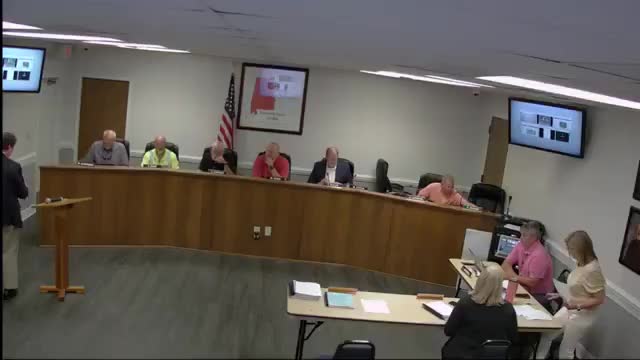
Summary
At a second budget hearing, district staff presented a fiscal 2026 spending plan showing $117 million in expected inflows and a $105 million general-fund expenditure estimate. The board approved the budget and a series of personnel and contract items, and received detail on capital projects, bus replacement needs and technology funds.
The Calhoun County Board of Education approved the district—s proposed fiscal-year budget and a series of personnel and contract recommendations after a second budget hearing during a regularly scheduled meeting in Calhoun County.
Mister Godwin, presenting the budget, said the district expects total inflows of about $117,000,000 for the year and described beginning balances and reserves that will support planned spending. "We start off the year right at $43,000,000 in our general fund," Godwin said, and the budget document shows $13,000,000 in capital projects and roughly $3.3 million in special-revenue funds.
The proposal lists state funding as the largest revenue source. "State is our biggest portion, mainly through the foundation program," Godwin said, noting the state allocation figure reported in the presentation at about $72,000,000 and that the district—s average daily membership used to calculate foundation funding was reported at about 7,006.61. Godwin said enrollment declines have reduced staffing units modestly: "We're down a quarter of a teacher counselor at 1 of the schools."
Godwin outlined other major items in the proposed budget: an $800,000 (annual) increase in technology-related funds, a near-$1.2 million net gain through a state initiative he identified as the RAISE Act (poverty, special education, EL and gifted allocations), and an $8,000,000 advancement-in-technology balance carried into the year. He also described transportation cost increases and bus-replacement needs: the district budgets roughly $2,200,000 overall for buses, receives about $7,500 per ten-year bus (approximately $75,000 over 10 years) from the state, and anticipates a $2.5 million bus purchase plan to replace 12–14 vehicles this coming year.
On expenses, Godwin said salaries and benefits remain the largest category, accounting for roughly 70% of the budget in the presented year, with operations and maintenance, instructional programs and capital outlay among other major functions. He described an increase in fringe-benefit costs tied to insurance allocations that will raise board-funded expenditures for positions that are not "earned" under state formulas.
On reserves, the presentation noted the district is required by law to maintain one month—s operating reserve; Godwin said that because of the timing of revenue receipts and planned project spending the district currently projects operating reserves of about 6.5 months but expects that to fall to roughly 3.5 months by the same time next year as funds are spent.
After the presentation, the board approved the budget and several superintendent recommendations by voice vote. The board also approved personnel items (listed in "personnel tab 1" and "personnel tab 1a"), three employee contracts ("personnel on b"), and service contracts for music enrichment and reading intervention. The board approved a request to allow district logos on baseball and softball turf projects.
Motions on the agenda and each listed item were moved and seconded and passed by voice vote during the meeting. The agenda itself and subsequent procedural motions (reconvene, adjourn) also passed.
The meeting closed with brief personal remarks from board members about community members recovering from accidents; the board adjourned after a final vote.