Get Full Government Meeting Transcripts, Videos, & Alerts Forever!
Get email alerts on the School Transportation topic
No spam. Unsubscribe anytime.
Indianapolis education leaders debate who should manage school transportation as task forces form
Summary
At a September meeting of the Indianapolis Local Education Alliance, Indianapolis Public Schools officials, charter operators and parents discussed transportation costs, eligibility rules, vendor constraints and equity. The alliance created two task forces — facilities and transportation — to develop options for the full group to consider.
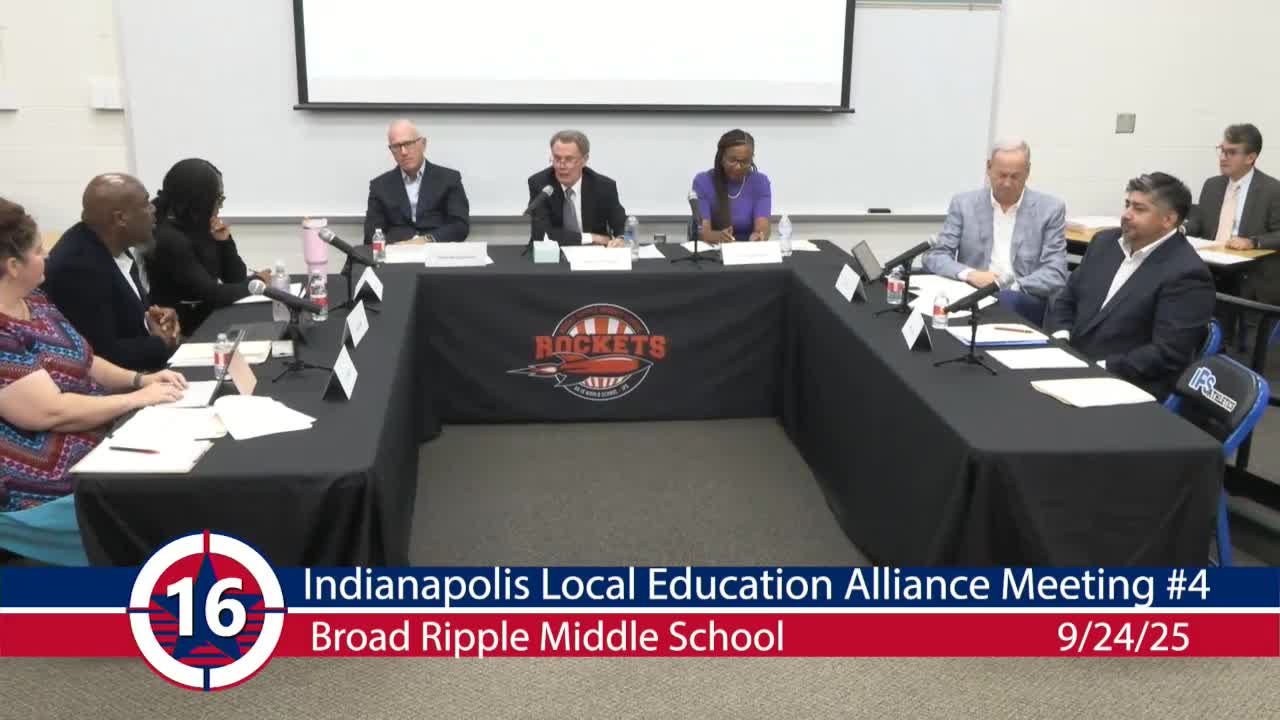
At its September meeting at Broad Ripple Middle School, the Indianapolis Local Education Alliance heard a detailed briefing on school transportation from Indianapolis Public Schools and charter-school leaders, followed by more than an hour of public comment that split along lines of control, equity and funding.
Indianapolis Public Schools deputy superintendent Andrew Stokes gave an overview of how the district delivers transportation, the program’s cost drivers and steps taken to reduce expenses while preserving access. "Transportation is a major equity lever," Stokes said, adding that IPS spends "about $40,000,000 a year" on contracted yellow-bus service. He said the system’s all-in cost per transported student is roughly $2,300 and that the district’s contract with First Student includes an escalator projected to raise yellow-bus costs about 4 percent for 2025–26.
The presentation described several core elements of how IPS assigns service. Eligibility is tied to a student’s home address and an enrollment zone introduced under the district’s Rebuilding Stronger initiative; walk zones vary by grade level, and high-school students may use public transit when a trip is under roughly 50 minutes and requires no transfers via IndyGo. Stokes said IPS reduced its daily routes through optimization from roughly 400 to about 280 and estimated the enrollment-zone redesign produced about an $8 million reduction in transportation expenses last year.
Charter leaders who spoke on the panel said the cost and logistics of providing busing limit what they can offer. Alicia Hervey, founder and executive director of the PATH School (a K–8 innovation school operating with IPS partnership), said PATH pays about $22,000 per month for district-provided buses this year and that in earlier years the school paid nothing because IPS covered summer and other transportation costs. "From an innovation partner perspective, the partnership we have with IPS around transportation is absolutely second to none," Hervey said.
Tommy Reddix, school leader for Paramount Schools, described operating a hybrid transportation model and provided per-bus and per-site figures to show the fiscal pressure on charter operators. Reddix said bussing at one large campus costs his organization more than $600,000 a year — roughly 12 percent of that campus’s annual revenue — and cautioned that opening a school without a transportation plan often reflects limited start-up resources rather than a policy choice.
Victory College Preparatory, Oaks Academy and other independent charter operators described the mechanics they use: fixed satellite stops, targeted routing to limit stop-to-family distance, and intensive staff time to process transfers and maintain routes. A Victory College Preparatory representative told the alliance that a citywide consolidated system could imperil families who currently ride charter-run routes from outside IPS’s boundaries.
Panelists and district staff stressed limits in the local vendor market and driver shortages. Petra Taylor, IPS director of transportation, and Zach Hall, executive director of operations strategies for ITS, both described ongoing optimization work and the practical constraints of routing software paired with manual validation. "There’s no silver bullet in this space," said a panelist describing routing technology and on-the-ground limits.
The alliance’s consultant, Michael O’Connor, said the body will form two task forces — facilities and transportation — to develop options the full alliance will consider. "The work product of each task force will be to produce a series or set of options for the broader ILEA to consider," O’Connor said. He said task-force meetings will be scheduled in October, will not be public, and that joint, public presentations of options are planned for early November, with a final report due to the legislature by Dec. 31.
Public comment emphasized two competing priorities. Many parents and IPS supporters urged the alliance to keep student transportation under the authority of the democratically elected IPS school board and to preserve the district’s rebuilding-stronger framework, arguing that local accountability and existing investments make IPS best positioned to manage complex routing, special-education and McKinney-Vento (homeless) transportation responsibilities. "The IPS school board, with this democratically elected and publicly accountable board, has already demonstrated that they have the tools in place to make improvements to our transportation system," said Angela Lee, a parent.
Other commenters and several charter representatives pressed for citywide collaboration, pilot programs or shared services to expand bus access to more students regardless of school type. Speakers in favor of a pilot cited participation from more than 50 schools and urged the alliance to include that pilot in its recommendations.
Speakers repeatedly flagged special populations and program constraints: Stokes and others noted that IPS serves nearly 900 students under the McKinney-Vento Homeless Assistance Act and provides door‑to‑door service when required by an Individualized Education Program. Panelists emphasized the additional staffing and equipment costs tied to special-education transportation.
The meeting did not produce a final policy decision but produced clear next steps: the Alliance assigned members to the two task forces and directed staff to schedule committee meetings in October, with public joint sessions on task-force outcomes planned for early November. The ILEA will take public comment and deliberate on options before transmitting recommendations to the Indiana General Assembly by the statutory Dec. 31 deadline.
Next public meeting: 6 p.m. Wednesday, Oct. 22 (location and details to be posted on the ILEA website).