Get Full Government Meeting Transcripts, Videos, & Alerts Forever!
Get email alerts on the Taxes topic
No spam. Unsubscribe anytime.
Michigan canvassers deadlock on Invest in My Kids summary, approve petition form
Summary
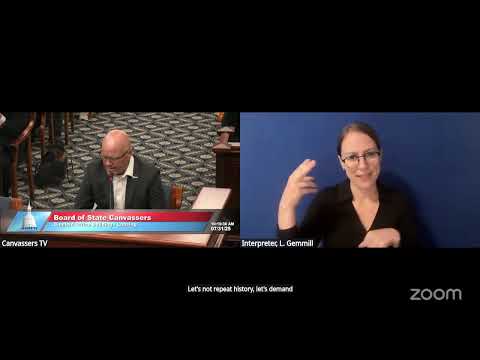
The Michigan Board of State Canvassers on July 31 failed to approve the director of elections’ 100‑word summary for the Invest in My Kids constitutional amendment but approved the petition form and updated petition manuals.
The Michigan Board of State Canvassers on July 31 failed to approve the director of elections’ proposed 100‑word summary for the Invest in My Kids constitutional amendment to impose an additional surcharge on high earners, but the board voted to approve the petition form and updated guidance manuals for petition sponsors.
The board deadlocked 2–2 on a motion to adopt language that would have described the proposal as “an additional 5% tax on annual taxable income over $1,000,000 for joint filers and over $500,000 for single filers,” with votes recorded as Vice Chair Gurewitz — yes; Member Cummings — yes; Member Cortes — no; Chair Hauskamp — no. The motion failed, prompting further debate and a later vote to approve the petition form itself as to layout and required elements.
Why it matters: public speakers, business groups and legislators asked the board to make clearer in any summary that the surcharge would apply to income reported on individual returns — a filing method commonly used by many small and family businesses — and to state how the new revenue would be treated and allocated. Supporters of the petition say the wording proposed by the director fairly describes the amendment and complies with the election‑law standard for a “true and impartial” summary.
What commenters told the board: More than two dozen members of the public and business organizations spoke in a lengthy public‑comment period. Kelly Saunders, vice president of policy and engagement at the Small Business Association of Michigan, told the board “simply put, this initiative is a small business tax” and asked that the summary explicitly note that small‑business earnings reported on individual returns could be affected. Amanda Fisher, Michigan state director for the National Federation of Independent Business, said, “By not including the impact on small businesses, the current language is misleading and somewhat deceptive.”
Other speakers pressed different points. Representatives of chambers of commerce and manufacturing groups urged specificity, warning the public that the proposal would create a new high‑rate burden. Proponents and backers countered that the text in the petition would restrict how the revenue may be used. State Representative Regina Weiss, who previously chaired K–12 budget work in the Legislature, told canvassers that the amendment’s text would require that revenue be deposited into the state School Aid Fund and “must” be expended to support classrooms in local school districts.
Director of Elections and legal counsel: Department of State staff and outside counsel briefed the board about the legal standard the board must apply when considering a director‑prepared summary. Counsel for the director argued the board’s role is limited under Michigan law and appellate precedent: if the director’s summary meets the statutory test — 100 words or less and a true, impartial statement written in common everyday words — the board should approve it rather than rewrite it to incorporate opponents’ arguments or speculative consequences.
Board action on form and manuals: After extended discussion, the board approved by voice vote updated staff guidance and petition manuals and then approved the petition “as to form” (layout, required elements and filing form) so the Invest in My Kids petition may be circulated. Those approvals passed by voice votes; the record shows the manuals and form motions carried.
What the board did not decide: The board stopped short of changing the summary language to include the specific phrases requested by some opponents — for example, a reference to a combined top rate or explicit mention of “small businesses.” The board also did not impose penalties or other sanctions related to earlier staff investigations of petition‑gathering practices during the meeting; staff reported on a separate canvass investigation but no board action to fine or disqualify sponsors was taken.
Looking ahead: The board’s failure to reach agreement on the text of the 100‑word summary means petition circulators can still gather signatures using the approved form; the petition summary that actually appears on circulated sheets will be the director’s version unless the board returns with a new majority showing. Board members and staff said they will consider procedural changes and enforcement guidance in future meetings to address concerns raised in public comment about signature collection and circulator affidavits.
Votes at a glance - Motion to approve director’s 100‑word summary for Invest in My Kids — FAILED (2–2). Recorded roll call: Vice Chair Gurewitz (yes), Member Cummings (yes), Member Cortes (no), Chair Hauskamp (no). - Motion to approve petition “as to form” (layout and required elements) for Invest in My Kids — PASSED (voice vote); board directed staff to allow petition circulation with the approved form. - Motion to approve updated petition manuals and staff procedures for statewide initiative and partisan nominating petitions — PASSED (voice votes); manuals will be used for petitions submitted after the meeting.
Ending: The board recessed for further deliberations on procedural improvements and sign‑gatherer enforcement procedures; staff will return to the board with revised manuals and any recommended process changes at a later date.