Get Full Government Meeting Transcripts, Videos, & Alerts Forever!
Get email alerts on the Assessment Literacy Interim Vs MAP topic
No spam. Unsubscribe anytime.
Parent presenter urges district to favor state interim assessments over MAPs and promotes assessment‑literacy workshop
Summary
A parent speaker urged the committee to use state interim assessments rather than MAP norm‑referenced tests and promoted an upcoming Teaching with Purpose conference workshop on assessment literacy.
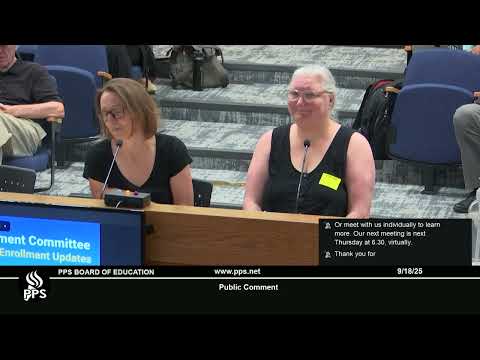
A parent and longtime district volunteer urged the committee Sept. 18 to favor the state’s interim assessments over the MAP norm‑referenced test when seeking an aligned measure of how students will perform on Oregon’s statewide exam.
Karanja Cruz, a parent and community member, told the committee that her experience as a parent and involvement with district assessment practices led her to conclude the Measures of Academic Progress (MAP) assessment is not the best interim predictor for the state test because MAP is norm‑referenced while the state interim assessment an educator she cited described is criterion‑referenced (a multi‑tier assessment). "It's like comparing apples and oranges," Cruz said, arguing a statewide interim aligned with the state test would provide a better snapshot of expected performance.
Cruz encouraged district staff and board members to attend a Teaching with Purpose conference assessment‑literacy workshop led by a state director of assessment and to consider the state‑provided interim assessment, which she said is free to districts. She also said classroom‑level formative practices — such as communicating daily learning targets — provide meaningful evidence of student learning alongside standardized measures.
District staff said they were able to receive Cruz’s materials for the public record and noted Dr. Armstrong was the conference keynote; committee members thanked Cruz and said they would consider the suggestions as the district implements new assessment requirements under state law.
Cruz provided a conference website — teachingwithpurposeconference.com — and said the workshop will be offered in fall and again as a follow‑up in April.