Get Full Government Meeting Transcripts, Videos, & Alerts Forever!
Get email alerts on the Home Repair Consolidation topic
No spam. Unsubscribe anytime.
Wake County proposes single $35,000 'Resilient Homes' grant to replace three rehab programs and remove loan barriers
Summary
Wake County staff proposed consolidating three home‑repair programs into a single Resilient Homes grant of up to $35,000 for homeowners at or below 50% AMI to reduce barriers created by a prior $90,000 loan product.
Morgan (Wake County housing staff) presented a proposal to combine three separate home‑repair programs into a single grant program called Resilient Homes.
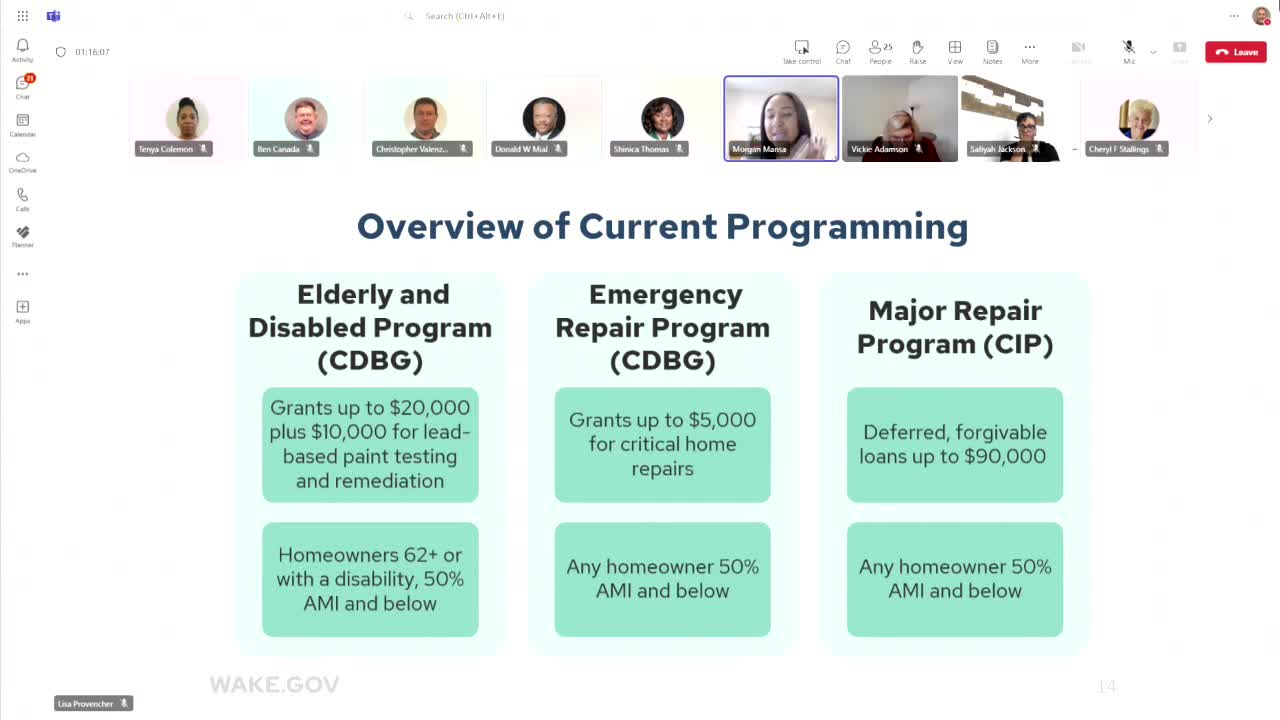
Under the current structure, Wake County operates an elderly and disabled program (grants up to $20,000), an emergency repair program (grants up to $5,000) and a major repair program that used a $90,000 forgivable loan for households at 50% AMI and below. Staff said the loan product has created barriers: from August 2024 to date, 19 households eligible for the major repair product declined to participate after learning it involved a loan; 14 otherwise eligible households were excluded due to credit score requirements; and nearly half of executed title searches revealed title issues that blocked assistance.
To address those barriers, staff proposed consolidating the three programs into one single grant of up to $35,000 for households at 50% AMI and below, with a required mission‑driven nonprofit partner to do intake, scopes of work and project management. Morgan said the $35,000 cap was chosen to preserve a grant (rather than loan) classification under North Carolina rules staff cited, while allowing meaningful repairs — for example, roof, HVAC, accessibility work and energy efficiency measures.
“We found that asking lower‑income households to take on a $90,000 loan has become a barrier,” Morgan said. “Moving to a $35,000 grant will make the program more accessible while still enabling deep repairs.”
Key program features presented: - One application and simplified intake (staff plan to use the Neighborly web system for online applications and keep a phone intake option). - Grants up to $35,000 for homeowners at 50% AMI and below; expedited access for households with disabilities per federal requirements. - A requirement that the county select a mission‑driven nonprofit partner through an RFP; the partner would help leverage philanthropic and state weatherization funds to stretch county dollars. - Continued health/safety and accessibility work, with added emphasis on energy efficiency and hazard testing (lead, mold, asbestos) and remediation when needed.
Funding: staff said existing program funding — approximately $1,850,000 annually from a mix of county and CDBG funds — is sufficient to launch the grant model without a county funding increase. Morgan estimated the consolidated grant model would allow the county to serve about 10 more households per year than the previous structure, not counting additional leverage the nonprofit partner could bring.
Commissioners and staff discussed leveraging donations and volunteer capacity (faith groups, business partners) to expand the pot. Morgan said the county has received inquiries from employees and external partners interested in contributing and will consult legal counsel about mechanisms for accepting private contributions.
Next steps: staff will solicit stakeholder feedback this fall, refine the proposal, issue an RFP in early 2026, and aim to select a nonprofit partner by March so a contract can be in place at the start of the next fiscal year. If implemented, staff plan a marketing and outreach campaign to increase awareness, especially among historically underserved groups.