Get Full Government Meeting Transcripts, Videos, & Alerts Forever!
Get email alerts on the Affordable Housing Development topic
No spam. Unsubscribe anytime.
Wake County says 5,449 affordable units created or preserved since 2019; pipeline large as federal funding remains uncertain
Summary
County housing staff told the Affordable Housing Committee the department has exceeded its strategic goals since 2019, with thousands of units in construction and pre‑construction. Officials said demand for gap financing far exceeds available local funds and noted uncertainty in federal grants and policy that could affect future production.
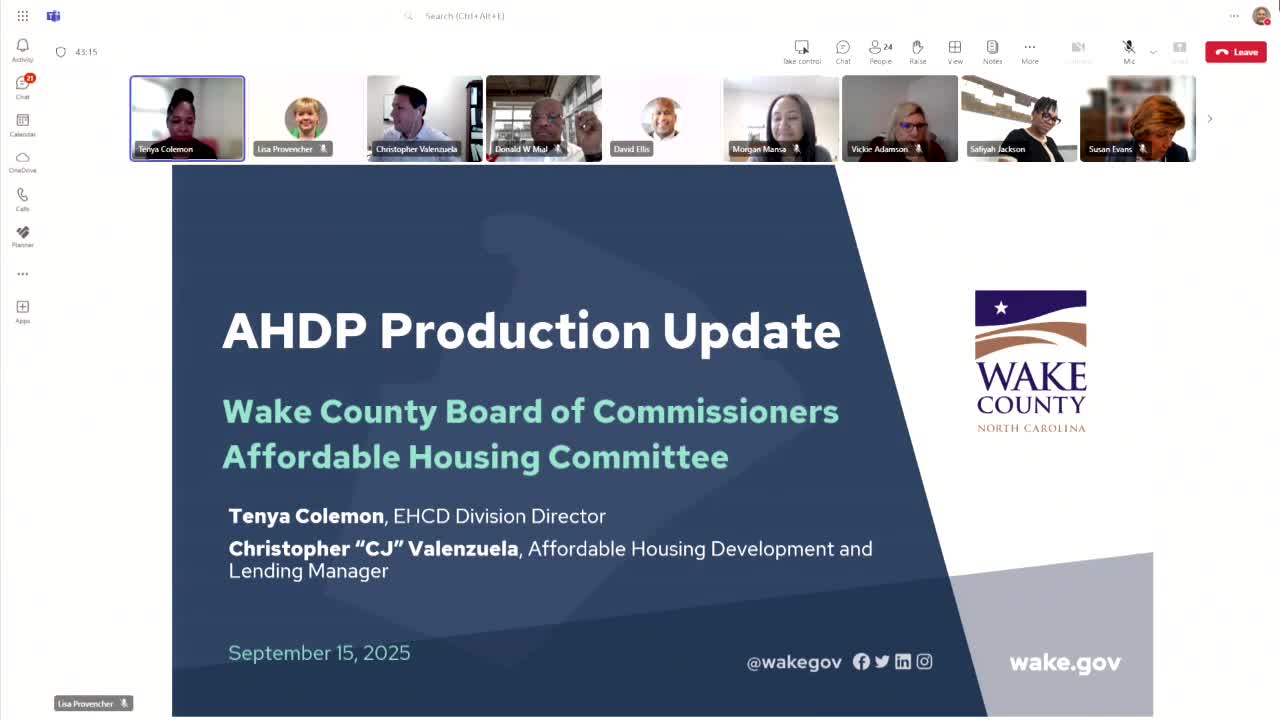
CJ Valenzuela, Wake County affordable housing development lending manager, told the Affordable Housing Committee that the county’s reimagined Affordable Housing Development Program has created and preserved 5,449 affordable housing units since 2019, exceeding the strategic goal set by the board.
The county’s rental portfolio includes 5,220 active units, 1,468 units under construction (1,168 expected within 12 months) and 1,704 units in preconstruction (1,099 scheduled to start by Q1 2026). CJ said 225 units have been preserved through the Wake County Affordable Preservation Fund’s acquisition bridge product. He told commissioners the department received more requests for gap financing than it could fund: in the most recent 2025 cycle the county funded 644 units while receiving more than 20 applications asking to finance more than 2,000 units and requesting over $40 million.
“Since the launch of our reimagined affordable housing development program in 2019 ... the housing department has created and preserved a total of 5,449 units,” CJ said. “Demand for our gap financing has increased every year.”
Why it matters: County staff and commissioners said the production numbers show that local investment has markedly increased affordable housing supply in recent years, but they cautioned that continued production depends on several external factors — especially federal funding and tax‑credit availability.
Tanya Coleman, the county’s new EHCD (Equitable Housing and Community Development) division director, presented recent and upcoming projects as examples of the county’s investments. She said Wake County invested $3.6 million in Trewelon Place, a 200‑unit project in Raleigh that reached final certificate of occupancy in May 2025. The county invested $760,000 in Hope Village at Method, a nine‑unit development targeted to youth aging out of foster care, and is supporting Newborn Crossing, a 195‑unit Raleigh project that includes 40 project‑based rental assistance units and is expected to reach final occupancy in December 2025. Rose Park Manor, an 81‑unit senior development serving households at 30%, 50% and 60% of AMI, was also showcased.
Morgan (county staff) gave AMI context for Wake County: the area median income for a one‑person household is just above $92,000; 60% AMI for a single‑person household is roughly $55,000. Morgan and other staff emphasized the county’s aim to prioritize projects that serve households at 60% of AMI and below.
Commissioners questioned how stable project budgets are after volatility during the pandemic and inflationary period. CJ and Tanya said some construction cost uncertainty has eased but newer policy changes — for example, Build America, Buy America rules — and the loss of one‑time funds such as ARPA (American Rescue Plan Act) and ERA (Emergency Rental Assistance) make underwriting more complex. CJ noted the department uses robust underwriting and often partners with municipal programs, which can reduce the need for repeated supplemental requests by developers.
Commissioners asked about federal support for Low Income Housing Tax Credits and other federal programs. Morgan said the county is monitoring federal appropriations closely and working with the Ferguson Group (federal lobbyists). Ben (county speaker) and Morgan said recent federal tax legislation left the LIHTC program in place for now, but staff asked the board to remain engaged at both federal and state levels.
Staff said the county has fully committed its ARPA and ERA funds and is evaluating other federal grant opportunities. Wake County is soliciting an administrative partner for an Opportunity Fund aimed at acquisition and gap financing in areas of economic opportunity. The county also plans an RFP for a Municipal Impact Fund to help smaller towns develop local housing plans and technical capacity; staff said those dollars would come from existing budgeted CIP/CFPP funding that the county intends to repurpose to support municipal technical assistance.
Votes at this meeting: The committee approved the minutes of the May 5, 2025 meeting by voice vote. The official record does not include a roll‑call tally; the motion was seconded by Commissioner Susan Evans and the minutes were approved as presented.
What’s next: Staff said they expect continued high demand for FY26 funding and plan to issue an RFP early in the next fiscal cycle for development financing and for the administrative partner for the Opportunity Fund. They will continue to monitor federal funding developments and report back to commissioners.