Get Full Government Meeting Transcripts, Videos, & Alerts Forever!
Get email alerts on the Zoning Code Update topic
No spam. Unsubscribe anytime.
Village of Jackson launches 14-month zoning code rewrite; emphasis on conditional uses, setbacks and housing variety
Summary
Consultants for the Village of Jackson presented a 14-month schedule and a policy menu of options for a comprehensive zoning code update at a joint special session of the Village Board and Plan Commission on Aug. 21.
Consultants for the Village of Jackson presented a 14-month schedule and a policy menu of options for a comprehensive zoning code update at a joint special session of the Village Board and Plan Commission on Aug. 21.
Tim Schwecky of Civitec Consulting told the meeting the project timeline includes a scoping and drafting phase, roughly eight months of drafting, followed by public review, an open house and formal hearings; the consultants said they will remain available for interpretation questions after adoption. “This is kind of our first meeting with the Village,” Schwecky said, adding the team has already completed a public participation plan and interviewed eight local developers, architects and builders as part of early outreach.
The consultants described “stress testing” the draft code — applying new rules to selected real parcels to check setbacks, lot sizes and other metrics — plus an online survey and one or more open houses before public hearings. They said the draft will be provided to staff and reviewed in pieces rather than as a single final document.
Why it matters: the village’s basic zoning dates largely to the 1970s with only piecemeal amendments since then, and the consultants said changes in state law (referenced generally as state statute updates including Act 67) make an update important for legal consistency and administrative clarity.
Key project elements and policy choices
- Scope and timeline: Consultants said the formal public-facing work on the code will run about 14 months, with roughly eight months of drafting and follow-up support after adoption. The project has 17 listed tasks, and the team expects to return draft sections to the planning commission and board for review as they are completed.
- Outreach and review: The team has completed targeted “listening sessions” with developers and plans an online survey and open house(s) to gather resident feedback ahead of formal public hearings. Schwecky said the consultants will re-engage the development community when specific questions arise during drafting.
- Conditional uses and Act 67: Consultants emphasized reviewing the village’s conditional-use process and aligning permit conditions with the evidentiary standards required under recent state law. Craig Heebner of Grama said some municipalities are moving to permit more uses by right and reserving a smaller set for conditional review; others eliminate conditional uses entirely. “There needs to be proof and evidence” for conditions tied to conditional uses, Heebner said, referencing state statute changes.
- Approval structure and ministerial reform: The presentation asked whether some approvals now routed to the plan commission or board could be delegated to staff when clear standards exist, to streamline the process for routine proposals.
- Housing variety and lot standards: Consultants introduced options to reduce exclusionary zoning by allowing a broader range of housing types within districts (for example, duplexes or townhomes in areas now limited to single-family) and by adjusting minimum lot and dwelling sizes and setbacks to enable more diverse, potentially more affordable housing forms. Several board and commission members discussed local preferences and tradeoffs: some attendees favored preserving larger lots in established neighborhoods, while others supported enabling smaller-lot development in targeted areas. Concerns were raised about stormwater, infrastructure costs and neighborhood character if lot sizes and side-yard setbacks are reduced.
- Accessory dwelling units and mixed use: The consultants described accessory dwelling units (ADUs) — carriage houses, basement units, garage apartments — as an option though they reported limited local demand from initial stakeholder interviews. They also described mixed-use options (ground-floor commercial with residential above), noting these are often most appropriate in traditional downtown or major-corridor settings.
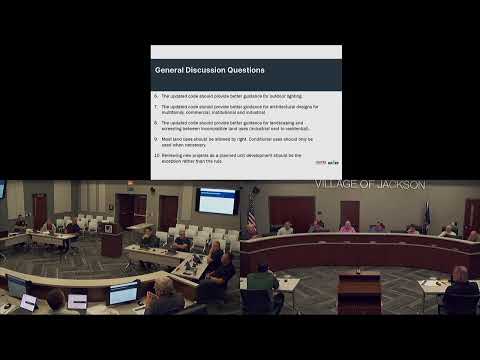
- Parking, signage, landscaping and design standards: The team recommended “right-sizing” parking minimums and, where appropriate, adding parking maximums to reduce large surface lots. They also flagged gaps in the village code on signage, outdoor lighting, architectural design and detailed landscaping/ buffering requirements and suggested the update include clearer, enforceable standards rather than leaving those matters highly discretionary.
- Planned Unit Developments (PUDs): Multiple participants said extensive use of PUD zoning over time has created ambiguity about the enforceable standards for some neighborhoods. Staff and board members described difficulty determining setbacks and other zoning details in properties governed primarily by older PUD approvals and development agreements; consultants said the update should offer clearer standards and reduce reliance on ad hoc PUD practices.
Public and board comments
Board and commission members asked about transition rules for permit applications submitted near adoption of a new code; Schwecky said the village can consider allowing applicants who submit shortly before adoption to opt into the new rules if that will not conflict with the village’s process. Attendees debated whether smaller lots and reduced side-yard setbacks fit the village’s character; several said such changes could be limited to higher-density or explicitly planned areas while preserving larger lots in traditional neighborhoods.
Infrastructure and stormwater were raised repeatedly as practical constraints: one participant noted tighter side yards reduce space for runoff and increase costs for stormwater infrastructure, which can shift long-term maintenance responsibilities to the village.
Next steps
Consultants said they will deliver a summary of listening-session findings, continue drafting code sections, and return draft language to staff and the planning commission. The scheduled sequence remains commission recommendation followed by final action by the Village Board.
Votes at a glance
- Motion to adjourn (final procedural motion): moved by Kripke, seconded by Emerick; voice vote taken and motion carried.
(For a description of formal actions recorded in the meeting, see the “actions” field in the article metadata.)
Ending
Consultants asked the commission and board for direction on which policy options to pursue; staff and board members requested sample redlines and targeted follow-up on conditional uses, buffering/landscaping standards and PUD clarity. The consultants said they will prepare draft code sections and public outreach materials, including an online survey and an open-house format, before returning materials for formal review.