Get Full Government Meeting Transcripts, Videos, & Alerts Forever!
Ketchikan Gateway Borough studies tax and revenue options to shore up local education fund amid Secure Rural Schools uncertainty
Summary
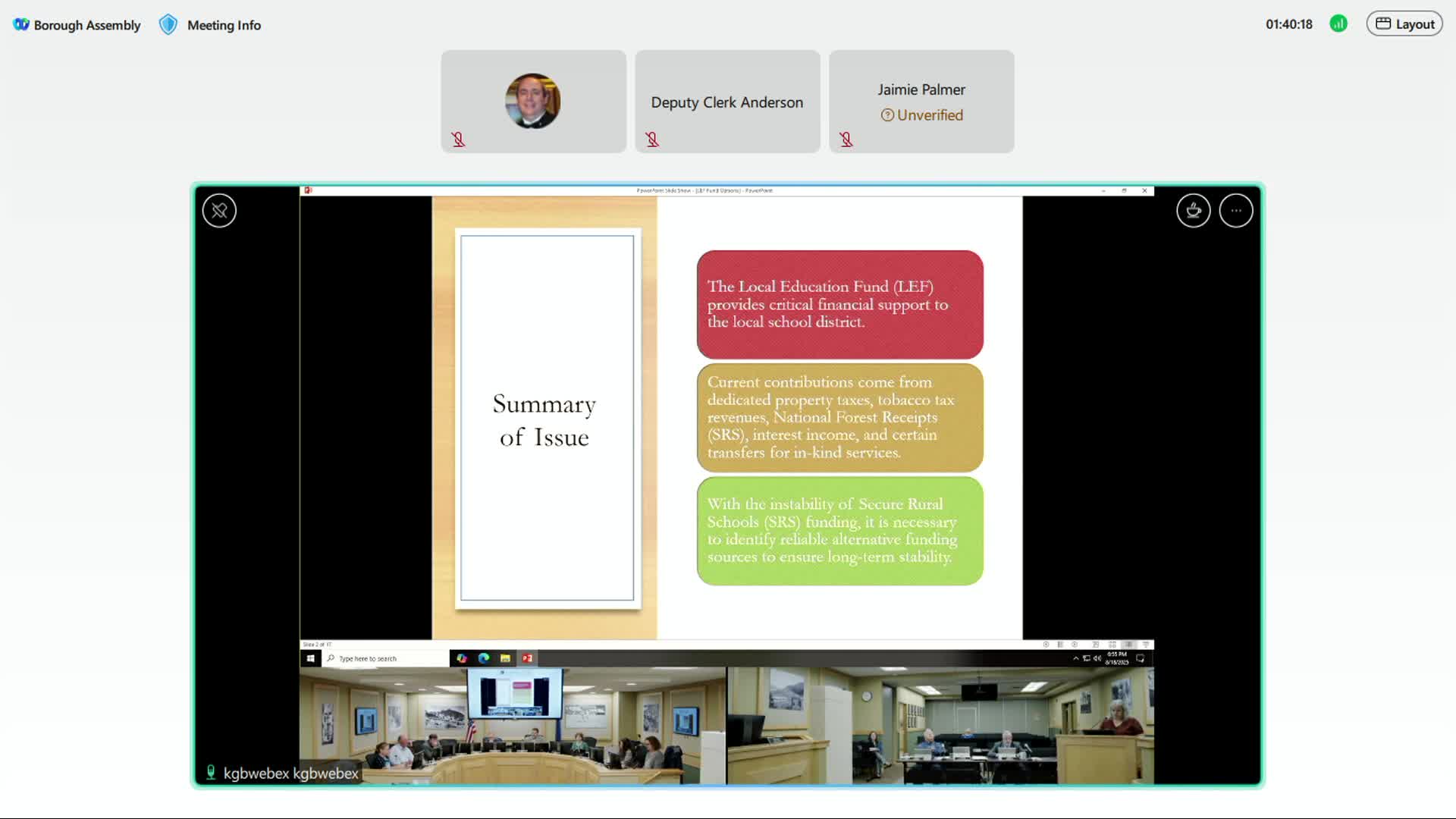
The Ketchikan Gateway Borough Assembly held a work session Aug. 18 to review options for replacing uncertain federal payments and to stabilize the Local Education Fund (LEF) that helps fund the Gateway School District.
The Ketchikan Gateway Borough Assembly held a work session Aug. 18 to review options for replacing uncertain federal payments and to stabilize the Local Education Fund (LEF) that helps fund the Gateway School District.
Finance Director Charlene Thomas told the assembly the presentation was prepared “in anticipation of the Secure Rural Schools funding either being drastically reduced or not being in existence at all,” and outlined a range of possible revenue sources and blends the borough could use to fill an estimated gap of about $1,000,000 a year.
The discussion matters because the LEF pays recurring costs for the Gateway School District including personnel and special-education services. Daniel Schuler, business manager for the Gateway School District, told the assembly the district will present an amended budget after the October count to reflect additional state education funding tied to a recent legislative override and to cover an identified net increase of three paraprofessional positions driven by special-education caseload changes.
Finance staff presented three classes of options: redirecting existing borough revenues (transient-occupancy tax, marijuana tax, remote-sales tax, or local/federal PILT); dedicating a portion of an existing tax stream (for example 10% of sales tax, estimated at about $914,800 annually); or creating new or increased taxes (a 0.25 percentage-point borough sales tax increase estimated to raise about $914,000, a 0.5-mill property tax increase estimated at $1,000,000, or raising the single-unit sales-tax cap from $2,000 to $4,000, estimated at about $1,140,000).
Thomas noted a number of scenario estimates: remote-seller sales tax receipts roughly $720,000 annually; transient occupancy redirection roughly $560,000; and marijuana tax receipts about $188,000. She also outlined blended approaches that would pull modest amounts from several sources rather than relying on one.
Assembly members and staff…
Already have an account? Log in
Subscribe to keep reading
Unlock the rest of this article — and every article on Citizen Portal.
- Unlimited articles
- AI-powered breakdowns of topics, speakers, decisions, and budgets
- Instant alerts when your location has a new meeting
- Follow topics and more locations
- 1,000 AI Insights / month, plus AI Chat