Get Full Government Meeting Transcripts, Videos, & Alerts Forever!
Get email alerts on the Education Funding topic
No spam. Unsubscribe anytime.
Ketchikan Gateway Borough studies tax and revenue options to shore up local education fund amid Secure Rural Schools uncertainty
Summary
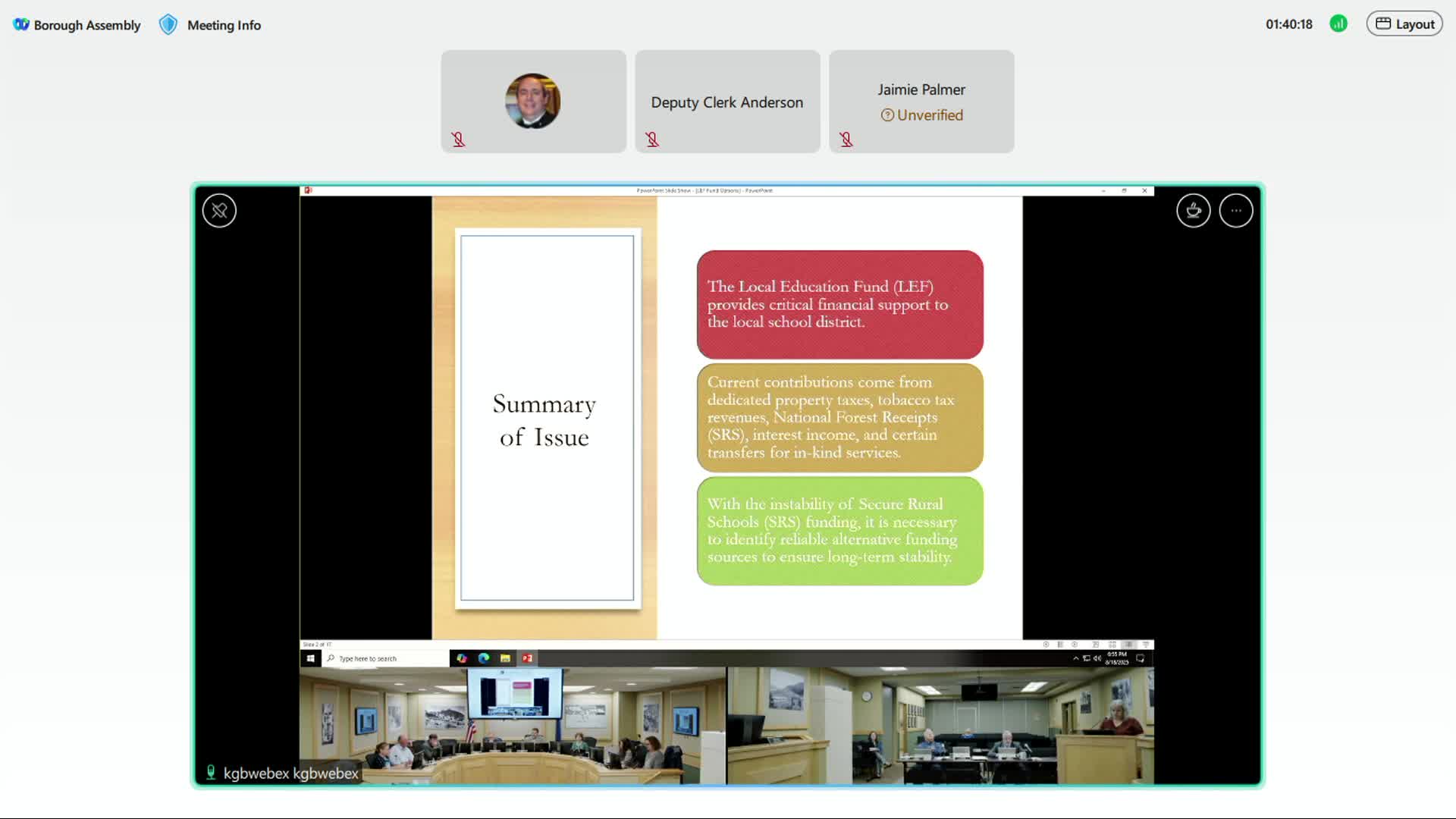
The Ketchikan Gateway Borough Assembly held a work session Aug. 18 to review options for replacing uncertain federal payments and to stabilize the Local Education Fund (LEF) that helps fund the Gateway School District.
The Ketchikan Gateway Borough Assembly held a work session Aug. 18 to review options for replacing uncertain federal payments and to stabilize the Local Education Fund (LEF) that helps fund the Gateway School District.
Finance Director Charlene Thomas told the assembly the presentation was prepared “in anticipation of the Secure Rural Schools funding either being drastically reduced or not being in existence at all,” and outlined a range of possible revenue sources and blends the borough could use to fill an estimated gap of about $1,000,000 a year.
The discussion matters because the LEF pays recurring costs for the Gateway School District including personnel and special-education services. Daniel Schuler, business manager for the Gateway School District, told the assembly the district will present an amended budget after the October count to reflect additional state education funding tied to a recent legislative override and to cover an identified net increase of three paraprofessional positions driven by special-education caseload changes.
Finance staff presented three classes of options: redirecting existing borough revenues (transient-occupancy tax, marijuana tax, remote-sales tax, or local/federal PILT); dedicating a portion of an existing tax stream (for example 10% of sales tax, estimated at about $914,800 annually); or creating new or increased taxes (a 0.25 percentage-point borough sales tax increase estimated to raise about $914,000, a 0.5-mill property tax increase estimated at $1,000,000, or raising the single-unit sales-tax cap from $2,000 to $4,000, estimated at about $1,140,000).
Thomas noted a number of scenario estimates: remote-seller sales tax receipts roughly $720,000 annually; transient occupancy redirection roughly $560,000; and marijuana tax receipts about $188,000. She also outlined blended approaches that would pull modest amounts from several sources rather than relying on one.
Assembly members and staff repeatedly emphasized trade-offs. Redirecting general-fund revenue would reduce the borough’s operating flexibility; creating new tax rates or a dedicated levy would likely require voter approval. Assemblymember Ron Thompson said the borough should keep planning now rather than wait for uncertain state actions, while Assemblymember Charlie Bailey urged the assembly also to pursue cost efficiencies in borough operating budgets before implementing new taxes.
The work session also flagged a rapidly developing state-level issue that could change the borough’s calculations. Officials who recently attended the Alaska Municipal League conference reported that the Alaska Department of Education and Early Development (DEED) is expected to publish guidance that would count some municipal in-kind contributions and certain capital expenditures toward the state’s “required local contribution” (the statutory local share used in foundation funding formulas). If DEED counts those items, it could reduce the amount the LEF must pay out of its discretionary pool — but it could also create volatile year-to-year funding results and prompt legal challenges, borough staff and the borough attorney said.
Schuler warned the assembly that the district is monitoring multiple moving parts: enrollment (average daily membership) estimates were about 1,917 for planning; the district reported it plans to bring an amended budget to the school board that will reflect additional state funding from a recent legislative override and the identified paraprofessional hires. Schuler also told the assembly the district expects typical year-end accruals, especially health-insurance claims incurred before June 30 and paid after; those accruals have historically been in the low hundreds of thousands of dollars and will be finalized in late September.
Managers noted available short-term options the assembly could consider while long-term structural choices are worked out. Borough staff said the assembly already has new, incremental revenues from recent actions (changes to transient-occupancy taxation and a small mill-rate raise) that lower the immediate shortfall; staff also signaled the borough has reserves that could be temporarily used while a permanent revenue plan is developed. The finance director recommended the assembly consider a target replacement of roughly $1,000,000 if Secure Rural Schools money does not return at historic levels.
Assemblymembers asked for more detailed scenarios showing: where specific general-fund service cuts would occur if revenue were redirected to LEF; the distributional effects of raising the single-unit sales-tax cap; and how proposed changes would affect resident versus visitor contributions (staff noted that increasing the cap would put more of the burden on high-ticket tourism retail, such as jewelry and curios). Several members asked staff to model blends of modest changes rather than a single large new tax.
After extended discussion, the assembly directed staff to return with more detailed proposals and scheduled follow-up: the assembly asked that the LEF-revenue item be brought back for discussion by the first regular assembly meeting in November, after the October enrollment and audit accruals are known.
Votes at a glance
Ordinance 20-82 — Allow mobile buildings as residences on construction sites, mobile-building restricted overlay (second reading) Motion: Adopt ordinance 20-82 (moved by Mr. Thompson; second Mr. Bailey). Vote: Arntzen yes; Bowling yes; Otis yes; Thompson aye; Bailey yes; Matson yes; Palmer yes. Outcome: approved.
Approval of claims — Claims totaling $3,973,398.60 Motion: Approve presented claims (moved by Mr. Thompson). Vote: Bailey yes; Matson yes; Palmer yes; Arntzen yes; Bowling yes; Otis yes; Thompson aye. Outcome: approved.
Resolution 31-43 — Joint resolution supporting federal funding for Substance Abuse Prevention and Drug-Free Communities grants (Ketchikan Wellness Coalition) Motion: Adopt joint resolution (moved by Ms. Arntzen; second Mr. Bailey). Vote: Bowling yes; Arntzen yes; Thompson aye; Bailey yes; Matson yes; Palmer yes; Otis abstained (declared fiduciary conflict). Outcome: approved (6 yes, 1 abstention).
Resolution 03-115 — Establish sales tax holiday (Oct. 4, 2025) Motion: Adopt resolution (moved by Ms. Bowling; second Ms. Matson). Vote: Arntzen yes; Bailey yes; Bowling yes; Matson yes; Otis yes; Thompson no; Palmer yes. Outcome: approved (6 yes, 1 no).
Consent calendar (as amended) Motion: Approve consent calendar as amended (moved by Ms. Bowling; second Mr. Thompson). Vote: Matson yes; Palmer yes; Arntzen yes; Bowling yes; Otis yes; Thompson aye; Bailey yes. Outcome: approved.
What’s next
Staff will return with more granular revenue scenarios that show the budget line items that would be affected by redirection, the distributional impacts of sales-tax cap changes, and updated estimates tied to finalized enrollment and audit accruals in October. The assembly directed staff to revisit the LEF funding discussion by the first meeting in November so the body can consider short-term reserve options and possible long-term revenue proposals before the January policy session.
Sources and attributions
This article is based on presentations and remarks during the Ketchikan Gateway Borough Assembly meeting and work session on Aug. 18, 2025, including the finance director’s presentation on revenue options and the Gateway School District business manager’s update on funding, staffing and enrollment. Quotations and paraphrases come from attendees identified in the meeting transcript.
Ending
The assembly’s Nov. 2025 follow-up will determine whether the borough pursues modest blended revenue changes, a dedicated new levy, or a temporary transfer from reserves — decisions that will shape how the borough balances school support, general fund services and tax burdens on residents and visitors.