Get Full Government Meeting Transcripts, Videos, & Alerts Forever!
Get email alerts on the Emergency Communications topic
No spam. Unsubscribe anytime.
Skagit County Public Health outlines emergency communications plan to speed public alerts
Summary
Skagit County Public Health presented a recently approved emergency communications plan to the Board of Health on Aug. 19, 2025, describing how the county will use CDC and Washington State guidance, a toolkit of canned messaging, and a secure alerting platform to improve timeliness and clarity of messages during public-health incidents.
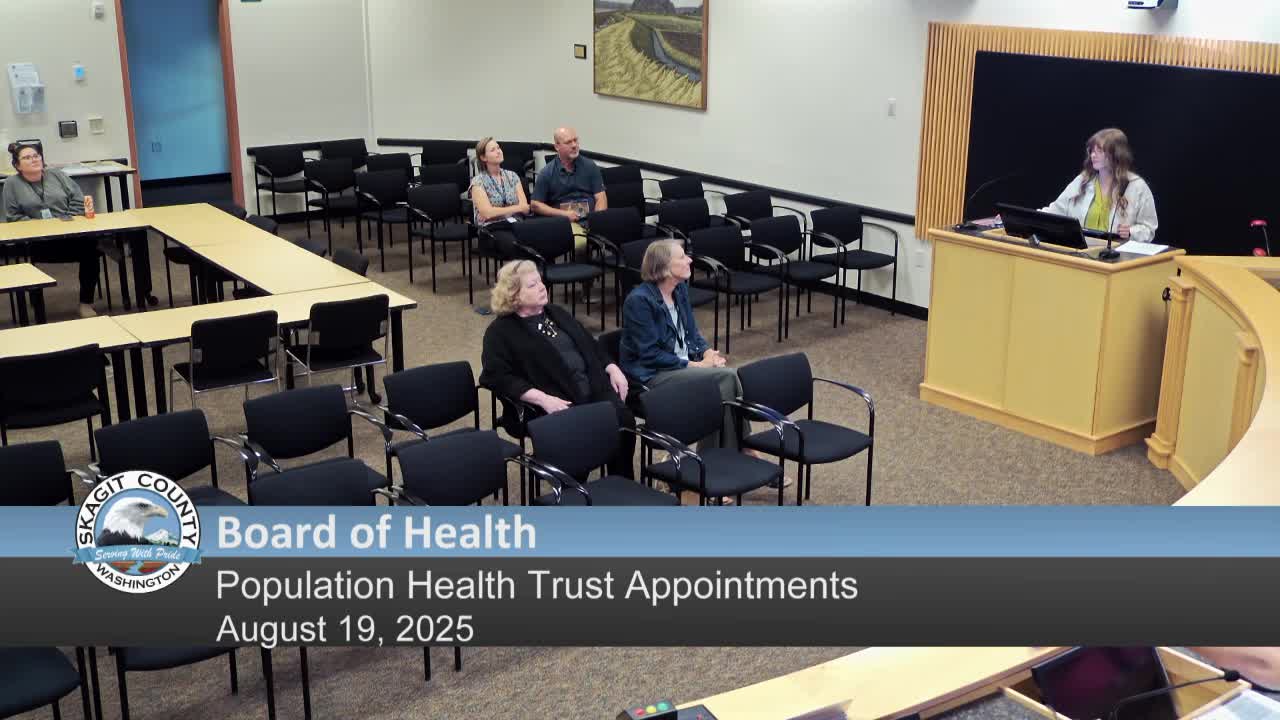
Carson Hansen, emergency response coordinator for Skagit County Public Health, presented a recently approved emergency communications plan to the Skagit County Board of Health at its Aug. 19 meeting. The plan is intended to streamline how the department communicates before, during and after public-health incidents such as disease outbreaks, hazardous wildfire smoke or extreme heat.
Hansen said the county developed the plan in response to an increase in the frequency and complexity of public-health events and because communications is repeatedly identified as an area for improvement in after-action reports. "Information is really important," Hansen said. "People need to have information so they know first and foremost what is happening … and what they can do to better protect themselves."
The plan draws on the Centers for Disease Control and Washington State Department of Health guidance and condenses the most operationally useful material into a local document Hansen described as a roughly 20-page tool staff can use in an incident. It clarifies roles and responsibilities, lists contact information for partner organizations, and adds annexes for internal and external communications processes.
Board members questioned where other county departments fit into the plan's "internal" and "external" categories. Commissioner Janicki said she wanted a notification cadence that alerts county employees before the public release of a major hazard message. Hansen and Public Health Director Keith Higman confirmed the plan treats county employees outside public health as part of the external notification group for planning purposes, but Hagman and Hansen said priority levels in practice would ensure elected officials and county staff receive early notice. "There are priority levels of communication, and Andrea and I talk about that — all employees, whether directly or indirectly involved, are part of that primary level of communication," Higman said.
Hansen described several concrete improvements: an internal communications toolkit with plain-language templates and talking points, clarified administrator roles for the county's alerting platform (a local license of the Everbridge system referred to in the plan as the Washington Secure System), and a maintenance schedule that calls for review of the plan every other year. He said the county's license for the alerting platform is funded by the Washington State Department of Health and the plan documents who is responsible for maintaining lists such as funeral-home contacts and partner email rosters.
Next steps Hansen identified include creating a consolidated toolkit of canned messaging (press releases, infographics and FAQs) for common incidents and implementing regular plan reviews. Hansen said the plan was written so it could be handed to any trained staffer to operate in an incident: "I could hand it to anyone, and they would be able to figure out what to do from it."
Board members praised the plan as a step toward making county communications less dependent on individual staff members. The plan will be used operationally while staff develop the canned-messaging toolkit and schedule the biannual reviews called for in the maintenance section.
The presentation included discussion but no formal vote or ordinance. The board did not take further action at the meeting on adoption steps beyond the presentation and clarifications provided by staff.