Get Full Government Meeting Transcripts, Videos, & Alerts Forever!
Get email alerts on the Train Quiet Zone topic
No spam. Unsubscribe anytime.
San Mateo council leans toward double closures at Villa Terrace and East Bellevue to secure train "quiet zone"
Summary
San Mateo City Council members on Aug. 18 indicated support for closing the Villa Terrace and East Bellevue at‑grade crossings (Option B) as the preferred path to create a train "quiet zone," directing staff to pursue Section 130 grant funding and to use city funds to phase city right‑of‑way work so certification can occur while external funding is secured.
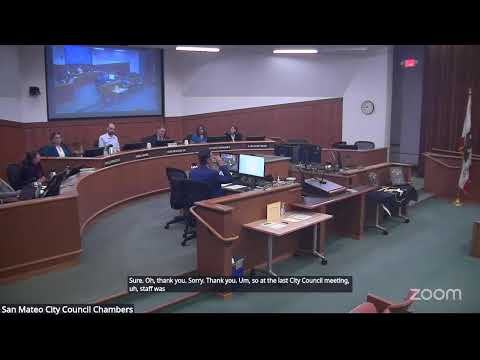
San Mateo City Council members on Monday heard a detailed staff update on efforts to create a train "quiet zone" through the city and expressed consensus support for a double‑closure plan affecting Villa Terrace and East Bellevue.
Engineered improvements under the recommended “Option B” would close the at‑grade crossings at Villa Terrace and East Bellevue and are intended to reduce the need for routine train horn sounding without eliminating horns for safety events. Jimmy Voe, engineering manager in Public Works, told the council the double‑closure option currently yields an estimated risk‑index level (the measure used by the Federal Railroad Administration to judge crossing safety) below the city’s target buffer in 2024 data but has risen along with increased Caltrain service; staff reported an increase in the index between July 2024 and August 2025 and said Option B remains the most feasible way to reach the required threshold while balancing schedule and cost.
The proposal and next steps
Voe said the city’s latest cost estimates are substantially higher than the amounts shown in prior presentations. Work that Caltrain now requires in its right‑of‑way — track‑adjacent concrete and asphalt removal, signal housing changes, and related rail improvements — pushed the double‑closure estimate toward roughly $3.6 million for construction and nearer $4.0 million when city staff time, design and construction management are included. Staff said the state’s Section 130 grade‑crossing safety program could fund about $1.8 million of work but that a funding gap of roughly $1.0–$1.5 million would remain; the city currently has about $1.23 million identified locally.
Voe outlined a phased approach staff would prefer if council directs it: complete the improvements that are wholly within the city right‑of‑way first (using the city’s local dollars) so the quiet zone can be certified, then complete remaining Caltrain‑right‑of‑way work later when outside grant funding (Section 130) or other sources are available.
Public safety, outreach and alternatives
Public safety staff reviewed response routes and said the proposed closures would not prevent fire or police access, Voe said. Staff also described a multi‑step outreach program (postcards, door hangers, a public meeting on Aug. 4 and an online survey) that produced roughly 250 survey responses. Among the alternatives tested, survey respondents and many in public comment favored Option B (double closures) or quad gates; few supported the median‑extension plan because it removes curb parking and limits driveway access.
Residents who addressed the council gave contrasting views. Chris Minerva (resident) urged quad gates and told the council: "Quads, anything, besides quads, anything else is shortsighted vision." Several residents and parents — including Peter Morgan and Mary Claire (homeowner) — emphasized safety concerns and cited suicides and close calls at Villa Terrace. Others, notably residents on Bellevue Avenue, warned that medians or closures would remove parking and create access challenges for families who rely on nearby curb parking; Kevin Zhao (Bellevue homeowner) said loss of parking would pose safety risks for family members returning home late.
Staff recommended Option B to council, both because it most reliably meets FRA risk thresholds under current traffic and train volumes and because it best matches community input overall. Council members asked for more traffic calming and parking mitigation work in nearby streets (complete‑street improvements for Peninsula and East Poplar were discussed, as were permit parking and other measures). Council members also asked staff to continue coordination with SamTrans and local school districts about bus routing and school drop‑off impacts.
Council direction and next steps
Council member Lisa Diaz Nash, among others, said the number of suicides reported by neighbors made safety the overriding concern. Council member Diaz Nash and others expressed support for pursuing Option B and securing Section 130 funding. Council member Fernandez recused herself from the item because she reported a real property interest near the crossings. Mayor Robert Newsome and several council members voiced support for the phased approach that allows the city to certify a quiet zone for parts of the corridor while seeking outside funds to complete Caltrain right‑of‑way work.
Staff will: - Continue applying for Section 130 (state) funds and pursue other grant opportunities; - Use local funds to phase and complete city right‑of‑way improvements to qualify for certification as soon as practicable; - Return to council with a detailed funding plan and implementation schedule (staff estimated a likely delivery window into 2026–2027 depending on Caltrain and grant schedules); - Continue expanded outreach and prepare traffic‑calming, parking and school‑drop‑off mitigation analyses for impacted blocks.
The council did not take a binding roll‑call vote on a final construction contract on Monday; instead it provided direction to staff and indicated a consensus preference for Option B and a phased funding approach. Staff repeatedly warned costs and required Caltrain work had increased since the project’s earlier estimates and said that delay would risk further cost escalation.