Get Full Government Meeting Transcripts, Videos, & Alerts Forever!
Get email alerts on the Dpw Budget topic
No spam. Unsubscribe anytime.
Indianapolis Department of Public Works unveils 2026 budget, $1.087B capital plan and staffing, equipment priorities
Summary
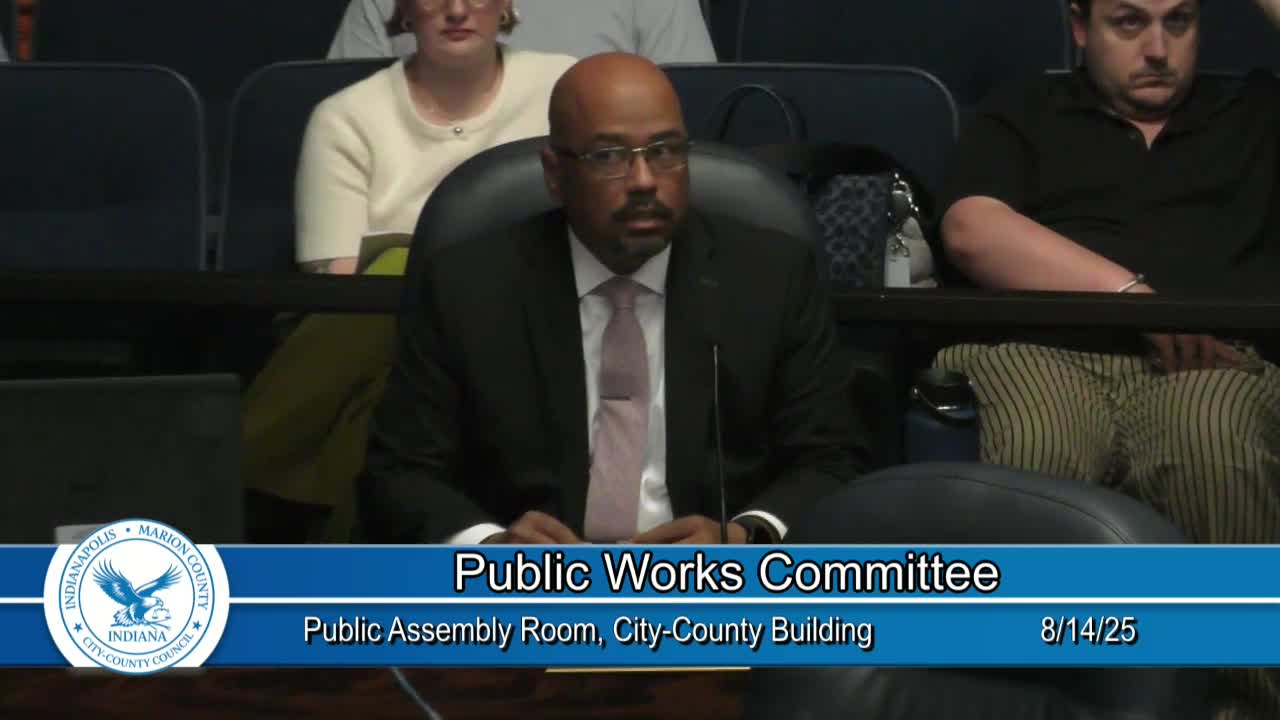
On Aug. 14, 2025, the Indianapolis Department of Public Works presented its 2026 operating budget and multi-year capital plan to the City-County Public Works Committee, outlining a $257.4 million operating budget and a roughly $1.087 billion transportation capital plan.
On Aug. 14, 2025, the Indianapolis Department of Public Works (DPW) presented its 2026 operating budget and a multi-year capital plan to the City-County Public Works Committee. Director Wilson and Sam Baras, DPW chief financial officer, reviewed revenue forecasts, staffing and operational priorities, planned equipment purchases and the department’s approach to a new state funding stream that would begin in 2027.
The introduced 2026 operating budget totals $257.4 million, a net increase of about $10.8 million versus the 2025 adopted budget, DPW staff said. The department described itself as a “dedicated fund agency” — meaning certain revenue sources are restricted by law or ordinance to specific funds and uses — and said available revenue growth constrained the operating increase to roughly $5.5 million in core funds (about $6.0 million when smaller sources are included). Chief revenue drivers discussed included MVH/LRS (gas-tax) distributions and departmental user fees such as the solid-waste user fee and the stormwater user fee.
Staff presented an updated transportation capital plan that totals approximately $1.087 billion over the plan period; that figure reflects the incorporation of a prospective state program that would provide $50 million a year to Indianapolis beginning in 2027, contingent on the city matching $50 million of new local revenue. Director Wilson said the department has begun planning how to use that new money and is preparing a capital program that emphasizes pavement preservation, targeted residential resurfacing, multimodal corridor work and other prioritized projects.
Staff highlighted several operating and programmatic elements in the introduced budget:
- Staffing and compensation: DPW reported ongoing impacts from a recently negotiated collective bargaining agreement (CBA). Staff said the department has about 810 budgeted positions and that fill rates have increased from the prior year; the introduced budget incorporates compensation adjustments stemming from the CBA and includes budgeting for attrition for the first time. DPW emphasized that some reallocations — not net new FTEs — were used to bolster functions such as trails maintenance and pavement-marking teams.
- Fleet and equipment: The operations equipment budget includes a $1.4 million recurring increase for equipment replacement and leases; staff said that will help accelerate replacement cycles for snow trucks, pavement-marking trucks and street-maintenance equipment. The committee was told the department ordered 14 one-ton snow trucks using $2 million from a spring supplemental allocation and expects those units for this winter season.
- Solid waste and recycling: DPW said it executed new contracts for residential collection, and the contract with LRS is projected to generate multi-year savings. The LRS contract begins transition work in 2026 and includes a universal curbside recycling rollout in 2028. DPW described a new solid-waste garage under construction, scheduled to open late 2025 or Q1 2026.
- Tax-drop events: The introduced budget adds $300,000 of ongoing funding to expand household hazardous-waste collection (the department called it the “tax drop” program), sufficient for roughly 12 additional events annually; the department also proposed one-time operations funding for setup costs for an East Side site to replace a site that recently went offline.
- Capital planning and data tools: DPW discussed use of DLT (decision optimization) software to prioritize pavement treatments using a data-driven algorithm that includes pavement condition index (PCI), traffic volumes, pothole complaints and crash data. Staff described a toolbox of treatments — from crack sealing and mill-and-overlay to micro-resurfacing, cape seal and chip-and-seal — and said they are evaluating alternative delivery methods (design-build, construction-manager-as-contractor, public–private partnerships) to accelerate delivery.
- Grants and federal funding: Sam Baras said the department’s most recent MPO funding round was its largest and that the city’s grant team has been more strategic in pre-scoring projects; staff cited a recent correction to Indianapolis’ population count in the state funding formula (Senate Bill 283) as affecting state distributions.
Committee members asked detailed follow-up questions about lane-mile outputs, the distribution of spending between thoroughfares and residential streets, engineering vacancies, residency requirements for city employees and the timing and scope of planned capital work. Nathan Sheets, deputy director of engineering, said staff can provide council members with output metrics (lane miles resurfaced, planned residential segments) and that project definitions sometimes span categories (trails, sidewalks and roadway work can overlap). Several councilors pressed for clearer mappings between revenue streams (one-time vs. ongoing) and the capital plan’s out-year projections.
On workforce issues, Director Wilson and staff said engineering positions are difficult to recruit; the department uses consultants and said some roles require specific municipal engineering experience. On residency rules, multiple councilors discussed whether removing the residency requirement would help recruitment; staff did not provide a quantified estimate but said greater hiring flexibility could be beneficial for hard-to-fill, specialized roles.
Vision Zero and community engagement: DPW noted the Vision Zero Task Force presented its action plan and that a public comment period ran July 1–31. Staff said Vision Zero consultants held pop-up events across nine townships and that public feedback will inform the action plan revisions and subsequent capital or policy choices.
The committee did not take a formal vote on the budget at this meeting; the session served as the departmental presentation and a question-and-answer period. DPW staff said they will return with more detailed breakouts and follow-up analyses at future briefings and that a winter-weather response plan will be presented to the Board of Works this fall.