
Housing commission forms subcommittee to revise flexible housing fund scoring and push RFP this fall
Get AI-powered insights, summaries, and transcripts
Sign Up Free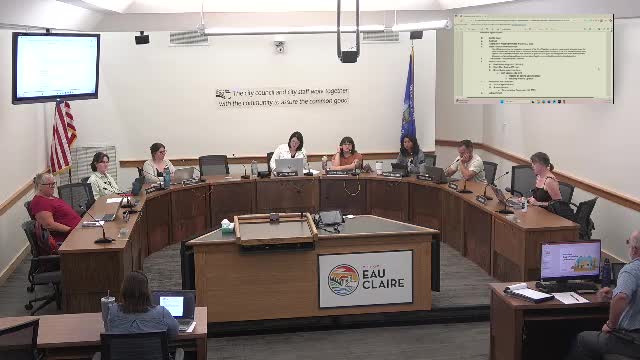
Summary
The Housing Opportunities Commission discussed use of $535,000 in flexible housing CIP (ARPA) funds, agreed the money must be used for capital expenditures, and voted to form a subcommittee to produce alternate scoring options for the commission to consider at its Sept. 10 meeting so a final recommendation can go to city council this fall.
The Housing Opportunities Commission met Aug. 13 and moved to create a subcommittee to revise the scoring matrix and recommend how to allocate the city’s flexible housing fund, a CIP account that currently shows a $535,000 balance.
The commission heard that the balance — referred to repeatedly by staff as $535,000 — is CIP money derived from ARPA and therefore must be used for capital expenditures tied to physical assets rather than for programmatic payments such as down-payment assistance. Staff also told commissioners the commission’s prior scoring matrix was based on the state LIHTC (Low-Income Housing Tax Credit) scoring system and may not fit rehab, scattered-site or non-LIHTC projects well.
Why it matters: commissioners said time is short to obligate or encumber the funds this year and that a clear, equitable scoring framework is needed so staff can release an RFP and encumber funds before the end of the calendar year if council approves. Several commissioners emphasized they did not want the award process to funnel all funding to a single, large developer or to favor a single project type.
Key details
- Fund balance and rules: Staff confirmed a balance of $535,000 in the flexible housing fund and said the account is part of the city’s capital improvement plan. As CIP funding, it must be tied to a physical asset; it cannot be used solely for intangible supports. Staff said some CIP carryover may be possible but not indefinite and recommended encumbering funds this calendar year where feasible.
- Scoring matrix background: The packet included the matrix used in the 2023 award round; staff said it followed LIHTC scoring closely (income targeting, mixed-income incentives, unit mix, supportive services, location and financial leverage), which makes the rubric strongly suited to LIHTC-style developments and less well suited to smaller rehab or scattered-site projects.
- Timeline and public process: Staff outlined the intended timeline: the commission’s recommendation would go to council after the commission approves criteria; council’s budget approval in November could finalize the 2026 CIP allocation (a tentative $250,000 was in the 2026 draft). If council approves a recommendation at the September meeting, staff said an RFP could be released quickly (the night council approves or the following day) so applicants could be evaluated before funds must be encumbered.
Commission action
- The commission voted to form a publicly noticed subcommittee to revise or propose options for the scoring matrix and bring recommendations back to the full commission at its Sept. 10 meeting for a commission vote and a subsequent council recommendation. The motion passed by voice vote; the commission did not record a roll-call tally in the transcript.
Discussion highlights and options considered
- Commissioners debated whether to keep the existing matrix, make targeted edits to better capture rehab and smaller projects, or create an entirely new rubric. Several members favored keeping the RFP flexible to attract a wider range of applicants, while others urged creating simplified application routes for smaller or nontraditional applicants (for example, community nonprofits or organizations that could manage multiple small-owner rehab projects).
- A staff suggestion discussed by commissioners: split the funding into tracks (for example, new construction vs. rehab, or rental vs. homeownership support) rather than awarding all funds to a single project. Staff noted splitting increases complexity but is feasible.
- Commissioners also discussed the practical advantage of inviting applicants to present proposals to the commission as part of the evaluation — an approach used in the prior round.
Next steps and follow-up
- The subcommittee (to be publicly noticed and include commissioners who volunteer) will produce two to three options (for example: keep the matrix, narrowly edit it, or a simplified alternative) and present them to the full commission on Sept. 10.
- If the commission approves a recommendation in September, staff intends to present it to the first available council agenda after that meeting with the goal of releasing an RFP promptly upon council approval.
- Staff and commissioners said any final award would require an executed contract obligating the recipient to deliver what they applied to do; staff described standard clawback provisions used in competitive awards.
Ending
Commissioners emphasized they would rather not rush a wholesale rewrite of the evaluation rubric but did want a publicly defended, equitable process and recommended the subcommittee produce options quickly so the commission can meet RFP and encumbrance deadlines this calendar year.