Get Full Government Meeting Transcripts, Videos, & Alerts Forever!
Get email alerts on the Small Donor Elections topic
No spam. Unsubscribe anytime.
Committee advances changes to Portland small-donor elections code after 2024 evaluation
Summary
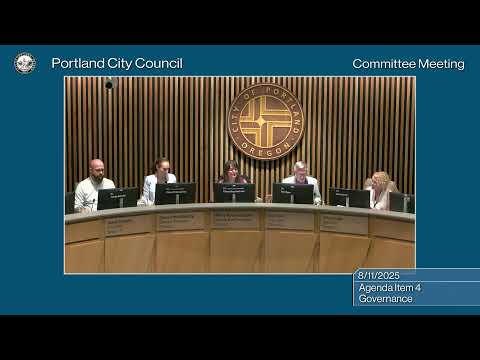
The Portland City Council Governance Committee voted Aug. 11 to send to the full council an ordinance amending the city's small donor elections code after a presentation by the Portland Elections Commission on the 2024 election cycle and the commission's recommended changes.
The Portland City Council Governance Committee voted Aug. 11 to send to the full council an ordinance amending the city's small donor elections code after a presentation by the Portland Elections Commission (PEC) on the 2024 election cycle and the commission's recommended changes.
The commission presented data showing a long-term shift in campaign financing toward smaller contributions and matching funds since the program's launch, while also reporting that underfunding in 2024 forced the PEC to reduce matching caps mid-cycle to avoid exhausting the match pool. Amy Sample Ward, chair of the Portland Elections Commission, told the committee the program's purpose is "to prevent corruption and the appearance of corruption caused by the real or imagined coercive influence of large financial contributions on candidates' positions and on their actions if elected to office."
The PEC recommended several changes described in its report and in the presentation to the committee. Top recommendations covered by the ordinance and accompanying staff work include: aligning the city program's election-cycle dates with recently adopted state campaign finance law; delegating certain changes to administrative rulemaking; reducing the auditor race match cap (the PEC proposed lowering the auditor cap from $100,000 to $50,000); clarifying how candidates who ran for another office during the same cycle (for example, school board) may later participate without penalty; and tightening how candidate-to-candidate and candidate-originated contributions are counted toward qualifying thresholds to discourage quid pro quo or exchanged-contribution arrangements.
The PEC told the committee that the program's recommended budget for the historic 2024 cycle was $4,000,000 but that previous underfunding left the program with ongoing allocations of about $1.3 million annually, a level the commission described as roughly 41% below what it calculates is necessary for reasonably sustainable operations. That underfunding, the PEC said, required reducing available matching funds for candidates during the 2024 cycle; recent one-time budget allocations restored some increases for upcoming cycles but left uncertainty about long-term, ongoing funding.
PEC deputy director Danita Harris and director Susan Mote answered detailed questions from committee members about mechanics of the program. Mote clarified how matching works: "The program always matched all the way up to the matchable amount even if it was given in, say, $5 increments. We just keep matching each $5 contribution until they hit the matchable amount." The commission said user surveys and campaign data continue to show the program has reduced reliance on large contributions and broadened the donor base, but also identified emerging problems in 2024, including reported quid pro quo exchanges between campaigns and third-party solicitation activity where paid organizations solicited small contributions and kept a fee.
PEC members emphasized limits on their authority: the commission can administer matching rules and recommend code or rule changes but cannot enforce or interpret state criminal inducement statutes. The PEC said it referred potential legal violations to the Oregon Secretary of State for review; that state-level investigation was still pending at the time of the committee meeting.
Committee members sought additional data before final council action on some items. Several councilors asked for more granular analysis of donor counts and the relationship between hitting program thresholds and electoral success (for example, how many donors candidates had at each qualification tier and how that correlated with votes). Councilor Ryan and others requested that the PEC provide this donor-count analysis and related charts to the committee before final action at council.
Committee members agreed to a two-step approach. The Governance Committee voted to forward the ordinance to full council with a "do pass" recommendation for the coding and clarifying changes the PEC described as necessary now, while explicitly asking PEC staff to return with supplemental analysis (including donor-count and threshold impact data and further discussion of third-party solicitation practices) before final council consideration. Vice Chair Ryan moved the ordinance; Councilor Pertelgine seconded. The clerk called the roll and the motion carried with an affirmative vote (see formal action below).
What the ordinance would change
- Align program dates with state campaign finance law so aggregate contributions are calculated on matching timelines consistent with state reporting, and change the deadline to return unspent funds to Dec. 31 following the election. - Delegate certain technical fixes and procedural decisions to administrative rulemaking, including a remedy for candidates who ran for overlapping offices within the same election cycle and clarity on whether contributions from participating candidates count toward qualification thresholds. - Reduce the auditor match cap (PEC proposed lowering the auditor cap from $100,000 to $50,000) so mid-cycle reductions, if needed, are felt more evenly across competitive races. - Clarify definitions and remove contradictory language introduced by earlier amendments so the code distinguishes matchable vs. allowable contributions and explains when matchable contributions may be collected.
Next steps and committee direction
The committee approved sending the ordinance to the full council with a due-pass recommendation and asked the PEC to supply additional charts and donor-count data used in the commission's internal review. Committee members requested the PEC return promptly with that supplemental material so the council could examine threshold mechanics (for example, how many distinct donors were counted toward a candidate's qualification tiers) before final council action. The Governance Committee's next meeting was scheduled for Monday, Sept. 8.
Why it matters
The small-donor matching program is designed to increase participation in city elections and reduce the influence of large donors by enabling candidates to run competitively on many small contributions amplified by public matching funds. The PEC's 2024 evaluation shows the program shifting funding sources toward small donors and matching funds but also shows how insufficient and uncertain funding can force mid-cycle adjustments that affect campaigns and public confidence. The committee's two-step approach aims to preserve immediate clarifying code updates while giving councilors time and data to consider bigger design questions such as qualification thresholds and responses to third-party fundraising practices.
Sources: presentation to the Governance Committee by Amy Sample Ward, chair, Portland Elections Commission; Danita Harris, deputy director, Small Donor Elections Program; Susan Mote, director; committee proceedings, Governance Committee, Aug. 11, 2025.