Get Full Government Meeting Transcripts, Videos, & Alerts Forever!
Get email alerts on the Disability Rights topic
No spam. Unsubscribe anytime.
HHS and ACL mark ADA anniversary, officials highlight civil‑rights enforcement, community living and workforce shortages
Summary
Federal and disability leaders at an HHS event marking the Americans with Disabilities Act cited recent enforcement actions, a resolved case that moved a young woman out of long‑term hospitalization, shortages of direct care workers and persistent gaps in accessible transportation.
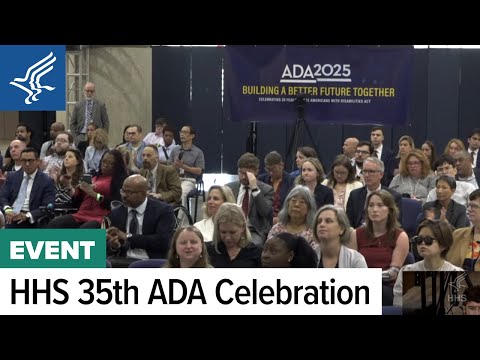
Acting Administration for Community Living head Mary Lazare convened a July commemoration at the U.S. Department of Health and Human Services to mark the anniversary of the Americans with Disabilities Act and to call attention to enforcement, community living and workforce needs.
The event brought federal civil‑rights and justice officials together with disability advocates who paired personal testimony with calls for expanded support. Paula Stannard, director of the HHS Office for Civil Rights, highlighted recent complaint resolutions and said the office will continue enforcing disability protections “through meaningful access, grounded in the law, and focused on restoring and protecting liberty, dignity, and access.”
The gathering used recent enforcement outcomes and personal stories to illustrate gaps in community integration and supports. Stannard described a case involving Alexis Radcliffe, who spent seven years in a hospital after becoming a ward of the state; OCR and Disability Rights North Carolina worked with the state and with the Centers for Medicare & Medicaid Services to secure funding options and move Radcliffe into community housing. Stannard said the case demonstrates the ADA’s integration mandate and OCR’s role: “Everyone has the right to live with self determination.”
Speakers also cited broader enforcement work. Jesus Osete, principal deputy assistant attorney general in the Justice Department’s Civil Rights Division, listed recent settlements and litigation addressing unnecessary institutionalization, segregation in adult care homes and improper use of seclusion and restraint in schools. “Today, we don't just celebrate the law. We don't just celebrate the ADA. We celebrate results,” Osete said.
Advocates and people with disabilities described how access tools and supports changed individual lives. Jordan Zimmerman, a nonspeaking autistic manager of education products and program design at the Center for Enriched Living, described gaining assistive communication at age 18 and said, “Under the ADA, I had the right to effective communication, but when speech is limited and no other way is offered, that right does not fully exist.” Zimmerman credited assistive technology, the protection and advocacy system and community supports with enabling education and employment opportunities.
Henley Williams, a program analyst in the ACL Office of Independent Living Programs, described the ADA as an engine of opportunity: “The ADA allows America to benefit from a reservoir of talent that was previously untapped by businesses, agencies, and communities,” she said, citing examples of centers for independent living that provide ramps, transportation and disaster response support.
Speakers pressed two recurring policy priorities: workforce and transportation. ACL leadership and Secretary of Health and Human Services Robert F. Kennedy Jr. emphasized chronic shortages of family caregivers and direct support workers and urged employers and stakeholders to recruit and retain more direct care staff so people with disabilities can live and work in the community. Kennedy said, “We already know we're about a million people shy of the supports that we need for both aging and disability population,” and called for coalition building to expand caregiving capacity.
Sean Kenimer of the National Council on Disability said NCD will release a report on ground transportation that finds wheelchair users commonly lack on‑demand, wheelchair‑accessible options. “To fulfill the promise of the ADA, people with disabilities need to be able to access transportation on par with the rest of society,” he said, urging federal and private action to expand accessible vehicles and services.
Speakers and presenters repeatedly urged expanding supports that enable employment, education and independent living, while acknowledging uneven progress. Whit (Wit) Downing of the Kansas Council on Developmental Disabilities described personal experience moving from dependence on benefits to full‑time employment and urged reforms to ease benefit cliffs and expand tools such as ABLE accounts. “The ADA laid the foundation, but we are the builders,” Downing said.
The program mixed policy descriptions with first‑person testimony. Radcliffe, who recorded remarks and joined virtually, said she is “so thankful to be a part of the ADA” and thanked Disability Rights North Carolina, Medicaid of North Carolina and the Office for Civil Rights for supporting her move into the community. Organizers noted OCR had resolved “more than 115 disability related complaints under Title II and Section 504” in the current administration, a figure Stannard cited as evidence of ongoing enforcement work.
No formal votes or regulatory actions were taken at the event; it was a commemorative program featuring federal announcements, advocacy remarks and personal narratives.
Looking ahead, speakers urged coordinated federal, state and private efforts to: expand direct care workforces; strengthen community‑based supports that prevent unnecessary institutionalization; promote accessible transportation; and enforce effective communication in health care and education settings. Organizers encouraged attendees and online viewers to continue collaboration through ACL and HHS engagement channels.