Get Full Government Meeting Transcripts, Videos, & Alerts Forever!
Get email alerts on the Adaptive Reuse topic
No spam. Unsubscribe anytime.
Ordinance committee forwards adaptive reuse ordinance to City Council to speed commercial-to-housing conversions
Summary
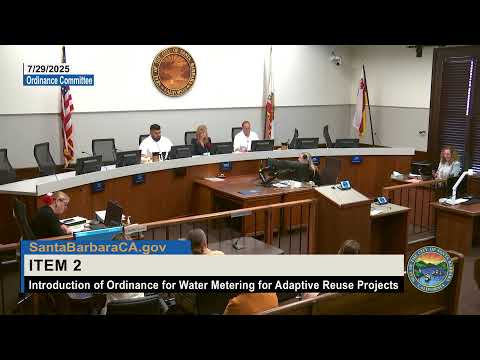
The Ordinance Committee of the City of Santa Barbara voted 2–1 to forward a proposed adaptive reuse ordinance to City Council for introduction and adoption, moving a package of incentives designed to make it easier to convert existing nonresidential buildings into housing.
The Ordinance Committee of the City of Santa Barbara voted 2–1 to forward a proposed adaptive reuse ordinance to City Council for introduction and adoption, moving a package of incentives designed to make it easier to convert existing nonresidential buildings into housing.
Dana Falk, project planner with Long Range Planning in Community Development, told the committee the ordinance implements Housing Element Program HE‑1 to “facilitate the conversion of nonresidential buildings to housing,” and recommended the committee forward the draft, determine it is exempt from the California Environmental Quality Act, and find it consistent with the general plan.
The ordinance would allow adaptive reuse projects citywide in areas that already permit multiunit residential uses, limit conversions to existing building envelopes, and require converted buildings to be at least five years old. The measure delivers four development incentives for eligible projects: removal of a separate maximum residential density (projects would be limited only by the existing building envelope), exemption from the residential open‑yard requirement, no additional vehicle parking beyond on‑site parking, and retention of existing setbacks. The draft also sets maximum average unit sizes of 800 square feet for rental projects and 1,200 square feet for ownership projects and requires active nonresidential ground floor uses on a defined portion of State Street. Projects must still meet existing rules such as inclusionary housing, stormwater management, minimum unit size, and bicycle parking.
Staff said the incentives could shorten the entitlement process because qualifying projects might not need a discretionary zoning modification; a project that fits the ordinance thresholds could proceed straight to building permit review. Staff also recommended the committee find the ordinance exempt under the CEQA general rule (CEQA Guidelines §15061(b)(3)). Falk said the ordinance must complete a total of four public hearings and that the Planning Commission had already recommended the draft with three minor changes, including lowering the minimum building age from 10 to five years and reducing average unit size caps.
Public commenters were broadly supportive of an adaptive reuse program but divided on inclusionary housing and unit‑size limits. Diane Black, speaking for the League of Women Voters of Santa Barbara, said, “We strongly support the proposed adaptive reuse ordinance as it's drafted,” and praised the ordinance’s requirement to continue inclusionary requirements while staff studies whether changes are needed. Several housing advocates and downtown business representatives, including Barry Tower of the Coastal Housing Coalition and Robin Elander, executive director of the Downtown Santa Barbara Improvement Association, urged more flexibility for projects in the Central Business District and asked the city to consider exempting downtown adaptive reuse projects from inclusionary obligations. Ben Romo, representing private owners who have pursued conversions, cautioned that “Imposing the city's inclusionary requirements on adaptive reuse projects will kill most projects downtown.”
Other commenters urged changes to the average unit size caps to better allow three‑bedroom units for families. John Campanella noted that the Planning Commission reduced a staff recommendation on average rental unit size from about 1,200 square feet to 800 square feet and urged reconsideration so rental projects can include larger family units without requiring an offset of smaller units.
Committee discussion centered on balancing speed and predictability for conversions against policy goals such as affordable housing production and downtown economic vitality. Council Member Mike Jordan said he would prefer additional work to give council more choices before forwarding the ordinance; Jordan listed possible changes for further vetting, including exemptions or different rules for inclusionary requirements in core downtown blocks, tiered average unit size allowances that permit larger family units, and addressing stormwater triggers and geographic scope for required active ground‑floor commercial uses. Chair Snedden and Council Member Gutierrez expressed support for moving the ordinance forward now and said the forthcoming nexus study and normal council review could inform any adjustments.
Motion and vote: Council Member Gutierrez moved and Chair Snedden seconded the staff recommendation to consider the proposed adaptive reuse ordinance and forward it to City Council for introduction and adoption, to determine the ordinance is exempt from CEQA, and to determine the ordinance is consistent with the general plan. The committee voted 2–1 in favor (Chair Snedden: yes; Council Member Gutierrez: yes; Council Member Jordan: no). The ordinance will next go to City Council for additional public hearings and final action.
The staff timeline anticipates returning to City Council for introduction and adoption in September (staff gave possible dates of Sept. 9 and Sept. 16) and completing the Housing Element Program by December 2025. Planning Commission previously reviewed the draft on June 12 and recommended changes now incorporated in the text.
If adopted, the ordinance would be a tool for property owners and developers to convert underutilized commercial buildings—particularly along State Street and other mixed‑use corridors—into housing, while keeping existing city standards on inclusionary housing and stormwater in force. Further adjustments to inclusionary requirements will be considered separately after the BAE nexus and feasibility study and subsequent council direction.
Votes at a glance
- Motion to forward the proposed adaptive reuse ordinance to City Council for introduction and adoption, to find it exempt from CEQA, and to find it consistent with the general plan: moved by Council Member Jen Gutierrez; seconded by Chair Meagan Snedden. Vote: yes — Snedden, Gutierrez; no — Jordan. Outcome: forwarded to City Council.