Get Full Government Meeting Transcripts, Videos, & Alerts Forever!
Get email alerts on the Public Power topic
No spam. Unsubscribe anytime.
Residents press St. Petersburg council to fund feasibility study on public power as Duke contract nears end
Summary
Multiple residents urged the City Council to fund a feasibility study into municipal (public) power ahead of the city's contract renewal with Duke Energy in 2026, citing rising bills, reliability problems and climate goals.
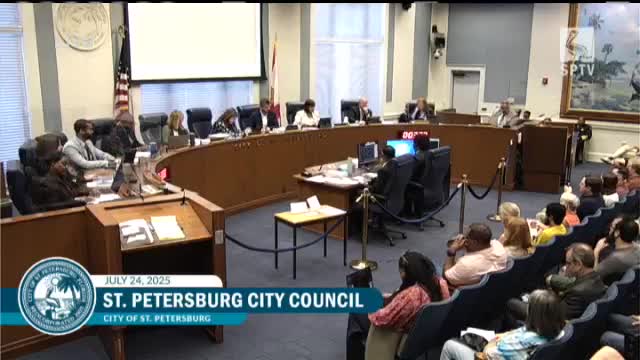
Multiple residents urged the St. Petersburg City Council on July 23 to commission a feasibility study on municipal (public) power as the city's contract with Duke Energy approaches renewal in 2026. Speakers at the open forum described steep electricity bills, inconsistent net-metering credits for rooftop solar and outages that pose health risks for residents who rely on medical equipment.
The call for a formal study came from a string of public commenters who said the city should evaluate whether a city-owned utility or other alternatives could deliver lower costs, more local accountability and faster progress toward the council's 100% renewable energy goal.
Why it matters: A feasibility study would provide city leaders with analysis of options, expected costs and transition steps if St. Petersburg were to consider municipal power or other alternatives when the current Duke contract expires. Proponents said the study is a timely, low-cost step to inform negotiations and long-term energy planning.
What residents said - Dalton Reynolds, a St. Pete resident, told the council the city is not on track to meet the 100% renewable-energy goal and that the Duke contract is "holding us back." He urged the council to "follow Clearwater's lead" by funding a public-power feasibility study. - Kathy Harrelson and others described unexpectedly high electric bills despite rooftop solar. Harrelson said crediting from Duke only applied in months when she was not using air conditioning, leaving her with bills she did not anticipate. - Multiple speakers, including Jason Scott and Michelle Lindsey, argued public power could deliver lower rates, more local jobs and better responsiveness than the investor-owned utility model.
Council response and next steps Vice Chair Hanowitz and several council members acknowledged the public interest and said the issue will be part of upcoming deliberations. Several councillors said the city's Legislative Affairs and Intergovernmental Relations Committee (and upcoming federal/state briefings) would be appropriate venues to hear more specific legal and financial analyses. Councilmember Gabbard noted the topic will be discussed at committee and said a formal referral or funding request for a study could be considered.
What the study would cover (as described by speakers and council members during the meeting and prior committee discussion): potential cost comparisons; reliability and outage history; staffing and capital needs for municipalization; impacts on local jobs and economic development; financing mechanisms; and timelines tied to the 2026 contract expiration.
Ending: Residents asked the council to move quickly to fund and scope a feasibility study so the city can make an informed decision ahead of the Duke contract renewal. Council members said they would include the item in upcoming committee briefings and consultations with staff and outside advisors.