Get Full Government Meeting Transcripts, Videos, & Alerts Forever!
Get email alerts on the Emergency Services topic
No spam. Unsubscribe anytime.
Collin County commissioners call Nov. 4 vote after public hearing on Emergency Services District No. 1
Summary
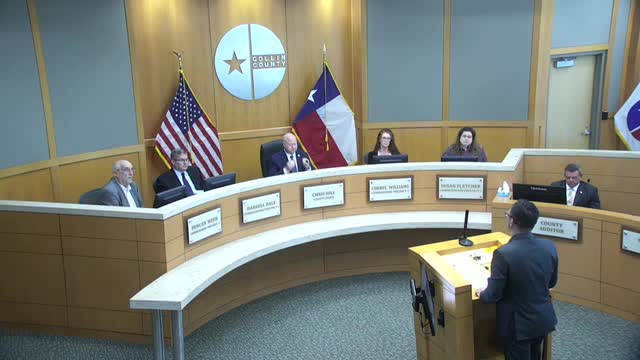
Collin County Commissioners Court held a public hearing and voted 5–0 to call a Nov. 4, 2025 election to let residents of the proposed Collin County Emergency Services District No. 1 decide whether to create the taxing district.
Collin County Commissioners Court held a public hearing on the creation of Collin County Emergency Services District No. 1 (ESD 1) and voted to set the district boundaries based on municipal ETJ consent and to call an election for Nov. 4, 2025, the court announced following the hearing.
County Administrator Yoon Kim opened the hearing with a summary of the petition process and the court’s role. "Today, we are conducting the public hearing on the creation of the emergency services district under health and safety code section 775.016," Kim said, and described the steps the court must take: set boundaries based on ETJ consent, determine feasibility under statute, and call an election. He emphasized that the court was not setting a tax rate: the initial rate would be set later by the ESD board if voters approve the district.
The hearing drew multiple speakers representing fire chiefs, volunteer department leaders and residents in unincorporated Collin County. Stuart Blassingame, president of the Collin County Fire Chiefs Association, read a statement of principles the association submitted to the county and said the association supports contracted service delivery rather than creation of a county fire department: "The District should not establish an independent Collin County Fire Department. Instead, all fire and emergency medical services should be delivered through contractual agreements with existing fire departments within Collin County to prevent duplication of personnel and resources," he said.
Many residents and local chiefs urged action to sustain fire and emergency medical services outside city limits if municipalities reduce contractual coverage. Richard Hill, a resident speaker, framed the stakes for unincorporated residents: "Failure to pass the emergency service district in Collin County on November 4 is not an option for the people living outside the city limits. The lives of men, women, and children will be at risk if this proposition fails," he said.
Kim presented preliminary taxable-value estimates and a range of possible revenues, noting limits on the county’s role in setting tax rates. Using appraisal district estimates, he said the district’s total taxable value would be roughly $18,400,000,000; taxable value attributable to municipal utility districts (MUDs) about $7,700,000,000; and a net taxable value after the court’s anti-double-taxing resolution of about $10,600,000,000. Kim provided an example: a hypothetical 10¢ tax rate on the district’s net value could produce roughly $9.5 million annually, though he stressed these are preliminary numbers and the court is not setting any tax rate today.
Speakers repeatedly raised questions about areas and households inside municipal ETJs and MUDs, and how any ESD would avoid double taxation for residents already paying MUD levies or municipal taxes. Kim and Deputy County Administrator Russell Schauffner said the court had passed a resolution stating the county’s preference to avoid double-taxing MUD residents and that multiple technical approaches (reimbursements, contract transfers, or other arrangements) would be available to work out overlaps if the ESD is approved.
Several city councils in Collin County submitted formal consent to include their ETJs in the proposed district; others declined or did not respond. Kim read a list of municipalities that provided ETJ consent and those that did not. He also said some municipalities (for example New Hope) formally adopted resolutions to include city limits in the ESD petition. He noted that a limited number of cities opted out, which affects boundaries that the court must adopt before the election.
Commission members and staff spoke to the timing and risk of a coverage gap if municipalities withdraw from existing service contracts before an ESD can be organized, levy a tax and begin operations. The court said it would continue to work with municipal partners to try to avoid any gap in coverage and that some cities had already agreed to extend existing contracts while talks continue. The court acknowledged that, legally, cities are not required to provide fire service outside their limits but that many long-standing mutual-aid and contract arrangements have sustained countywide response.
After public comment and staff discussion, the court moved to adopt the proposed order that sets ESD 1 boundaries based on the ETJ consents, finds the district feasible to promote public safety, and calls a confirming election for Nov. 4, 2025, with ballot language set as proposed in the packet. The motion carried 5-0.
What’s next: the court’s action establishes the boundaries the elections office will use to determine who is eligible to vote on the question. If the Nov. 4 vote approves creation of ESD 1, the new district board will be appointed by the commissioners and would set the district’s initial tax rate; that tax rate is not set by the court today. County staff said they will post updated materials on the county website and work with the elections office to make informational materials available now that the court has called an election.
Votes at a glance - Call election for creation of Collin County Emergency Services District No. 1 (agenda items 2a & 2b): motion to set boundaries based on municipal ETJ consent, find feasible under Health & Safety Code §775.016 and call Nov. 4, 2025 election; outcome: approved (motion carried 5–0). - Consent agenda (routine items minus several pulled items): approved; motion carried (vote not recorded in transcript minutes). - Grants policy update (board-level policy to standardize grant review and PTO handling for grant-funded staff): approved (motion carried; court adopted redline changes and a grandfathering clause for PTO accruals tied to effective date). - District clerk: transfer magistrate court clerks to district clerk’s office (organizational move required by statute); motion approved (court adopted order; motion carried 5–0). - District clerk: budget amendment for two months of pretrial release staffing/equipment: approved (motion carried; funds adjusted as presented). - Sheriff’s Office: budget amendment for jail overtime (to cover shortfall through end of fiscal year): approved (motion carried). (Court discussion noted the amendment will be revisited as part of the FY2026 budget process; the court directed staff to provide additional detail on overtime drivers.)
Ending The court closed the public hearing and moved on to remaining agenda items, including consent items and multiple budget and staffing items. County staff committed to posting timelines, resolutions and mapping materials on the county website and to answering follow-up questions about municipal consent and MUD intersections. The Nov. 4 election is now scheduled to allow voters inside the established ESD boundaries to decide whether to create Collin County Emergency Services District No. 1.