Get Full Government Meeting Transcripts, Videos, & Alerts Forever!
Get email alerts on the Education State Of Schools topic
No spam. Unsubscribe anytime.
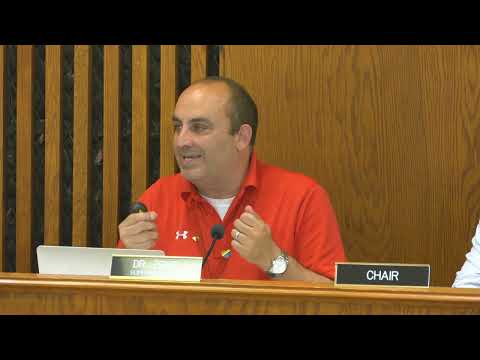
Superintendent Steve Zrike reviews district progress, flags student belonging and early-childhood alignment
Summary
At the July 28 Salem School Committee meeting, Superintendent Steve Zrike delivered the annual state-of-the-schools presentation, highlighting gains in graduation and advanced coursework while flagging student sense of belonging and the need for vertical alignment from pre-K to grade 2.
Superintendent Steve Zrike told the Salem School Committee on July 28 that the district has made measurable gains on multiple indicators while facing gaps in student belonging and early-grade alignment.
Zrike opened the presentation by noting that some state data remain embargoed and unfinalized, including spring MCAS results, but said internal measures and preliminary counts give a picture of the district’s status as it enters the final year of its three-year strategic plan. “We don’t have all the data in from this school year,” Zrike said, noting that some MCAS information was still under embargo.
The presentation summarized progress under four priorities: elevating learning, empowering educators, centering belonging and strengthening foundations. Zrike cited strong growth at the high school level and called out advanced-coursework participation among 11th and 12th graders as “in the low seventies,” a figure he said exceeds the strategic-plan goal. He also reported a 4-year graduation rate of 81.6 percent for the 2024 cohort (students who finished within four years), with some students still completing requirements after the cohort year.
But Zrike said the district faces important challenges. He singled out student responses to the Panorama survey point that only about 49 percent of students reported that they feel valued in school. “Not enough students are telling us that they feel valued in school, and I think that’s a place we have to double down,” he said. Committee members asked for more disaggregated data. Member Cruz requested breakdowns by trusted-adult indicators and by grade and school; Zrike said the data are available by grade level and school, and that staff would share additional cross-tabulations in the fall.
Zrike also raised an early-childhood concern: while the district has developed an expanded, higher-quality pre-K experience in partnership with community providers, he said some kindergarten-through-second-grade instruction has not been vertically aligned to build on that pre-K readiness. “We need to build from that,” he said, describing planned joint professional development and data-sharing work this fall to improve transitions.
Other details provided during the presentation included: - Portrait of a Graduate: the district is elevating a multi-language (English, Spanish, Portuguese) “portrait of a graduate” that emphasizes critical thinking, creative problem solving, collaboration, communication, self-awareness and cultural competence. - Attendance and chronic absenteeism: Zrike said chronic-absence and dropout metrics have improved and met 3-year targets in several schools, citing Collins as an example of progress. - Special education and multilingual learners: he said these groups continue to lag in proficiency and remain a focus. - Staff retention and diversity: Zrike said overall retention had improved as the district settled a new contract, but that teacher diversity had plateaued after gains earlier in his tenure. A follow-up presentation on diversification followed the state-of-schools report.
Zrike closed by listing concerns about students’ postsecondary planning: although more students participate in rigorous coursework, many leave high school without a clearly defined college- or career-planning outcome. He said the district will continue to focus on college-and-career planning at middle and high school levels.
The presentation prompted several follow-up items the committee said it expects to receive this fall, including more detailed Panorama disaggregations, regular “pulse checks” on belonging and a report on vertical alignment work between pre-K and K–2 classrooms.