Get Full Government Meeting Transcripts, Videos, & Alerts Forever!
Get email alerts on the Market Octavia Impact Fees topic
No spam. Unsubscribe anytime.
Planning commission backs limited support for waiving Market Octavia impact fees after heated public debate
Summary
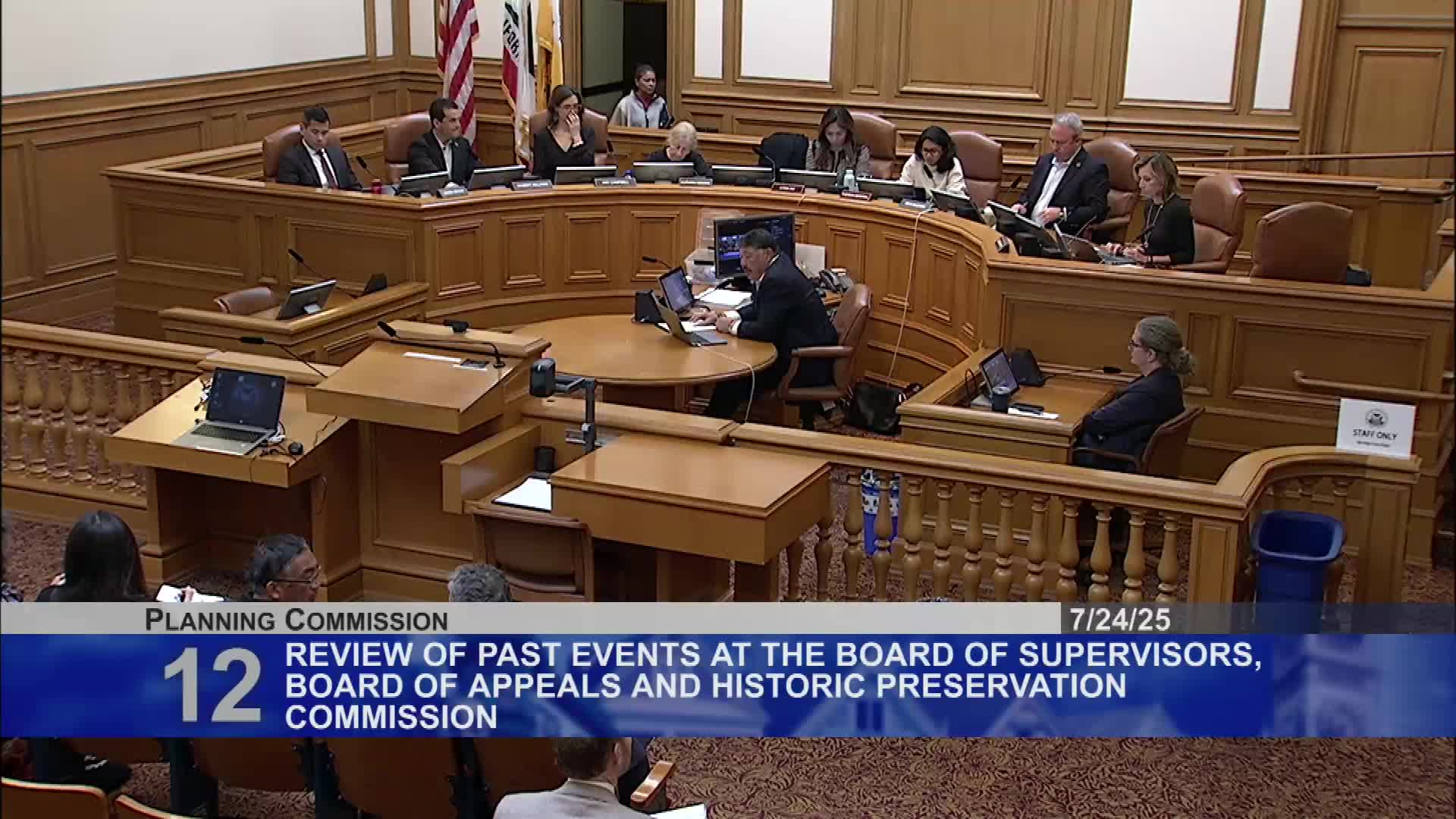
The San Francisco Planning Commission on July 24 recommended approval of legislation to waive several Market Octavia–area impact fees, asking the Board of Supervisors and city agencies to continue neighborhood outreach and to consider partial or time‑limited approaches; the motion passed 4–3.
The San Francisco Planning Commission on July 24 recommended approval of legislation introduced by Mayor Lurie and Supervisors Dorsey and Mahmood to waive several Market Octavia–area development impact fees, but asked that the Board of Supervisors and city agencies continue neighborhood engagement and consider revisiting or partially reinstating the waived fees in the future. The motion passed 4–3.
The vote came after more than two hours of public comment and presentations from the Mayor’s Office of Economic and Workforce Development, Planning Department staff and neighborhood groups. Commissioners who supported the recommendation said removing the extra, area‑specific fees could help stalled projects get to construction; opponents warned the change would forfeit tens of millions of dollars earmarked for community projects and affordable housing.
The issue dates to the adoption of the Market Octavia Plan in February 2007 and the plan’s implementation in 2008. The plan created area fees that, until now, have funded neighborhood projects and helped finance affordable housing. OEWD staff told the commission the area has produced about 4,800 housing units since adoption, including about 1,700 affordable units (roughly 35%), and about $53 million in impact‑fee revenue that has been collected and spent on parks, streets and other public improvements. But OEWD and other city staff said development in Market Octavia has largely stalled since 2020: 26 approved residential projects accounting for about 2,700 units remain unbuilt, and fee collection has been minimal in recent years.
OEWD analyst Jacob Bintliff said the stacked area fees can add $20,000–$60,000 per unit in additional costs in parts of the plan area and that some stalled projects could be moved toward construction if the extra area fees were removed while keeping citywide fees in place. "By reducing some of these city costs on the projects, we're hoping we can help stimulate the housing development," he told the commission.
Supporters from housing advocacy and development groups repeatedly echoed that point. Mark Babson, president of Emerald Fund, a local developer, said construction costs and layered fees are keeping projects from penciling out: "If these fees went away, it will become much closer to financial feasibility. We're not there." David Kim, a volunteer with San Francisco YIMBY and a renter, said removing the fees could be one way to unlock housing production and property tax revenue.
Opponents pressed the commission to slow down and seek more analysis and community outreach. Robin Levitt, a longtime member of the Market Octavia Community Advisory Committee (CAC), asked the commission to continue the item so residents and the CAC could evaluate the proposal in detail: "Targeting these fees feels a little bit like rearranging deck chairs on the Titanic," she said, arguing there is no guarantee that waiving fees will overcome larger market barriers to construction.
Several neighborhood organizations and affordable‑housing advocates emphasized concrete budget and program impacts. The Planning Department packet and multiple speakers noted a near‑term gross revenue effect in the tens of millions of dollars; one speaker and multiple staff references put the amount of programmatic funds tied to the area fees at about $46,000,000. The Community Land Trust and Council of Community Housing Organizations urged the commission to continue the item until the city could identify replacement funding or an off‑ramps strategy for projects that rely on the fee revenue for public improvements or affordable units.
The ordinance before the commission would: (a) waive the Market Octavia area fees for both stalled pipeline projects and future projects in the plan area while retaining citywide fees (inclusionary housing obligations, transit sustainability fee and others); (b) remove several SUD (Van Ness Market Special Use District) provisions that rely on those fees; and (c) add a sunset clause to the Market Octavia CAC, which has struggled to maintain a quorum and whose principal role is to advise on expenditure of impact‑fee funds that have not been collected in recent years.
Madison Tam, legislative aide to Supervisor Matt Dorsey, told the commission the waiver aims to unblock housing that would in turn generate larger, more reliable streams of property tax revenue and citywide impact fees. "Bringing new homes to this neighborhood will fulfill a nearly two‑decade‑long vision, support small businesses and jobs, contribute to our tax base, and move the needle on downtown recovery," she said.
Planning Department staff described measures they would take if the Board approves waivers, including continuing to deliver priority infrastructure projects through existing capital and departmental funding sources where possible and reporting on how pipeline projects could be advanced.
The commission also considered whether to delay its recommendation to allow more time for outreach. Several commissioners and community speakers urged a continuance; others said the department and sponsoring offices had already committed to follow‑up meetings over the August recess and that a delay would not change the timetable for the Board of Supervisors. After deliberations Commissioner Campbell moved to recommend approval with explicit language that the Board should (a) prioritize additional community engagement and (b) consider revisiting fee levels (including partial or time‑limited waivers) if economic conditions change. The motion passed 4–3 with Campbell, McGarry, Braun and Commission President Tsao voting aye; Commissioners Williams, Imperial and Moore voting no.
Votes at a glance - Motion (continuance of items 1 and 2 on the continuance calendar): "Move to continue items 1 and 2 as proposed." Passed unanimously 7–0. - Motion (approve consent calendar): "Move to approve all items as proposed." Passed unanimously 7–0. - Motion (adopt minutes): "Move to adopt the minutes." Passed unanimously 7–0. - Motion (Planning Commission recommendation on PCA to waive Market Octavia area fees): "Recommend approval with commitments to additional community engagement and consideration of revisiting fee waivers (partial/time‑limited)." Passed 4–3.
What the commission asked for next The commission asked Planning and OEWD to: (1) continue outreach to the Market Octavia CAC, Hayes Valley Neighborhood Association and other local stakeholders during August; (2) provide written materials for the September hearing explaining how the family‑zoning and area‑plan mapping intersect with Market Octavia boundaries and the proposed changes; and (3) when feasible, report back with analyses of alternatives to the fee reductions (for example partial reductions, time‑limited waivers, or performance‑triggered reductions tied to build‑out timelines).
Why it matters The decision seeks to balance two competing priorities: (1) removing localized cost barriers that proponents say are preventing large, entitled projects from moving from approval to construction and thereby stalling housing and tax revenue growth; and (2) preserving a locally negotiated funding stream that historically paid for parks, pedestrian and transit improvements and a modest portion of affordable housing in a neighborhood with limited open space. The outcome sends the measure to the Board of Supervisors with the commission’s recommendation to approve but with a clear request for additional outreach and a requirement that the board consider mitigation or re‑instatement options as conditions change.
Community reaction and next steps Supporters from housing advocacy groups and developers urged the Board to adopt the waiver to jump‑start construction. Several neighborhood groups, affordable housing advocates and CAC members asked the Planning Commission and sponsoring supervisors to pause for more analysis and public input; at least one neighborhood association announced an August 28 community meeting with OEWD. The Board of Supervisors will consider the legislation—and the commission’s recommendation—during its legislative process after the summer recess.
The commission’s recommendation does not change existing citywide fees or inclusionary housing requirements; those remain in effect under the proposal. The Planning Department and OEWD told the commission they will continue coordinating with MOHCD, SFMTA and other departments on delivery and funding options for the community projects historically tied to the Market Octavia fees.
End notes: numbers and context The Market Octavia Plan was adopted in 2007 and took effect in 2008. Since adoption the plan area has produced roughly 4,800 housing units, including about 1,700 income‑restricted units (≈35%). Area fees collected and spent on public improvements are reported at roughly $53 million to date; staff and multiple speakers cited an approximate $46 million figure for the programmatic funds at stake under the proposed waivers. OEWD told commissioners 26 approved residential projects (≈2,700 units) in the plan pipeline have not broken ground since 2020. Commissioners requested additional outreach and written materials before the Board of Supervisors’ further consideration.