Get Full Government Meeting Transcripts, Videos, & Alerts Forever!
Get email alerts on the Land Use Development topic
No spam. Unsubscribe anytime.
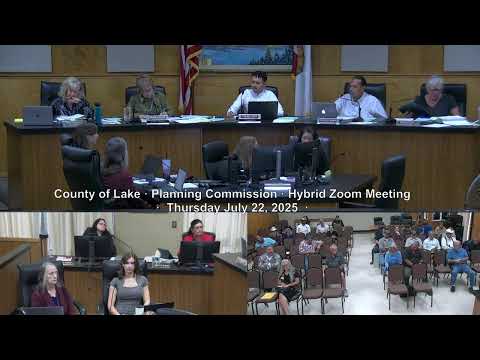
Lake County planning commission reviews revised EIR, zoning and use permits for Guenoc Valley mixed‑use project
Summary
The Lake County Planning Commission on July 24 reviewed a revised environmental impact report and permit requests for the proposed Guenoc Valley mixed‑use development by Lotus Land Investment Holdings Inc., a 16,000‑acre resort, agricultural and residential project that staff says required further wildfire and evacuation analysis after court rulings.
LAKE COUNTY, Calif. — The Lake County Planning Commission on July 24 received a detailed presentation on the Guenoc Valley mixed‑use plan development proposed by Lotus Land Investment Holdings Inc., including a partially revised environmental impact report that staff says responds to court orders requiring more analysis of community evacuation and wildfire risk.
County planner Laura Hall outlined the applicant’s permit requests, including multiple rezone and use permit applications and an associated development agreement. Hall said the Guenoc Valley site covers roughly 16,000 acres east of Middletown and that a separate, 12.6‑acre parcel in Middletown (the Santa Clara/Middletown workforce housing site) is also part of the application.
Why it matters: the project would change the general plan and create a new Guenoc Valley zoning district to allow a large, clustered resort, agricultural and residential development on dozens of parcels. Staff and the project’s environmental consultant said the revised EIR focuses on wildfire risk and evacuation after a superior court and appellate decision required additional analysis.
Acorn Environmental consultant Annalise Sanborn told commissioners the courts upheld most of the 2020 EIR but required further work on community evacuation and wildfire. “In 2022 the superior court found that the EIR analysis complied with CEQA in all areas with the exception of community evacuation,” Sanborn said, describing the sequence that led to the July 2024 and March 2025 draft partially revised EIRs and a July 2025 final partially revised EIR.
The revised analysis added project modifications meant to reduce wildfire risk and improve evacuation, including removal of some remote development areas, construction of an emergency Grange Road connector and a Wildfire Prevention Plan (WPP) that calls for vegetation management, fuel breaks, and hard‑shoulders on roads. Sanborn said models in the draft PR EIR indicate implementation of the WPP would reduce modeled flame length and would slow fire arrival times in some scenarios, giving additional time for evacuation.
But the EIR still finds some impacts will remain “significant and unavoidable,” staff said. Project topics identified as significant and unavoidable at this stage include aesthetics, agricultural land conversion, greenhouse gases, noise (project traffic increases on part of Butts Canyon Road), and transportation impacts at certain off‑site intersections where mitigation requires action by other jurisdictions.
Staff emphasized the EIR and the draft findings treat those issues as requiring a statement of overriding considerations under CEQA. Director of Community Development Myra Turner presented a draft condition limit on groundwater extraction near Middletown: “There shall not be any wells created or operated by the permit holder in the Caliomi Valley Groundwater Basin except for the following: 1) on‑site wells within the approved Guenoc Valley project site, and 2) one well within the off‑site well site if the Caliomi Valley Water District does not build and operate a well on that site,” Turner said.
Middletown workforce housing: staff described a proposed rezone of 3.5 acres within the 12.6‑acre Santa Clara parcel from R‑1 (single‑family) to R‑2 (two‑family) to allow duplexes and a community clubhouse as part of a tentative map that would ultimately create 38 parcels (staff said the tentative map and final subdivision approvals will return to the commission later). Hall noted the parcel sits inside the community growth boundary with municipal sewer and water access and earlier approvals had allowed a 50‑lot subdivision that later expired.
Agricultural impacts and mitigation: county staff and the consultant said mapping updates have increased the acreage mapped as important farmland and that the phase‑1 area of potential effect could lead to up to about 325 acres of important farmland being converted. Sanborn said mitigation would require permanent protection (for example, conservation easements) of equivalent farmland, within 100 miles and with appropriate infrastructure, but that even with mitigation the impact remains significant and unavoidable.
Public comment reflected a sharp split among residents and local organizations. Supporters, including Lake County Chamber of Commerce CEO Amanda Martin and several local business owners, cited jobs, tax revenue and construction opportunities. “It presents an opportunity to create lasting economic benefits for our community and also increase our resiliency and our wildfire readiness,” Amanda Martin said.
Opponents and concerned residents focused on evacuation, water, farmland loss, and local infrastructure. Reverend Julia Bono of Middletown said the Santa Clara workforce housing site is “not appropriate for this town’s scale, infrastructure, or cultural character,” and urged relocating workforce housing to the Guenoc Ranch site. Lake County Agricultural Commissioner Catherine Vanderwall told commissioners she was “not doing my job if I did not get up here and say something,” noting the proposed conversion of more than 300 acres of prime farmland and that soil‑based designations are not interchangeable.
Fire and evacuation concerns animated much of the public testimony. Multiple speakers questioned whether air evacuation assumptions are practical and whether a single new connector and local road improvements would be adequate to evacuate thousands of people in a fast‑moving wildfire. The EIR’s updated wildfire analysis and WPP assume a mix of roadway evacuation, temporary refuge areas and limited aerial evacuation for certain unit types; applicant counsel Rob Bridal clarified a commonly cited number, saying the EIR assumptions “do not add up to 25% of the overall population,” and that the phase‑1 aerial evacuation assumption corresponds to dozens — not thousands — of units in the initial phase.
What staff recommended: staff presented a set of seven motions for the commission’s consideration. Those included recommending the Board of Supervisors approve general plan amendments and a new Guenoc Valley zoning district; adopting CEQA findings, a statement of overriding considerations and a mitigation monitoring program; adopting use permits for the Guenoc Valley and the Middletown workforce housing site conditioned on later Board actions; and recommending approval of a development agreement and a specific plan of development for phase 1. Staff also noted that permits adopted by the commission would have “no force or effect” until the Board of Supervisors acts on the related general plan and zoning amendments.
Next steps: commissioners asked staff and the applicant detailed technical questions on mapping, water supply assessments, the scope of the agricultural mitigation (including the 100‑mile radius allowance), the nature of proposed helipads (one is for emergency response; another is described as a float seaplane location at Dieter Reservoir), and whether roads inside the project would be offered for public dedication. Staff said the EIR and appendices, maps and many of the referenced studies (traffic, water, wildfire) are in the administrative record and that further public review materials are available.
No final decision on the EIR certification or project approvals was made at this hearing. Staff asked the commission to act on the sample motions in the staff report; the record shows staff’s recommended motions were presented for consideration but not voted on by the commission during the portion of the meeting covered in the transcript.
Commissioners and staff paused for a scheduled recess to continue deliberations and questions after the break.
Ending note: the planning commission’s recommendations, certification decisions (if any), and any zoning or development approvals required by the Board of Supervisors will be documented in forthcoming agendas and staff reports; the administrative record (draft/final PR EIRs, appendices and comment letters) are posted with the project file in county planning records.