Get Full Government Meeting Transcripts, Videos, & Alerts Forever!
Get email alerts on the Environmental Health Cyanotoxins topic
No spam. Unsubscribe anytime.
Lake County supervisors ask for formal plan after cyanotoxin monitoring update
Summary
County environmental health and tribal monitors briefed the Board of Supervisors on cyanotoxin monitoring at Clear Lake, reporting July 11 sample results and requesting clearer direction and a funded workplan to sustain monitoring, outreach and mitigation efforts.
CLEAR LAKE, Calif. — Greg Weatherby, Lake County director of environmental health, and Sarah Ryan, representing the Big Valley Band of Pomo Indians’ Clear Lake monitoring team, told the Board of Supervisors on July 11 that ongoing cyanotoxin monitoring is giving local officials the data they need but that the work group now needs a clearer mandate and funding to continue.
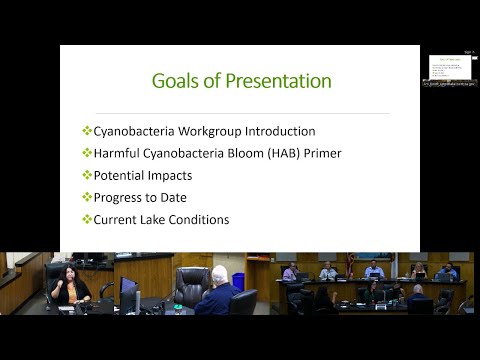
The presentation summarized current toxin levels, monitoring coverage, public‑outreach efforts and mitigation projects and asked the board to define the work group’s scope, deliverables and reporting cadence. Weatherby said the county’s capacity is limited and that environmental health has reduced staff time on the effort because of strained budgets; he asked the board to indicate whether it wants the group to continue in its present form and how the county should prioritize staffing and funding.
The work group exists to coordinate monitoring, public health communications and mitigation planning among the county, the two nearby cities, tribal monitors and state partners. “Without the monitoring work that Sarah and her team are doing, the county would be absolutely blind to what is a very dangerous situation,” Weatherby said during his opening remarks. Sarah Ryan summarized the tribe’s monitoring program and the group’s decade‑long development, saying the local network now publishes toxin results publicly and conducts community outreach.
Why it matters: Cyanotoxins — the toxic chemicals some cyanobacteria produce — pose risks to recreation, pets and private water intakes and can affect local businesses that depend on the lake. County officials and tribal monitors said transparent, regular reporting and clear signage help residents and visitors make choices about recreation and private water use.
Key facts presented - Monitoring and reporting: Big Valley’s monitoring team samples twice monthly in summer; the county and partners post toxin results to the state portal (mywaterquality.ca.gov) and to Big Valley’s Clear Lake cyanotoxin page. The presenters reported July 11 results showing two “danger” sites at Clear Lake Oaks and the Elam Indian Colony shoreline and multiple warnings elsewhere. - Sample summary (summer 2025 to date): 3 sampling events since June were cited; the presentation noted 41% of lower‑arm samples, 40% of Oaks‑arm samples and 11% of upper‑arm samples registered at caution/warning/danger levels for microcystin in the sampling period described. - Historic high: presenters reminded the board that 2021 recorded the highest measured toxin levels to date on Clear Lake (reported in the presentation as about 160,000 micrograms per liter), far above recreational guidance values used by toxicologists. - Private intakes and drinking water: County and presenters said public water systems that serve most residents have filtration systems and had non‑detect or low results in the tests discussed; private shore‑drawn intakes showed greater vulnerability in past sampling (the presentation cited about 50% detectable toxins in a subset of private intakes tested in the CalWatch/Tracking California effort). - Public health: Presenters noted the difficulty of confirming human illness from cyanotoxins, described the state illness work group’s case‑confirmation approach (matching symptoms, timing and water quality), and said the county and tribe routinely send informational materials to clinicians and veterinarians.
Discussion and next steps Supervisors broadly agreed the work group should continue but asked staff to present a more formal work plan and budget. Supervisor Sabatier said, “I think the work group is necessary. I want to give it the flexibility it needs to kind of be elastic in the sense of growing and shrinking as needed,” and urged attention to the Middle Creek Restoration Project as a long‑term nutrient and sediment strategy. Water Resources Director Pawan Upadhyay noted that the county’s lakebed ordinance (chapter 23) protects tules and that the board has previously declared emergencies and supported research for the Clear Lake hitch and related restoration work.
Public comment highlighted local and state collaboration: Susan Paul Yukonis of Tracking California said the Clear Lake monitoring and illness‑tracking work “is truly, truly a model for many other places within the state, the nation, and internationally.”
Outcome and direction The board did not take a formal vote. Supervisors asked staff and the work group to return with a recommended workplan, proposed deliverables, reporting cadence and budget estimates so the board can decide whether to formalize leadership and identify a funding source. Presenters noted that current county monitoring and outreach are being carried out with limited staff and realignment funds and that sustaining or expanding efforts will require a dedicated funding strategy.
Ending Presenters said they would return with specific recommendations, possible lead organizations and a budget request to sustain monitoring, signage, clinician outreach and coordination with mitigation projects. The work group emphasized that monitoring, shared messaging and local leadership are the means the county is using to inform residents and reduce uncertainty about lake safety.