Get Full Government Meeting Transcripts, Videos, & Alerts Forever!
Get email alerts on the Public Safety Drug Activity topic
No spam. Unsubscribe anytime.
CB2 human services members flag visible drug use around Lafayette, Canal Street and call for agency coordination
Summary
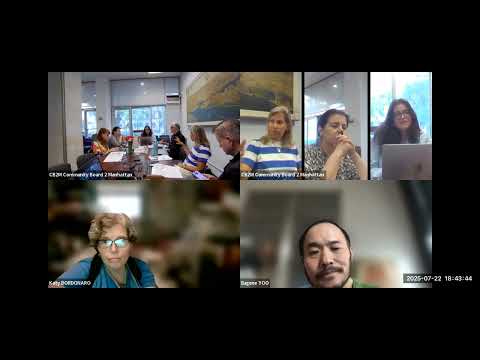
Community Board 2 members discussed rising visible drug use and public‑safety concerns around Lafayette Street, Canal Street and adjacent areas, noted the Village Interagency Task Force pilot’s reported placements and data, and called for coordinated agency responses and more data sharing before drafting resolutions.
Members of the board’s human services and related committees described an increase in visible drug use and public‑safety concerns in parts of Community Board 2, including Lafayette Street, Canal Street and areas near Washington Square Park and Mercer Street.
A member summarized outreach and data from the Village Interagency Task Force, which the board described as a pilot program that has placed people into services and collects counts of discarded needles and other indicators. "They put 14 people in the house, and they have no idea who stayed, who moved, who's back on the street," a member said, urging realism about outcomes even as the task force reported placements; the task force also reported needle-collection figures for Washington Square Park.
Board members discussed Greenwich House and Bellevue Hospital roles in local responses and cautioned against immediate public resolutions until the board had more information. One board member said Greenwich House and other local providers were unfairly accused in media reports: "There was a New York Post article that was saying that Greenwich House was a safe injection site and that that they're responsible for all the drug activity on the street, which, of course, is very painful for them, and they were not happy with that."
Members emphasized that calls to 911 and 311 produce different responses and data streams; one member noted that repeated 311 complaints can be required to elevate cases to agency attention. The group discussed short-term measures such as bollards and camera-sharing agreements between building owners and precincts as immediate tactical responses while larger interagency solutions are pursued.
Ending: Committee chairs agreed to delay drafting a public resolution until staff can gather more information from city agencies and the Village Interagency Task Force and to coordinate a future meeting that includes law enforcement and service providers so the conversation is evidence-based and multiagency.