Get Full Government Meeting Transcripts, Videos, & Alerts Forever!
Get email alerts on the Waste Management topic
No spam. Unsubscribe anytime.
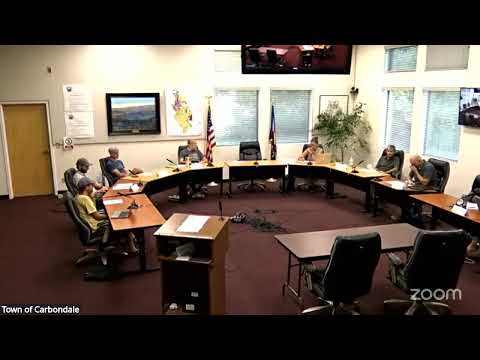
Carbondale environmental board weighs spending bag-fee funds, presses for water conservation and town electrification
Summary
At an environmental board meeting, members discussed options for spending the town's plastic bag–tax fund on composting and waste-reduction programs, reviewed water-system repairs and projects, and affirmed continued pursuit of town electrification projects including town-hall heat-pump work and pool electrification funding.
The Carbondale Environmental Board on a regular meeting discussed how to use the town's plastic bag fee fund to expand composting and waste-reduction programs, reviewed recent water-system outages and upcoming treatment and well projects, and reaffirmed goals on electrifying town facilities.
Board members said one of their immediate tasks is to prepare a proposal for the Town Board about using the bag-fee fund to support local composting and restaurant programs. "One of the things I will mention we're going to do is to help restaurants who aren't currently composting get involved in a compost program," the board chair said. The board agreed to schedule a short working session to sketch options and then present a proposal to the board of trustees at its upcoming work session.
Why it matters: the bag-fee fund and other local grants are among the few discretionary pots the board can direct to pilot programs that might shift local waste streams and reduce landfill deliveries. Board members repeatedly framed spending as a mix of incentives for restaurants and residents and possible future regulatory steps if voluntary programs do not scale.
Board discussion and decisions
- Bag-fee fund: Members reviewed figures discussed during the meeting: an opening balance shown earlier this year of about $80,000, projected revenue of roughly $35,000 and planned spending of $25,000 that would have left an estimated year-end balance near $90,000; meeting discussion indicated roughly $25,000'$30,000 might be available for new projects after existing commitments. The board identified candidate uses including: (a) financial support to help restaurants start composting, (b) low-income pilot compost programs, and (c) outreach and education. Board members emphasized designing supportive programs (education, technical assistance, short-term subsidies) before considering fines or mandates.
- Next steps on the bag-fee money: The board agreed to form a brief working session to draft a proposal and to bring options to the environmental-board update for the trustees. Members confirmed they will post any work session publicly and not take formal votes outside a regular meeting.
- Composting scope and enforcement: Several members noted Aspen-style mandatory commercial composting focuses on food-service establishments rather than all commercial entities. The board discussed beginning with restaurants and designing incentives to reduce contamination and administrative burden for small businesses.
Water, treatment and hydro updates
Town utilities staff reported a mechanical failure on the main line from the Nettle Creek plant that left the system with low available capacity for about two weeks; staff said flows at Nettle Creek are also low for the year and currently near a baseline of roughly 380 gallons per minute. "We do wanna continue, recommending people to conserve water to their best of their ability," a utilities representative said, urging voluntary conservation rather than mandatory restrictions at this time.
Staff also said they have mobilized a driller to replace Roaring Fork Well No. 1, which failed earlier in the year; once drilled the state takes about six weeks to approve the well before it returns to service. The board heard that the town plans to go out to bid for a filter upgrade at the Roaring Fork Treatment Plant in August with construction targeted for winter; members described the filter work as simplifying the treatment process.
On the town's small hydro project, staff reported progress on interconnection and meter installation but said a mechanical contractor found bearings not rated for the installation; staff plan to commission the unit for testing, then remove and replace the bearings.
Electrification, grants and town projects
Board members reviewed local electrification priorities. Staff said the town received a CORE grant tied to pool and electrification improvements; during Q&A a board member asked whether the CORE funds targeted heat pumps and solar panels and staff responded that the grant "is about the electrification aspect of it" and is tied to those improvements. The board discussed continuing to press for town-hall electrification (heat-pump HVAC) and noted there has been work and proposals on that subject in past packets. Members also noted the town has taken steps toward an electric fleet (two Ford F-150 Lightnings and some electric mowing equipment) but that heavy equipment and large trucks remain a technology and cost barrier.
Building codes and climate planning
Members revisited earlier goals tied to building codes, a community climate action path and the VCAPS/Climate Action Plan. The board noted recent adoption of new building codes but observed some sustainability items the board had sought were not included. Staff and members discussed a change in how construction fee schedules are managed (fees detached from code text), which may allow annual fee adjustments to add incentives or disincentives such as lower fees for heat-pump installations or higher fees for gas hookups.
Other items discussed
- Bee Friendly turf-replacement grant: Board members said Bee Friendly remains active and grant funding exists; coordination with CLEAR and a town match from Water Fund were discussed. Members agreed to confirm current administrative arrangements with the program's organizers.
- No-idling signage: The board noted Wells Fargo had posted a no-idling sign at a drive-through and discussed contacting the post office about similar signage; members said the town lacks enforcement authority and is relying on voluntary compliance.
- Community events and outreach: The board recorded that Dandelion Days was successful and discussed using town communications and the board's outreach plan to alert residents to expiring federal or state incentives (e.g., tax-credit timing) for electrification.
Votes at meeting start
The meeting recorded two procedural votes to approve previous meeting minutes. The chair moved to approve the May 19 minutes; the motion was seconded and approved by voice vote. The chair moved to approve the June 16 minutes; the motion was seconded and approved by voice vote.
What the board will do next
Board members instructed staff and volunteers to produce a short, written proposal on options for disbursing bag-fee money and to meet in a public working session to refine that proposal before presenting an update to the board of trustees. They also asked utilities staff to continue public outreach on voluntary conservation while projects (well replacement, filter upgrades) proceed.
Ending
Board members closed the meeting after setting a short follow-up working session to sketch bag-fee proposals and assigning specific presentation roles for the trustees' update.