Get Full Government Meeting Transcripts, Videos, & Alerts Forever!
Get email alerts on the Energy And Climate topic
No spam. Unsubscribe anytime.
Metuchen Board hears budget-neutral ESIP proposal to fund roofs, HVAC and solar
Summary
Architects and DCO Energy presented a proposed Energy Savings Improvement Plan (ESIP) to the Metuchen Board of Education that would finance roof restorations, HVAC upgrades and possible solar as a bond repaid from guaranteed energy savings; presenters said an investment-grade audit would be required before firm costs are set.
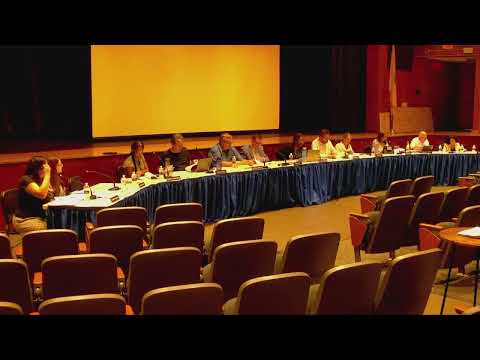
Spiesel Architects and DCO Energy presented an Energy Savings Improvement Plan, or ESIP, to the Metuchen Board of Education on July 22, explaining how the district could fund building repairs, new roofs, HVAC upgrades and possible solar installations using bonds paid from projected energy savings rather than taxpayer-backed levies.
The ESIP proposal was presented by Steve Siegel, principal in charge of Spiesel Architectural Group, and Greg Burns, senior business development manager at DCO Energy. Burns described ESIP as “a budget neutral financing mechanism to achieve capital improvements and reduce your energy consumption,” and said projects are financed for 15 to 20 years with annual energy savings required by law to cover bond payments.
Board members were shown three sample project scenarios built from earlier district audits and Spiesel’s scope. The presenters said the district’s current annual utility spend is roughly $900,000. One scenario that includes selective rooftop-unit replacements and some roof restorations showed a net operational position of about $4,300 a year cash positive after debt service; a more conservative scenario that removed some rooftop units produced about $15,000 a year in net savings. Presenters emphasized these figures are preliminary and would be refined during an investment-grade audit that they estimated would require about four months of site-level measurement and contractor pricing.
Greg Burns said the program can include solar under a power-purchase-agreement (PPA) model in which a third party installs and maintains solar and the district pays a reduced electric rate for the power produced. Burns and Spiesel’s team modeled a conservative PPA rate of about 4¢/kWh for Metuchen; in that conservative scenario allowing only the high school to interconnect, the solar portion would add roughly $110,000 a year in cash-positive savings, while including all four school rooftops could push the modeled savings above $250,000 per year. Burns cautioned that interconnection capacity is determined by the utility and the district will not know which sites can be tied in until interconnection applications are submitted and reviewed.
Presenters identified several program features and legal/regulatory checks: ESIP work in New Jersey is implemented by Division of Property Management and Construction–qualified energy service companies; the New Jersey Board of Public Utilities (BPU) reviews and provides oversight of ESIP projects; and the legislation (originating in 2009 and amended in 2012) requires that projected savings escalate at statutory rates and remain cash-positive each year. The presenters noted that public entities do not receive federal tax credits available to private PPA owners, and that tax-credit deadlines affect project economics. Burns cited a federal investment tax credit (ITC) milestone for systems to be energized by December 31, 2027, saying that uncertainty about future federal incentives can affect bids and pricing.
Board members pressed presenters on operational and risk details. Construction committee chair Michael Glassberg asked whether the district’s utility bill would rise once recently installed air conditioning systems are fully functional; Burns said the district’s modeled baseline will be recalculated once final equipment specifications and run hours are known and estimated that the district’s annual utility cost could increase “to a minimum probably $40,000 a year” and possibly exceed $900,000–$950,000 once all new systems are active. Board member Miss Killeen asked about long-term maintenance and replacement in a 15-year PPA; presenters said PPA contractors typically own, operate and maintain the solar arrays for the contract term and must meet output guarantees (presenters cited a 90% minimum kilowatt-hour output commitment in example PPA language).
Presenters said contractual protections and procurement safeguards are typical: the district would run a competitive procurement/RFP for PPA providers and will review vendors’ financial strength and project experience. Burns said his firm has completed dozens of ESIP projects in New Jersey and offers an energy-savings guarantee; Spiesel noted independent third-party review of energy savings calculations and BPU review are required as checks on assumptions.
No formal board action was taken at the July 22 meeting. Presenters and board members described the next steps as a board decision about whether to authorize an investment-grade audit; that audit would produce firm subcontractor pricing and a finalized financing package, including soft costs (financial advisor, bond counsel, rating, underwriting) that the presenters described as “costs of issuance.”
Board members thanked presenters and indicated additional technical questions and committee-level follow-up would continue. Presenters said they could supply comparable district case studies and completed project documentation to inform the board’s decision.
Why it matters: ESIP allows the district to address deferred capital needs without a voter referendum by using projected energy savings to pay debt service. The approach shifts technical and financial risk into the procurement process and requires careful independent review of savings forecasts, interconnection approvals from the local utility and ongoing contract protections for warranties, performance guarantees and insurance.
Looking ahead: If the board chooses to move forward, the district would enter the investment-grade audit phase, submit interconnection applications for solar to the utility, finalize a scope of work with Spiesel and DCO, and proceed to financing and construction if bids and guarantees meet the board’s expectations.
Sources: Presentation and Q&A at the Metuchen Board of Education meeting, July 22, 2025; presenters Steve Siegel (Spiesel Architectural Group) and Greg Burns (DCO Energy).