Get Full Government Meeting Transcripts, Videos, & Alerts Forever!
Get email alerts on the Sign Regulations topic
No spam. Unsubscribe anytime.
Planning commission recommends sign ordinance changes to accommodate large industrial parks
Summary
Planning staff presented amendments to Bryan County's sign ordinance to accommodate very large warehouses and multi-building industrial parks, and the commission voted to forward recommended changes to the Board of Commissioners.
Bryan County planning staff presented proposed amendments to the county sign ordinance intended to address signage for large industrial buildings and multi-building industrial parks.
Staff said the existing sign regulations were written for smaller-scale development and do not anticipate very large warehouses or industrial parks with multiple large buildings. The proposed changes would add allowances and tiers for large single buildings and for industrial parks, including:
- A freestanding-sign allowance for very large buildings (staff used 500,000 square feet as the threshold) with at least 1,000 feet of roadway frontage and multiple access points; additional freestanding signs would need to be spaced by at least 500 feet. Staff said a property that meets the criteria could apply to staff for the additional sign without a variance after the ordinance is adopted.
- New aggregate signage tiers to cover building sizes above the current ordinance’s upper limit (the current ordinance capped tiers at 45,000 square feet). Staff proposed new tiers for 45,000–149,000; 150,000–499,999; and 500,000+ square-foot buildings with higher allowed wall and site signage so signage is proportional to building size.
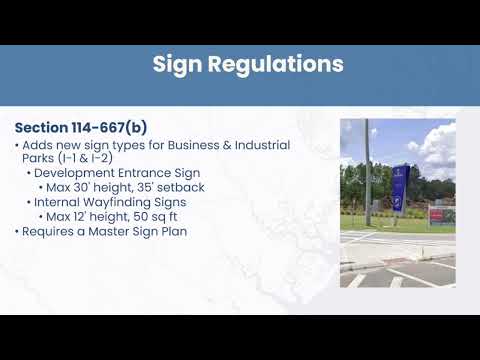
- Two new sign types for industrial parks: a development entrance sign (proposed maximum height 30 feet with a 35-foot setback from the public right-of-way) and internal wayfinding signs (proposed maximum height 12 feet and up to 50 square feet) for internal intersections. Staff also said tenant panels could be allowed on development entrance signs and that signs within an industrial park would be reviewed under a master sign plan to ensure design consistency.
- Staff confirmed the ordinance would continue to prohibit digital signs for these industrial applications and noted illumination controls are already addressed elsewhere in county lighting standards to limit spillover and glare.
Staff used local examples to illustrate tiers, citing a recently constructed WoodSpring Suites (about 49,000 square feet) as an example for the lower new tier, a mid-size building example with about 190 square feet of wall signage in the mid tier, and a substantially larger building (about 760,000 square feet) to illustrate the top tier. Staff said the fourth-question warehouse on Highway 280 (an example with long linear frontage and multiple access points) illustrated a scenario that would qualify for multiple freestanding-entry signs at different access points.
Commissioners asked whether the allowances would apply to single-tenant buildings (staff said yes, the current draft does not require multi-tenant occupancy), about illumination and digital signage (staff confirmed controls and said no digital signs are being introduced), whether the proposed 35-foot setback would create conflicts with truck sightlines (staff said setbacks were considered and that other counties use similar standards), and whether property maintenance or appearance standards would be enforced through covenants or county property-maintenance enforcement (staff said property-maintenance enforcement could apply for severe cases; covenants/HOAs commonly address routine appearance).
The commission opened public comment; no public comments were recorded. A motion to approve the ordinance amendments as outlined on the agenda was made and seconded, and the commission voted in favor. The commission will forward a recommendation to the Bryan County Board of Commissioners for final approval.