Get Full Government Meeting Transcripts, Videos, & Alerts Forever!
Get email alerts on the Water Supply Howard Park topic
No spam. Unsubscribe anytime.
City officials say Howard Park pipeline capped; chief disputes claim US Mine receiving city water
Summary
Fire Chief Kenny Mackey told the Ione City Council that a raw water pipeline through Howard Park was capped near the barn and is not supplying US Mine, and that an increase in local water use is linked to new high‑flow irrigation heads. Residents urged testing after several childhood cancer cases in town.
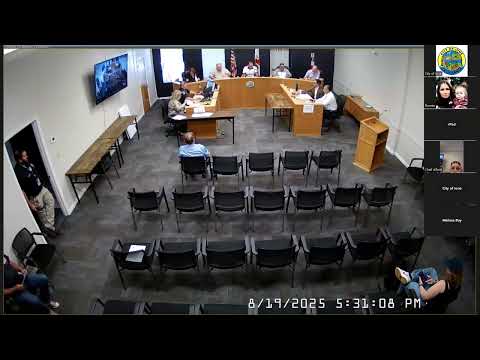
Fire Chief Kenny Mackey told the Ione City Council on Aug. 19 that the raw water pipeline that runs through Howard Park was installed in the 1950s, later transferred through several owners and has been capped near the barn so US Mine is not receiving city water.
Mackey, who presented slides and offered to walk council members through the site, said the line originally served a sand plant and was later owned by Owens‑Illinois, Unimin and the current owner, US Mine. He said the Amador Water Agency (AWA) supplies treated water to a vault at the park; the line from that vault into US Mine’s easement is not an active supply to the company and the portion beyond the vault was cement‑capped around 2018. “There’s nothing to hide,” Mackey said, adding that the capped section now has a thrust block and a blow‑off valve so crews can flush the line when needed.
The chief said recent pressure and low‑flow complaints at the sports fields coincide with the replacement of about 250 irrigation heads with higher‑capacity heads and that a pressure‑regulating device installed by AWA monitors the system. Mackey characterized social‑media allegations that the city was giving free water to US Mine as inaccurate and said public works and the water agency have confirmed the capped condition.
Why it matters: Residents have linked a recent cluster of childhood cancer cases to local water. Several speakers at public comment and other council members urged the city to pursue testing and clear public answers about whether contaminants could be entering the water supply.
Council members and residents pressed for clarity. Resident Patricia Anjija said the four childhood cancer cases reported in town are “about 16 times the national average” and asked the council to lead efforts to test water locally, calling on the city to “step up.” Susan Gonzales said doctors at a local military hospital had warned a family not to drink Ione water; another commenter said past training foam at a nearby facility raised concern about PFAS contamination.
Council members and staff clarified ownership and responsibility: the Amador Water Agency owns the treated water line to the vault; the raw water pipeline predates current city boundaries and had been used historically by industrial owners. City Manager George Lee and Mackey said the city had not assigned any AWA account number to US Mine, and that recent repairs and reconnections were paid for by private parties tied to the facility, not by providing water service to the company.
No new ordinance or contract was adopted at the meeting. The council did not vote on a water‑testing program or a directive to commission outside testing during the session; some council members said staff would follow up and make related items available on a future agenda. Mackey offered to print his presentation and to walk any council member through the site.
Residents repeatedly urged further action. Several requested that the city request or require testing of local wells and drinking supplies; council members noted that multiple agencies (city, county, water agency and state regulators) may have differing responsibilities for sampling and enforcement.
Looking ahead: Mackey said the purple hydrant on the track is intended for flushing and water‑quality operations and that AWA has installed monitoring devices. Residents who made public comment pressed the council to obtain independent testing and clearer agency responses; the council did not adopt a formal testing plan at the Aug. 19 meeting.