Get Full Government Meeting Transcripts, Videos, & Alerts Forever!
Get email alerts on the Comprehensive Plan Future Land Use topic
No spam. Unsubscribe anytime.
Alachua County commissioners review future land-use capacity, direct staff to draft amendments
Summary
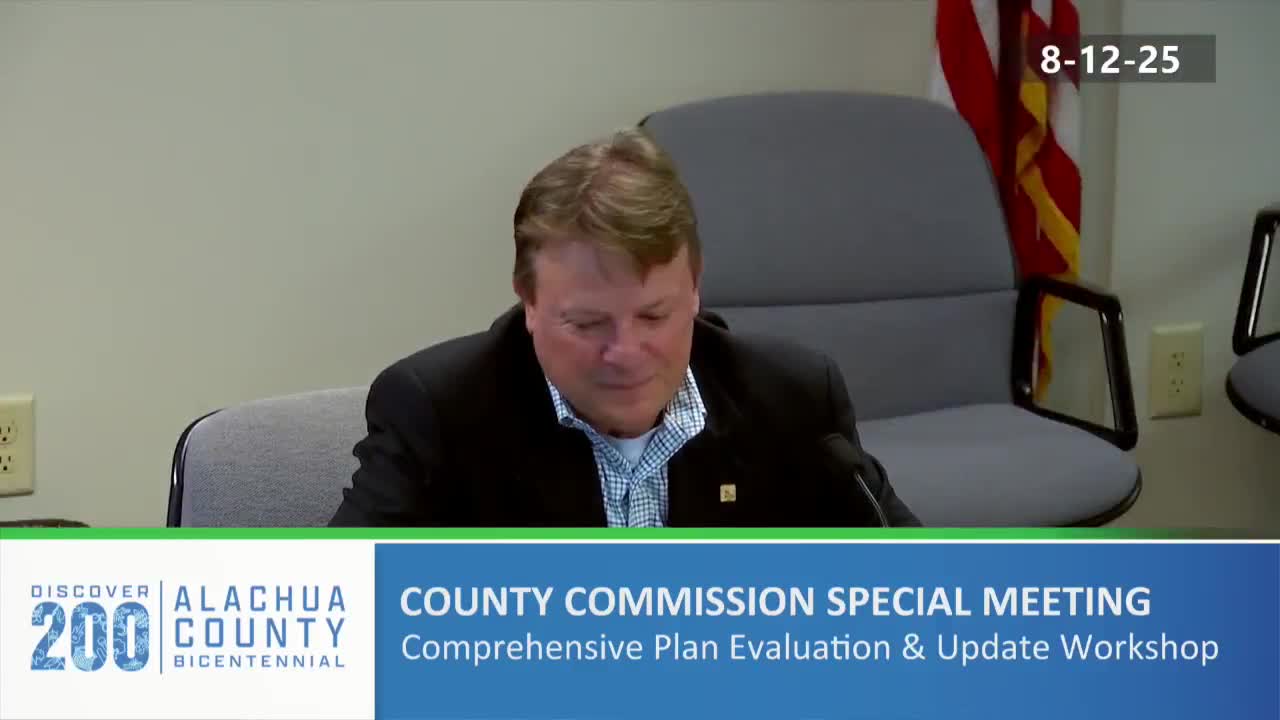
Alachua County commissioners at a special Aug. 12 workshop reviewed preliminary findings from a mandated evaluation of the county comprehensive plan and unanimously directed staff to draft amendments focusing on the future land use element.
Alachua County commissioners at a special Aug. 12 workshop reviewed preliminary findings from a mandated evaluation of the countycomprehensive planand unanimously directed staff to draft amendments focusing on the future land use element.
County planning presenter Ben Chumbley told the board that "by statute, this is a process that all local governments are required to go through every 7 years," and that the workshops are intended to identify changes needed to keep the plan consistent with state law and local issues.
The presentation summarized population and development trends, urban-cluster capacity, activity-center policy, transit-oriented and traditional-neighborhood development (TOD/TND), accessory dwelling units (ADUs), commercial and tourist-entertainment designations, and several technical updates staff recommends including references to the Live Local Act and coordination with Gainesville Regional Utilities (GRU).
Why it matters: staff said the future land use element sets the county's overall development pattern, directing where housing and nonresidential uses can be located and how dense development should be. Commissioners asked whether the county has the urban-cluster capacity to absorb projected growth and pressed staff on tools other than boundary expansion, such as higher densities in urban areas, redevelopment of infill neighborhoods and coordination with municipalities and utilities.
Key findings and figures presented - County growth since 2010: Chumbley said the countypopulation increased by roughly 49,000 people since 2010 (about 3,500 per year), with roughly 52% of that growth inside the city of Gainesville and 31% in the unincorporated county. - Projections to 2050: staff showed a countywide projected increase of almost 93,000 people by 2050 and an estimated increase of about 32,000 people in the unincorporated area; Chumbley presented an estimate that the unincorporated area would need roughly 14,000 new housing units by 2050. - Urban-cluster undeveloped land: staff previewed a preliminary urban-cluster inventory of about 4,600 acres of undeveloped residential or mixed-use land, which the presentation estimated could accommodate roughly 14,000 residential units (about 32,700 people using the county household size used by staff). - Approved but unbuilt units: staff listed roughly 2,800 units in developments with final approvals and about 10,000 units in approved preliminary development plans; those totals are treated separately from the raw undeveloped acreage estimate. - Location of new approvals: staff reported approximately 97% of newly approved residential units since 2014 have been located inside the county's urban cluster, consistent with the county policy goal of concentrating growth.
Policy issues and board discussion - Urban-cluster capacity and alternatives: commissioners asked whether the county should raise allowable density within urban-cluster high-density categories or rely on municipalities to accommodate growth. Several commissioners favored concentrating additional density in urban clusters and municipalities rather than expanding the urban-cluster boundary. Chumbley noted the plan requires evaluating urban-cluster capacity and, if needed, pursuing measures such as density changes, municipal coordination, or phased expansion.
- Utility and infrastructure constraints: commissioners repeatedly raised GRU coordination and potable water/wastewater capacity as essential prerequisites to any urban-cluster changes. Staff acknowledged that any boundary expansion would require alignment with GRU plans and facility capacity analyses.
- Eastside Activity Center: staff recommended a two-stage approach for the Eastside Activity Center (a long-designated mixed-use node): short-term code and plan language tweaks to reduce overly prescriptive mixed-use requirements, and a longer-term, more detailed area plan with landowners and community participation to resolve parcel fragmentation, infrastructure sequencing and environmental corridor constraints (the presentation referenced a strategic ecosystem/greenway set-aside across parts of the area).
- TOD/TND and activity-center flexibility: commissioners supported lowering minimum acreage thresholds for TOD/TND in places, tightening block and bicycle-parking standards, and adding design incentives to encourage taller, denser buildings where appropriate. Staff recommended reconciling plan language with code updates already underway.
- Accessory dwelling units: the board discussed the homestead-exemption requirement for ADUs. Chumbley summarized current county rules that require proof of homestead exemption and owner occupancy to qualify for an ADU. Commissioners generally signaled support for removing the homestead requirement inside the urban cluster to expand housing options, while keeping stronger controls outside the urban cluster to avoid incentivizing dispersed rental development without urban services.
- Commercial and tourist-entertainment uses: staff recommended updating the countycommercial land-use descriptions (many of which date from the 1990s) to reflect mixed-use development and to better distinguish tourist-entertainment uses located at interstate interchanges from commercial opportunities inside the urban cluster.
- Data centers and large industrial uses: commissioners requested analysis and potential code language to treat very large, resource-intensive uses (for example large data centers) as a special case so the county can evaluate water, power and transportation impacts before permitting placement in unincorporated areas.
- Other technical topics: staff flagged the need to remove or soften statutory conflicts (for example EV-charging requirements that are preempted by state law), add enabling language for shared/park-on-demand parking reductions, clarify medical-clinic land-use alignment, delineate additional rural-cluster boundaries, and consider policies to support urban agriculture and night-sky protections.
Public comment: two residents spoke during public comment. One resident who identified herself as Morning Scribe Lindberg provided unit counts for the city of Alachua and urged protection of green space; another, Grace Goodfellas, urged the commission to resist rezoning proposals that would encroach on Paynes Prairie buffer areas and highlighted wetlands and flood-zone constraints on a specific rezoning request that will come back as a quasi-judicial matter.
Board action and next steps: after discussion, the board voted unanimously to "receive the presentation and provide direction to staff on potential updates to the comprehensive plan related to the future land use element." Staff said it will return with draft amendment language later in the year, and reminded the board the county must transmit any statutorily necessary amendments to the state for review by March 31 (the date the staff cited).
Votes at a glance - Motion to adopt agenda (special meeting start): moved and seconded; commission recorded the motion as adopted unanimously (vote counts not specified in the transcript). - Motion at conclusion: "Receive the presentation; provide any direction to staff on potential updates to the comp plan related to the future land use element." Motion seconded and approved unanimously (outcome: approved; vote counts not specified in the transcript).
What comes next: staff will prepare targeted amendment language for the future land use element and additional analysis on urban-cluster capacity (including combining undeveloped acreage estimates with approved-but-unbuilt unit totals), return with more detailed options on Eastside Activity Center planning, and refine code/comp-plan alignments for TOD/TND, commercial categories, ADU rules, and proposed standards for large resource-intensive uses.