Get Full Government Meeting Transcripts, Videos, & Alerts Forever!
Get email alerts on the Airport Capital topic
No spam. Unsubscribe anytime.
Council hears multi-year airport capital plan as JetBlue interest raises parking, security questions
Summary
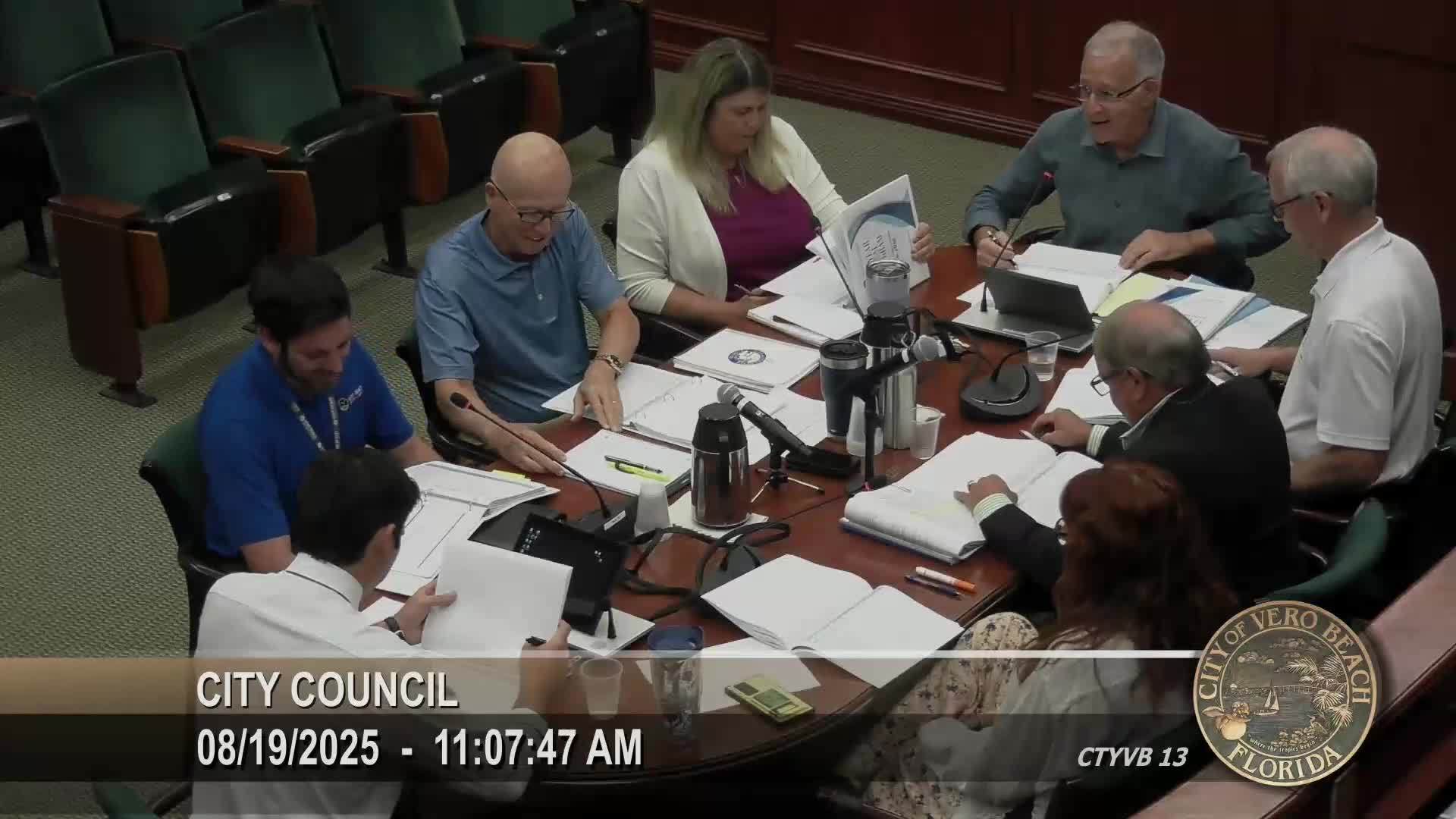
Vero Beach City Council members heard a briefing from airport staff on a multi-year capital program that includes a terminal rehabilitation, taxiway extensions, drainage work and parking improvements, and discussed potential operational impacts after airline interest from JetBlue emerged.
Vero Beach City Council members heard a briefing from airport staff on a multi-year capital program that includes a terminal rehabilitation, taxiway extensions, drainage work and parking improvements, and discussed potential operational impacts after airline interest from JetBlue emerged.
The briefing covered active and planned projects, funding timelines and near-term milestones. Staff said a terminal rehabilitation project has a notice-to-proceed of Sept. 2 and an anticipated completion in April 2026; work will be funded with a combination of Florida Department of Transportation (FDOT) grants that partly expire this year and FAA grants that extend into 2027. Staff described several airfield projects — taxiway extensions and design work, an airfield electrical upgrade including a new beacon with a winch system for maintenance, and rehabilitation of drainage infrastructure — that aim to improve safety and aircraft flow.
Why it matters: the projects affect passenger experience, aircraft operations and city capital planning. Council members asked how near-term events — including the appearance of additional airline schedules — change priorities for parking, terminal layout and permitting.
Staff told the council the airport’s terminal rehabilitation will address building maintenance and add features such as an outdoor covered baggage claim and expanded baggage handling areas. An aircraft rescue and firefighting vehicle (ARFF) is now in service after the airport moved off a rented vehicle from the 1990s. For taxiways and runway-related projects, staff said the work is intended to reduce runway crossings and resolve FAA-identified water retention in safety areas.
On parking, staff cited a recent study by Hansen that estimated a need of about 500 spaces. The budget includes a terminal parking project shown in summary materials as $1.3 million in total project cost; staff asked the council to note a minor discrepancy between a backup line item and the summary sheet and confirmed the total should be $1.3 million. Staff said preliminary talks are under way with private developers who may build parking, and observed that private development or leases may move faster than the city could through a traditional RFP and construction timetable. Staff also said a public–private partnership (P3) or lease would trigger a specific process if it were structured under P3 rules and that applicable ordinances would need to be followed.
Staff discussed passenger counts and eligibility for a passenger facility charge (PFC). The FAA’s preliminary report showed about 88,000 passengers for the current year; staff said the airport is preparing for growth toward the 100,000-passenger threshold that changes eligibility and planning assumptions. Staff noted that applying for a PFC carries an application cost of about $40,000 that can be reimbursed through PFC revenue if approved, and that PFC revenue is restricted to FAA-eligible projects rather than general city revenue.
Council members pressed staff about the practical effects if another airline begins service. Staff said JetBlue had scheduled service and would be on-site for follow-up discussions; staff described JetBlue’s contemplated operations as roughly two daily operations and said the airline was evaluating how to operate within the airport’s current terminal footprint. Staff said JetBlue was considering A220 (about 140 seats) and A320 (about 160 seats) variants; Breeze currently operates A220-type flights at roughly 137 seats. Staff said runway capacity effects would be limited — staff estimated new airline operations would account for about 1% or less of total operations — but that parking, the secure (TSA) screening/sterile area and passenger circulation would be the most-constraining elements.
Staff emphasized that airport airline access is governed by federal obligations at a federally obligated airport and by the airport’s airline agreement and common-use policies; the airport cannot unilaterally block an airline from operating if it meets the airport’s requirements. Council members asked whether current security and TSA space had been paid for by airlines; staff clarified that TSA security infrastructure is a TSA responsibility.
Council members and staff discussed next steps: staff will continue negotiations with airlines, pursue private development options for parking and return with cost and timeline updates. No formal council action or vote was taken during the briefing.
Council members thanked airport staff at the conclusion of the presentation.