Get Full Government Meeting Transcripts, Videos, & Alerts Forever!
Get email alerts on the Economic Development topic
No spam. Unsubscribe anytime.
County council adopts resolution giving broad authority to spend solar agreement revenues; residents press for accounting of $225,000
Summary
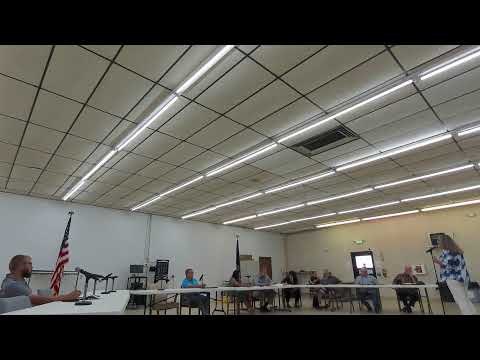
Pulaski County Council adopted Resolution 25-12, allowing the council to allocate and invest revenues from solar economic-development agreements for a broad array of uses; residents asked the council to account for $225,000 they say the county never received from two developers.
Pulaski County Council adopted Resolution 25-12, a broad policy allowing the council and county finance officers to allocate revenues from solar economic-development agreements to a range of uses including infrastructure, workforce development, public services and incentives, and to invest some funds at the council’s direction.
The resolution was presented to the council as a framework authorizing the council to decide how revenues received under economic-development agreements may be spent or invested, and to adopt rules and procedures to guide long-term expenditures. A council speaker clarified that the resolution does not authorize spending without a subsequent motion, discussion and vote of the council.
At the meeting a motion to adopt Resolution 25-12 was made and seconded; the motion passed with one recorded no vote.
Why it matters: The measure gives the council formal flexibility to use revenues from local economic-development agreements — including potential uses that range from one-time project contracts to investment of funds — but retains the council’s requirement to approve specific expenditures on a case-by-case basis.
Public questions about missing payments followed the vote. Multiple residents said two solar developers named in earlier agreements — Mammoth Solar and Moss Creek — were contractually required to pay a total of $225,000 to the county for items such as decommissioning, drainage and road use, and said the county’s records do not show receipt of that money. One public commenter urged the council to "provide the documentation and the evidence for where that money went." (Comment attributed to a public commenter during the meeting.)
A county staff member identified as Nathan reported that Mammoth paid outside firms directly: $24,000 to Baker Tilly, $48,000 to Tankersley Law, and $40,000 to Barnes & Thornburg, for a total of $112,000. He said the firms’ invoices and the amounts paid reflected services rendered that came in under the figures originally anticipated in the agreements. Nathan said he had not been asked to compile Moss Creek payment details and offered to follow up.
Speakers at the meeting urged the council to locate documentation, invoices or contracts verifying where the payments were recorded and whether any funds were placed in the county treasury. Council members and a staff speaker repeatedly noted that, even if the resolution expands permissible uses, any disbursement of the funds would require a separate council action and appropriate documentation.
The council did not announce a specific follow-up timeline during the meeting; a public commenter requested that the council report back at the next commissioners’ meeting or the next county council meeting.
Votes at a glance: Resolution 25-12 — motion to adopt; outcome: adopted (one no vote).
Names and roles referenced during public comment and staff response were supplied orally during the meeting and recorded in the meeting transcript as a public commenter, Nathan (staff member), and references to the former county attorney, Kevin Tankersley, who was named in public remarks as having authored or been involved with the agreements.
Ending: Council members indicated the new resolution is intended to provide administrative flexibility to manage incoming economic-development revenues, while also noting that individual spending decisions will continue to come before the full council for approval. Members of the public asked the council to investigate the $225,000 discrepancy and to report back with documentation.