Get Full Government Meeting Transcripts, Videos, & Alerts Forever!
Get email alerts on the Planning Commission Governance topic
No spam. Unsubscribe anytime.
Board asks ad hoc to compile codified planning commission duties and continue bylaw review
Summary
After extended discussion the Board of Supervisors voted to direct the ad hoc committee to continue compiling codified duties and propose potential code changes clarifying the planning commission’s roles; the board did not adopt amended bylaws at this meeting.
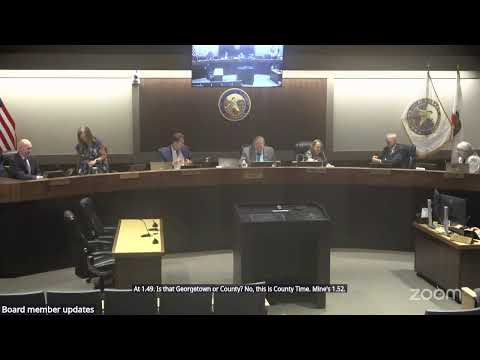
The Board of Supervisors on Aug. 12 directed an ad hoc committee to continue reviewing the planning commission’s codified duties and to return with recommendations, after an extended public and board discussion about the role of the planning commission, Brown Act constraints, and process for changing bylaws.
Rob Peters, deputy director of planning, presented proposed amendments to the County Planning Commission bylaws, noting the planning commission had forwarded its own recommended changes and the board’s ad hoc modified them. Peters said the ad hoc recommended clarifications including more explicit direction that the planning commission undertake study sessions and projects only as directed by the board, simplifying special‑meeting language, tightening agenda publication timing, and clarifying adjournment and cancellation procedures.
Peters told the board there was one provision that the ad hoc sought to remove — language that previously allowed a majority of the planning commission to agendize items discussed during public comment at the next meeting — and that the strikeout did not appear correctly in the packet. "Section 5 a through c as proposed by the planning commission was replaced with the language you now see in section 5," he said.
Supervisors questioned whether the board should adopt bylaws directly or refer its proposed changes back to the planning commission for adoption, noting ambiguity in county code about the process. County counsel advised a conservative approach: rather than the board adopting bylaws the ad hoc had edited, the board could refer the proposed changes to the planning commission for adoption and then take final action, reducing process risk under the ordinance.
Public commenters including Planning Commissioner Dave Spahr and former commissioner Cheryl Bligh Chester urged that the planning commission be consulted and that changes not reduce the commission’s ability to request agenda items or carry out study sessions. Several speakers emphasized the planning commission is a legislative body whose duties are referenced in county code and the charter, and cautioned against unintended limits on its authority.
After discussion the board voted 5‑0 to adopt the following course: direct the ad hoc committee to continue compiling all codified duties of the planning commission (from county ordinance and other code sections), identify potential revisions to clarify roles and return to the board with recommended changes. The board did not adopt final bylaw changes at the Aug. 12 hearing.
The board and staff also discussed process safeguards to avoid Brown Act issues when supervisors and planning commissioners communicate; county counsel outlined how serial communications through intermediaries can create disallowed meetings. The item will continue with ad hoc work to create a comprehensive list of codified duties and to craft proposed code or bylaw changes consistent with the board’s final direction.
Next steps: the ad hoc will compile an inventory of code provisions governing the planning commission, coordinate with staff and the planning commission as appropriate (within Brown Act rules), and return to the board with recommended revisions and a recommended process to finalize bylaws.